
What this means for a BI firm
Your clients have long lists nobody gets through, and your team knows how to read them. Here is how a BI firm can deliver a read on every unit, and keep the method.
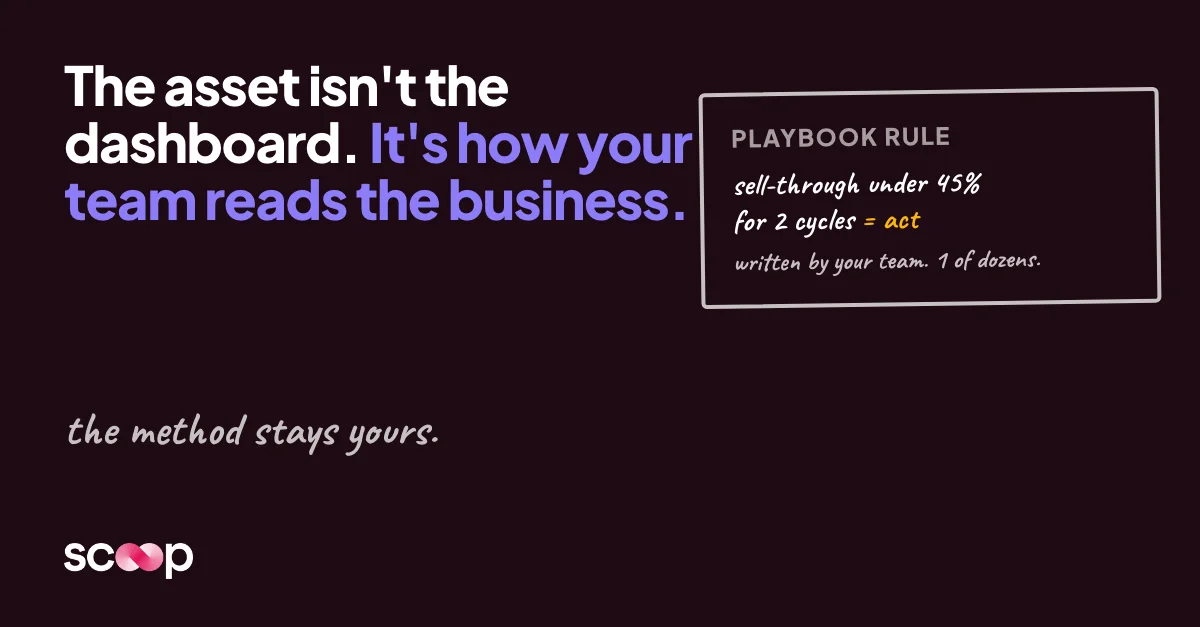
Every BI firm I know has the same two things: clients with data they can't fully read, and people who know how those clients' businesses actually work.
That's most of what it takes to give a client a read on every unit. The rest is machinery.
What your firm already has
Your senior consultant who has worked with a client for years knows which numbers matter. Which accounts are seasonal. Which region always looks bad in March and why it doesn't matter. Which drop is a data problem and which is a business problem.
Today that knowledge goes into a build. Your team learns how the client reads the business, encodes a little of it in the dashboards, and hands it over. Then the engagement ends, the client's business changes, and the read goes stale.
That knowledge is exactly what a read on every unit runs on. The playbook rule in our sample report, "sell-through under 45% for 2 cycles," is one line of it. A real client has dozens.
How it works with a firm
1. Pick one client your team knows well. Not your biggest. The one where you know what normal looks like and could check the output by hand.
2. Write down how their best person reads it. We sit with that person, or with your senior consultant, and record them going through their real numbers: what they look at first, what normal looks like, what they check next, what they ignore, what a manager can actually do. Different people disagree; that gets consolidated into one standard.
3. Test it on units your team knows cold. Most of it lands as "yes, that's what I'd say." The exceptions get added, and it runs again.
4. Scoop runs it every cycle. Every unit, against that standard, with the numbers computed the same way every time and every brief checked before it goes out. It sits on top of the client's existing warehouse and BI tools. Nothing gets replaced.
5. Your firm delivers and maintains it. When the client's business changes, the standard changes with it. Your team owns that.
What each side gets
Your client gets a short brief for every clinic, customer account, branch or product line, every cycle: what changed, why, what to do, and whether last cycle's actions worked. From people they already trust.
Your firm gets work that's maintained and run instead of finished and handed over, and something most BI work never has: a record of what was recommended, what the client did, and whether it moved the number. That's the conversation every client wants to have about their analytics, and almost none can.
And the method stays yours. The worry I hear most from consultants is that automating what they do means handing over the thing that makes them worth hiring. It doesn't. The way your firm reads a business is your IP. You reuse it across clients in the same industry, and this just lets you deliver it at a scale your team couldn't reach by hand.
We get to work with people who know their clients far better than we ever could. That's how the best partnerships I had at Birst worked, and I think it's still the right way to do this.
What it isn't
It doesn't fix bad source data. If a client's systems are a quarter broken, it works with the three quarters that line up, and it says so.
It doesn't replace your team. It takes the part nobody has time for, reading every unit every cycle, and leaves your people on the part only they can do.
And it isn't a dashboard project. There's no build to hand over at the end.
The fair test
The fair way to judge this is on a business you know well. Their data, as you've already modeled it. Their rules for reading it. Your judgment of the output.
If it doesn't find what your team would have found, you'll know quickly.
Run the fair test on one of your clients. Book 20 minutes with our team and bring a client you know well.
The rest of the series: What a read on every unit looks like and What we learned running it in production
Get insights like this every week
Analytics, ops strategy, and product updates. No noise.
Keep reading

Why LLMs struggle with basic math
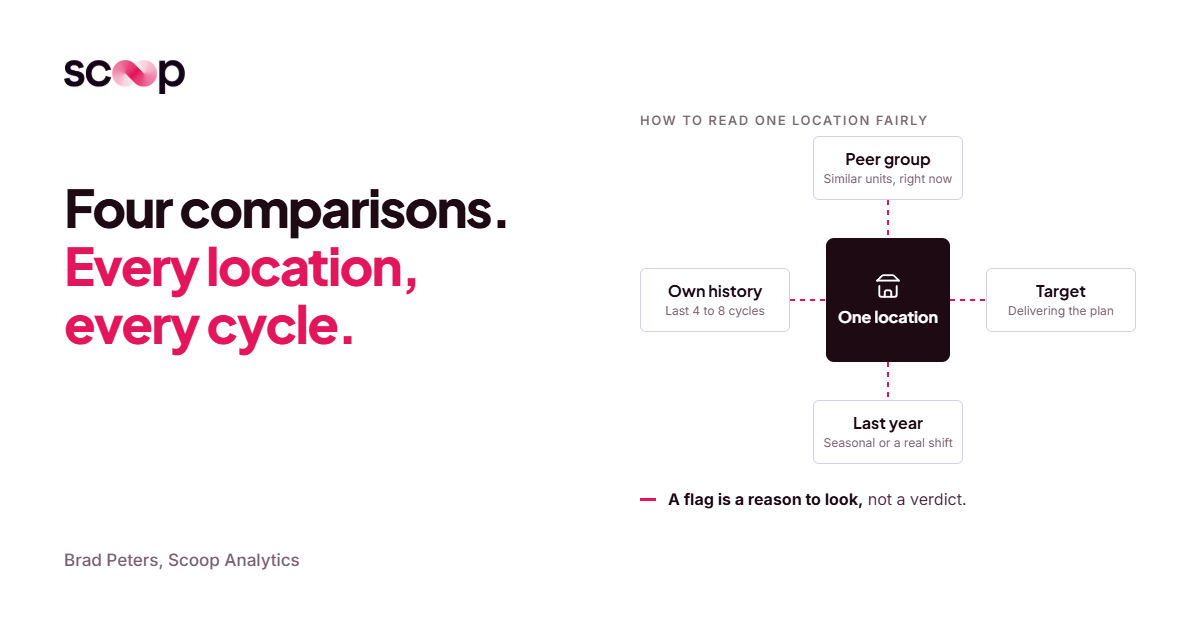
How Do You Benchmark Locations Against Each Other Effectively?
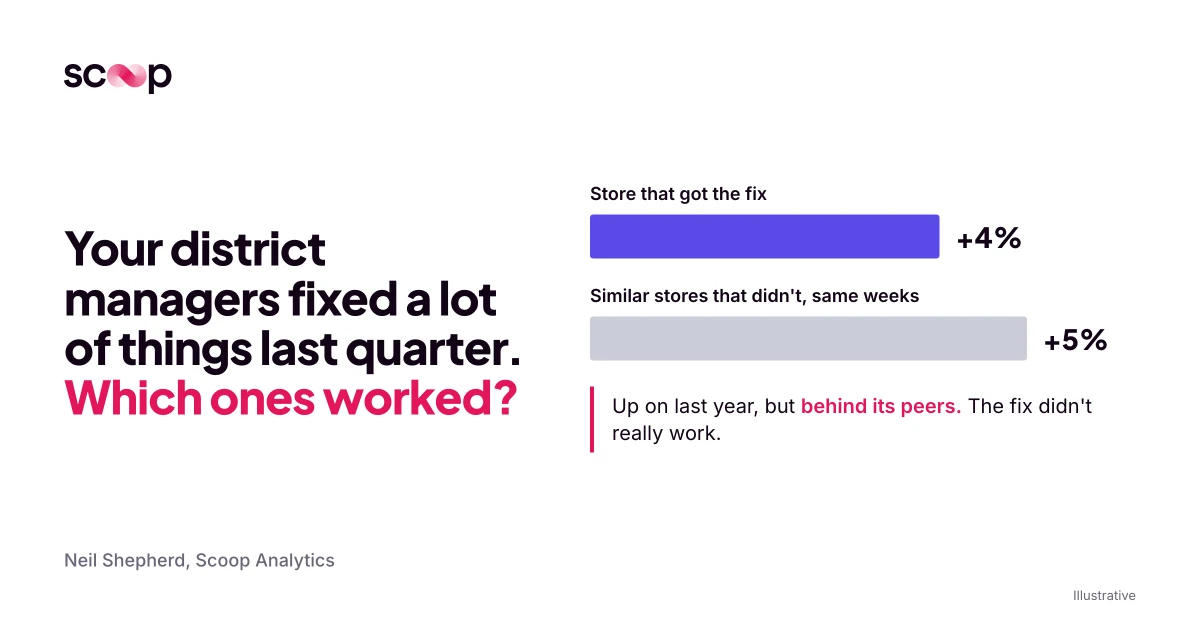
Your district managers fixed a lot of things last quarter. Which ones worked?
Book a discovery call
Reach out to start a two-way conversation about your industry, your performance variations across locations, and whether Scoop is the right fit for you.