
Your district managers fixed a lot of things last quarter. Which ones worked?
Most store visits end with an agreed action, and very few chains check whether it worked. What checking properly looks like, and how one specialty retailer finds its opportunity stores every cycle.
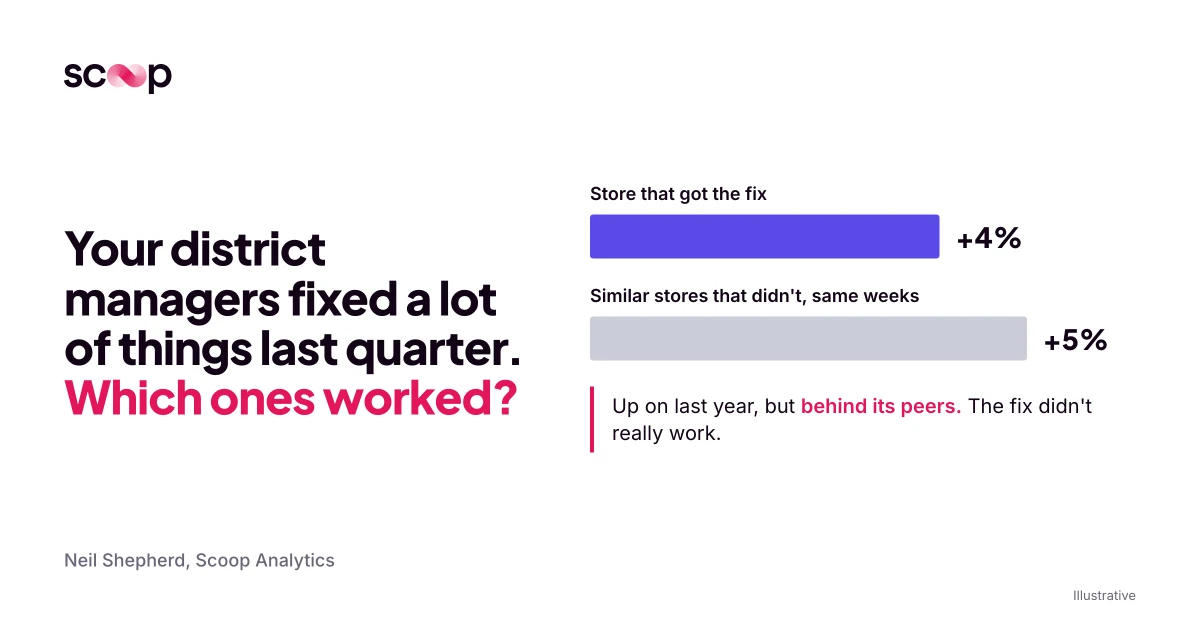
Most store visits end with an agreed action, and in my experience very few chains go back and check whether it worked. A district manager spots a problem, agrees a fix with the store manager and moves on to the next store. Weeks later the number is up or down, and nobody can say whether it was the fix, the weather or the competitor across the road.
So the same issues come back, the same conversations happen next quarter, and the playbook never gets smarter. The loop is broken in the other direction too: in Zipline's 2026 survey of 227 retail leaders, 70% of store leaders said they lack a clear, effective way to share concerns when an initiative doesn't work.
Why "up on last year" isn't proof
The usual check is before and after, or this year against last. Both mix the effect of the fix with everything else that moved in those weeks: the season, a promotion, a shift in traffic across the district. A store that improved 4% while its peers improved 5% didn't really improve.
What checking properly looks like
- Write the action down, with an owner and a date.
- Decide up front which number should move, and by when.
- Compare the store to similar stores that didn't get the action, over the same weeks.
- Look again next cycle, then close it, keep it or change it.
It isn't complicated in principle. It's just hard to do by hand across hundreds of stores, so it rarely happens.
What it looks like in practice
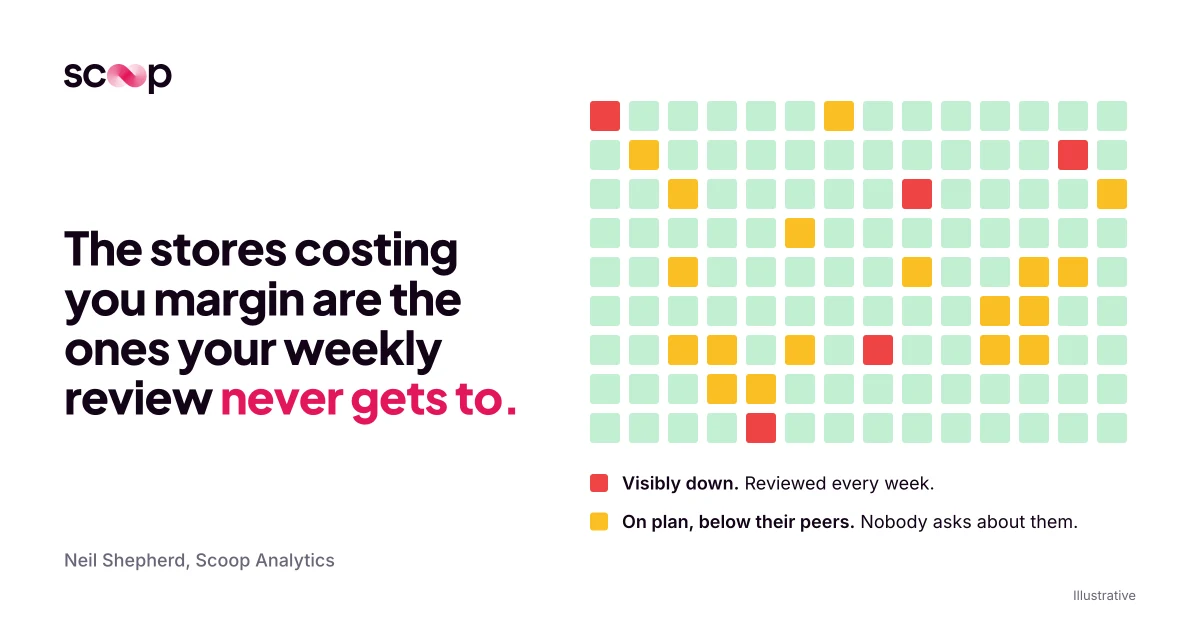
One of our customers, a national specialty retailer, uses a phrase I've started borrowing: opportunity stores. Not problem stores. Stores that look fine on paper and have more in them.
Their COO's view was that the margin sat in the middle of the fleet, not at the bottom. So the work became finding those stores every cycle and giving each district manager a clear read on what to do about them, without adding analysts to do the digging. It's gone well enough that they're now rolling out to four more districts and launching internationally.
That's what we built Scoop to do. Every store gets a specific, traceable action plan each cycle, and the next brief shows whether those actions moved the number.
If that's roughly where you are, happy to walk you through a brief on stores like yours. 20 minutes, and I'd rather show you real output than slides.
How does your team know whether last month's store actions actually moved anything?
Get insights like this every week
Analytics, ops strategy, and product updates. No noise.
Keep reading
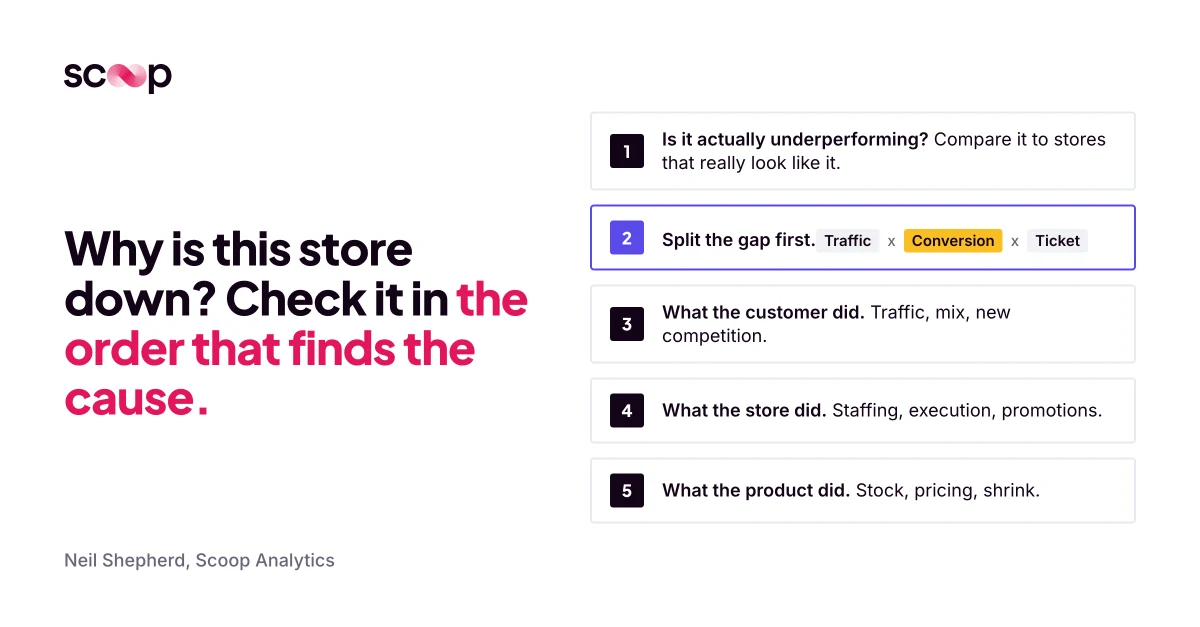

Book a discovery call
Reach out to start a two-way conversation about your industry, your performance variations across locations, and whether Scoop is the right fit for you.