
What we learned running it in production
Giving every unit a read sounds simple. Running it every cycle at about 1,200 locations taught us what actually matters. Seven lessons.
A report that gives one unit a read is easy to mock up. Running it for real, for every unit, every cycle, is a different job.
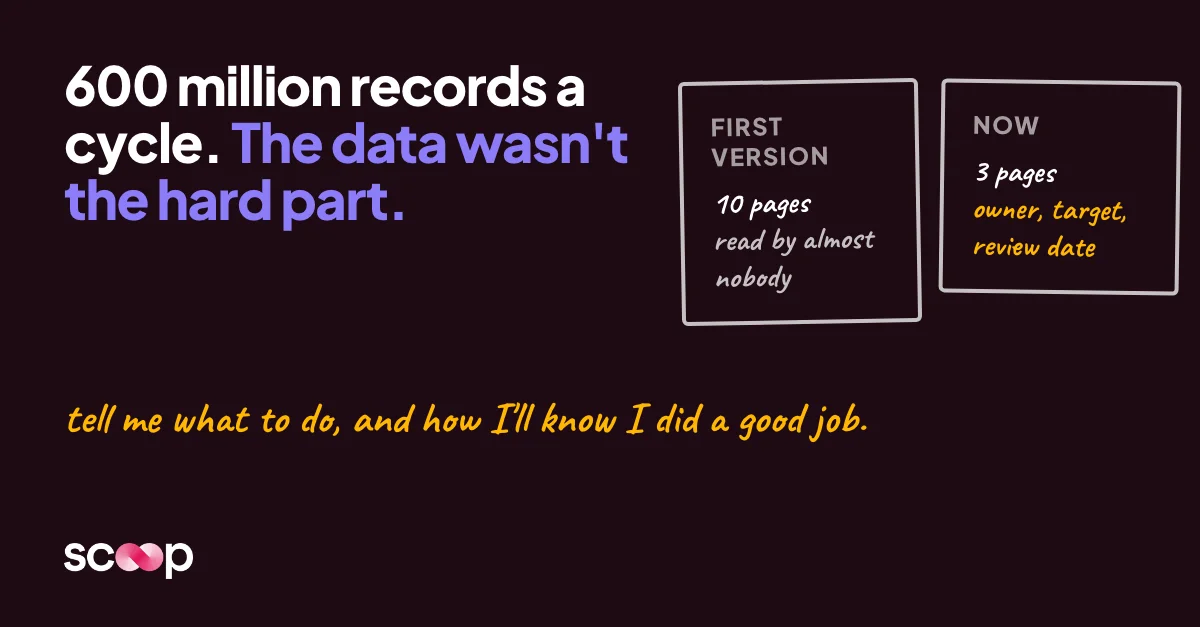
We're rolling it out across a national retail chain with about 1,200 locations. A single cycle works through roughly 600 million records, and each location gets 30 to 50 checks of its own. That's tens of thousands of results every cycle, and every one of them has to be right before a manager sees it.
Here's what that taught us. Seven lessons.
1. People don't know what to ask
We started where most of the industry started. We connected the data and let people ask questions.
Technically, it worked. Then we read the logs. Most people didn't know what to ask. An open text box hands the hardest part of the job, knowing which question matters, right back to the person who came for help.
So we stopped waiting for questions. The read gets done on every unit whether anyone asks or not.
2. One analysis, not 1,200 opinions
If every location gets its own free form take, you get 1,200 opinions that can't be compared. The moment two briefs sit side by side on a manager's desk and use different yardsticks, nobody trusts either one.
So every unit is judged against one standard: the same rules, the same thresholds, the same peer comparison. Each one is investigated on its own path, because its numbers lead somewhere different. But they're all judged the same way.
3. Shorter beats complete
Our first version of the report ran ten pages. It was thorough. Almost nobody read it.
We cut it to three. The first paragraph says what matters. The rest is there for anyone who wants to check the work. The test we use now: can a manager read the top in the parking lot before they walk in?
4. Their words, not ours
Every business has its own vocabulary, and the read has to use it. If a client says "flat," the report says flat, not "roughly flat." Every time a manager has to stop and translate, it costs trust.
5. The recommendations are what people want
I've watched this for a long time. Sales managers, account managers, operations managers: almost none of them want to dig through reports. Their job is their people and their customers. The analysis is the part they'd rather skip, so the action that comes out of it is usually vague and done halfway.
What a manager wants is simple: tell me what to do, and tell me how I'll know I did a good job. "Spend more time with your team" doesn't pass that test, because nobody can check it. A recommendation tied to the numbers does. It's specific, it has a target, and it can be measured.
6. A recommendation isn't done until you know if it worked
The first instinct is to treat the report as the finish line. It isn't. A recommendation nobody acts on is just a better dashboard.
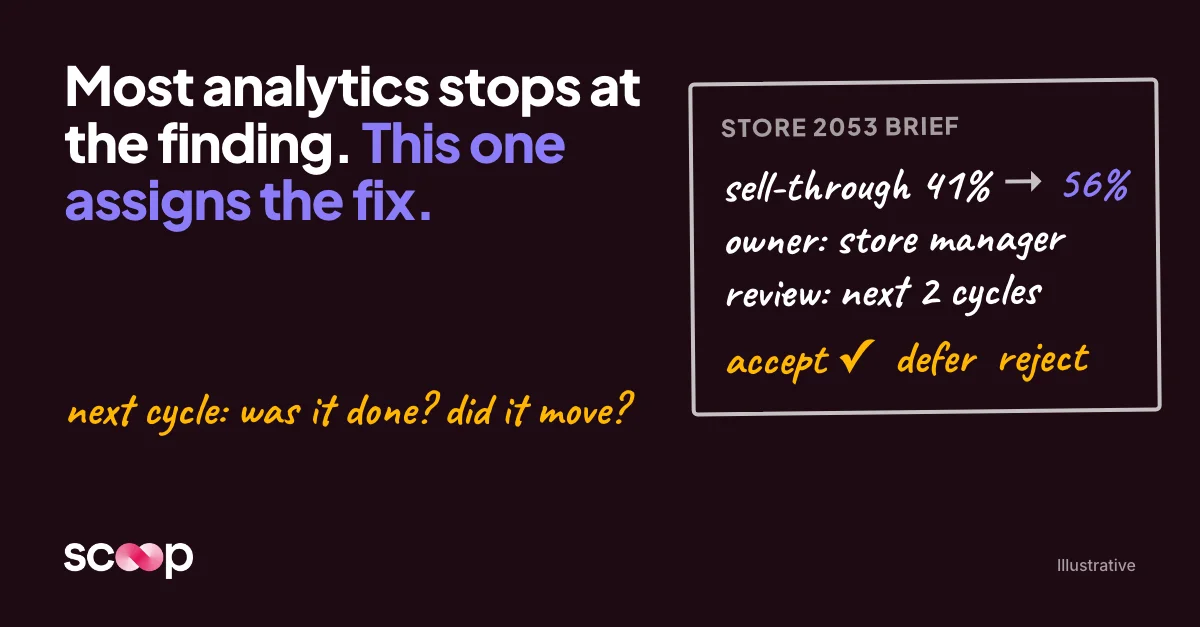
So every action has an owner, a target and a review date, and the manager accepts it or doesn't. The next cycle checks whether it was done and whether the number moved, and carries anything open forward.
None of that is high tech. It's a record of what was recommended, how long it stayed open, whether it was accepted and whether it worked. But almost no business has ever been able to keep that record across hundreds of units. That loop is what turns a report into a management routine, and it's how you learn which fixes actually work.
7. Once it works, they want more
The first cycle was every two weeks. The people using it asked for weekly, which doubles the work: about 1.2 billion records a cycle instead of 600 million. Then more people want it, further down the organization. Then come the next questions: which people need coaching, and why one region runs behind another.
It's a good problem, and it's also the reason this has to run as an operation, not a project someone finishes.
None of this is new
Around 2005, at Siebel, the next big thing was supposed to be recommendations. Customers sat through every dashboard we showed them, but what they wanted was to be told what to do next. Then the industry moved to the cloud, spent a decade rebuilding dashboards, and recommendations got set aside.
Before Birst, I built analytics for wealth management firms that delivered a read to every advisor. The advisors who used it measurably outperformed the ones who insisted they already knew their book. That was tracked, not asserted.
The idea hasn't changed in twenty years: get the best person's read to everyone who needs it, and check whether it worked. What changed is that it can now run on every unit, every cycle, without an army of analysts.
What this means for anyone delivering it
If you're thinking about giving a client a read on every unit, the analysis is the smaller part. The bigger part is the operation: one standard, the client's language, a short report, actions with owners, and a loop that checks whether they worked.
What would your best client say if their managers got that report every week?
Start here: What a read on every unit looks like
Get insights like this every week
Analytics, ops strategy, and product updates. No noise.
Keep reading
What a read on every unit looks like

"How Long Does It Take a Lead to Convert?": What I Learned This Week from a Sales Team

"That Is What I Always Hoped an Analyst Would Do": What I Learned from a Marketing Leader This Week
Book a discovery call
Reach out to start a two-way conversation about your industry, your performance variations across locations, and whether Scoop is the right fit for you.