
An ROI you'll love, in as little as 4 weeks.
Implementation isn't a software installation: it's training an AI on how your best operators run the business. In as little as four weeks, Scoop is live: diagnosing every location, every cycle, and delivering plain-language action plans to the right people. You'll walk away with better margins and an organizational asset that outlasts the tool.
Implementing Scoop was straightforward and was mostly configuration work. For a smallish department like ours, that's a huge boon. We don't have engineers to spare.
The obstacles are real. We designed around them.
Scarce management time
Your best operators are busy running the business. Training Scoop has to fit inside a few structured conversations, not a project that competes for their week.
Limited IT support
Most IT teams can't take on a long integration project. Implementation has to work with a day of read-only access, not a quarter of engineering time.
Skepticism about AI
Managers who've seen AI initiatives come and go are right to be cautious. Adoption has to come from a tool that makes their week easier, not another dashboard to check.
Pilots live within 4-5 weeks, full rollout within 12. Here's how.
Connect it.
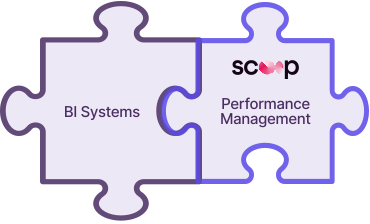
Connecting Scoop to your existing BI and analytics data is straightforward, as little as a day if it's all in one place, slightly more if it needs additional connectors and mapping. Read-only access works best, but flat files work too.
Train it.
Training is straightforward. Scoop needs between 8 and 10 hours of your best operators' time: walking through dashboards, investigating patterns and benchmark anomalies, and building corrective action plans. That gets encoded into a customer context stack (an ontology) that makes it predictable and repeatable. Scoop works the way you do. Nothing needs to change. You tell it how you want to run your business.
Define the output briefings.
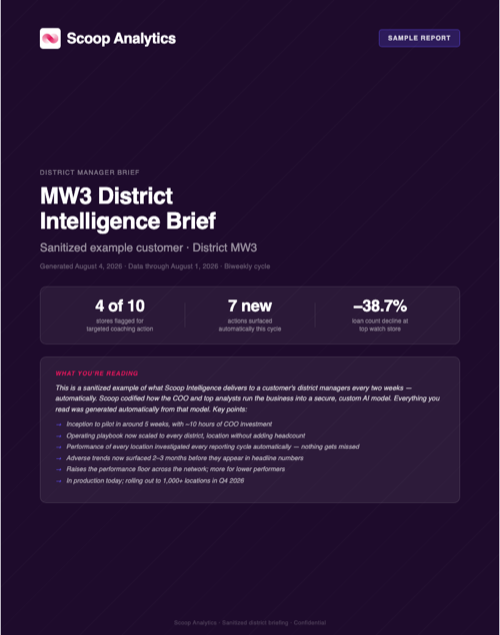
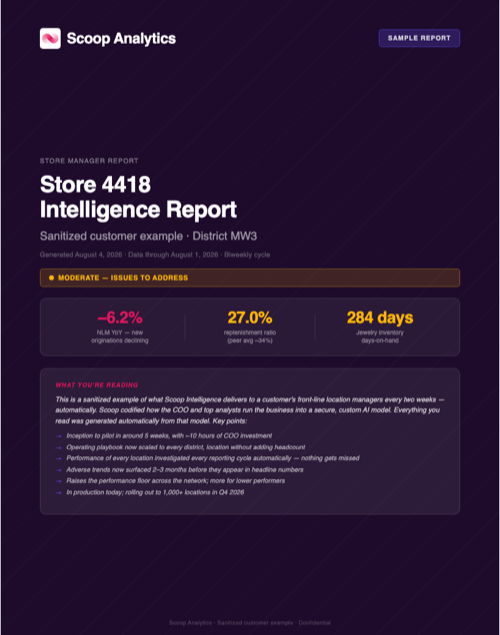
No manager wants overload. This step defines, quickly and from existing templates, what each manager gets every Monday morning, or whatever your cadence is: key metrics, trends, color-coded alerts, root cause explanations, and action plans. We give you multiple options to pick from, refine, and iterate on, so it stays simple.
Pilot with a small team.
We typically reach pilot in four to five weeks. A forward-looking region with meaningful performance variance across locations works best. The implementation team iterates on the reports with that management chain until they're bought in and using it every day.
One region, its districts, and its stores, live and iterating.
Scale out.
After the pilot, we roll out incrementally, or all at once, as we've done with some customers. Scoop supports multiple operating units with different definitions and even different languages, which are best addressed with their own pilots.
Every region, every district, every store, on the same playbook.
Scoop goes where your data and infrastructure live.
Deployable in your environment. Talk to us about your specific requirements.
Scoop hosts
The fastest way to get started. We set up the infrastructure, maintain it, and run inference on our side.
Your VPC
Scoop is fully containerized. Deploy it into your own AWS, Google Cloud, or Azure account, wherever your data already lives.
Self-managed / private cloud
For the strictest security requirements, run and manage Scoop entirely within your own private cloud.
Book a discovery call
Reach out to start a two-way conversation about your industry, your performance variations across locations, and whether Scoop is the right fit for you.