SaaS apps have data models. AI apps have context models. Here's why that distinction matters.
What Is a Context Model in AI? The Data Model Analogy
I have built analytics companies for twenty years. I sold the last one to Infor. And the single hardest lesson I learned is this. The model is not the hard part anymore. The context is.
A context model is the structured framework that tells an AI what to look for, how to interpret what it finds, and what to do about it, specific to your business and your purpose. Without one, AI is a powerful tool pointed at nothing. With one, it does the judgment work that used to live only in the heads of your best operators.
Here is my claim, and I will spend the rest of this piece defending it. Most of what your best COO analytics leader knows is not written down anywhere, and until you capture it, no AI will run your operation the way they would.
- A context model gives AI a point of view, not just data access.
- It is built for one purpose: managing performance across your operation.
- It is the difference between an AI that guesses and an AI that decides the way your best operator would.
What most people think context means, and why they're wrong
Here is the mistake I see everywhere. People think giving AI context means giving it everything. Dump every document, every dashboard export, every spreadsheet into a database, and trust the model to sort it out.
It feels thorough. It is actually the surest way to build something that cannot be trusted.
An unstructured pile of information has no priorities and no rules. Ask it the same question twice and you can get two different answers. For operational decisions, where consistency and data governance are the whole game, unpredictable is just a nicer word for useless.
If you just create a giant dumping ground of stuff and throw it in a vector database and hope the LLM sorts it out, that's not structured context. To make this something that actually performs requires a very strong point of view on what you're trying to accomplish.
The problem was never the amount of information. It was the absence of structure. Three specific ways the dumping-ground approach falls apart:
- It is unstructured, so the model has no map of what matters most.
- It is unpredictable, so the same input produces a different output.
- It cannot be governed, so you cannot audit why the system said what it said.
I hit this wall myself, years ago, with the first wave of chat with your data tools. The technology worked. It just did not understand the business it was being asked about. The AI ran into the exact same problem people do. It did not have the context.
The data model analogy
So let me give you the analogy that finally made this click for me. Every SaaS application you use is built on a data model. Salesforce is the cleanest example. Salesforce decided what an Opportunity is, what an Account is, what a Contact is, and how they relate. That model is not plumbing. It is most of the intellectual property.
AI applications have an exact equivalent, and it is the context model. It is the layer that turns a generic AI data analyst into one that actually understands how your business runs. The way I put it to people:
Think of generic AI like a database. It's a tool. But a database doesn't encapsulate workflow and processes and businesses. That's why you have an application. We're the Salesforce layer. Claude and ChatGPT are the database.
Sit with that, because it reframes the whole market. The frontier models everyone is racing to license are the database. Powerful, general, and on their own, not an application. The parallel is exact:
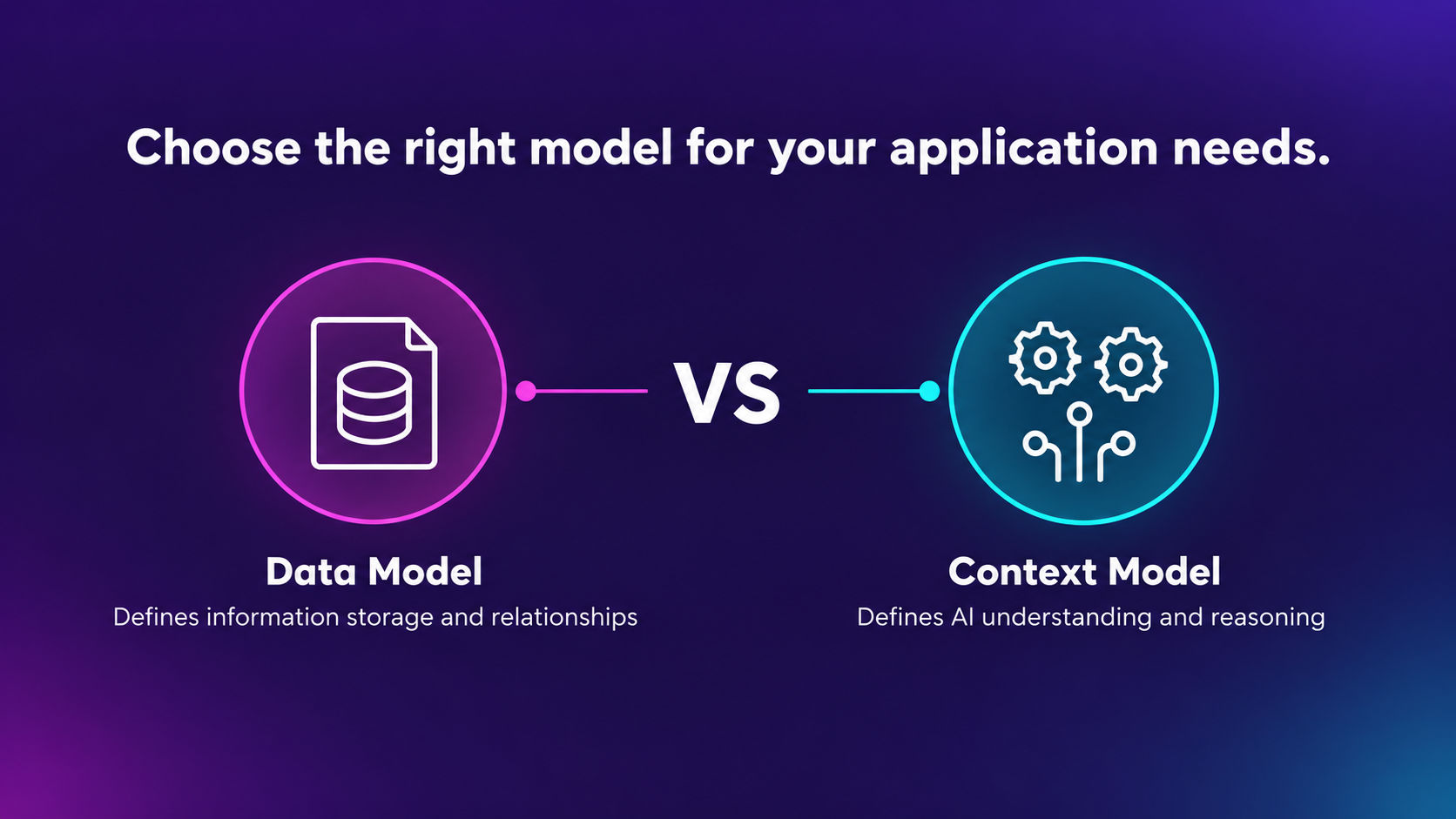
- A data model defines how information is stored: records, fields, relationships.
- A context model defines how an AI understands a domain: what concepts matter, how they relate, how to reason about them.
- SaaS apps are built on data models. AI apps are built on context models.
In SaaS applications, there's a data model, a huge chunk of the IP. For Scoop, for an AI application, we have a context model. That context model is highly designed and optimized for the purposes of driving performance management.
This is also why raw model horsepower, however impressive, is not a neuro-symbolic AI system on its own. The reasoning structure has to be built by someone who knows the domain. That structure is the context model, and it is the part nobody can shortcut.
What a context model for operations actually contains
Now, what goes into one. Not every document in the business. That is the dumping-ground mistake wearing a different hat. A context model holds the specific interpretation logic your best operator carries in their head, and nothing else.
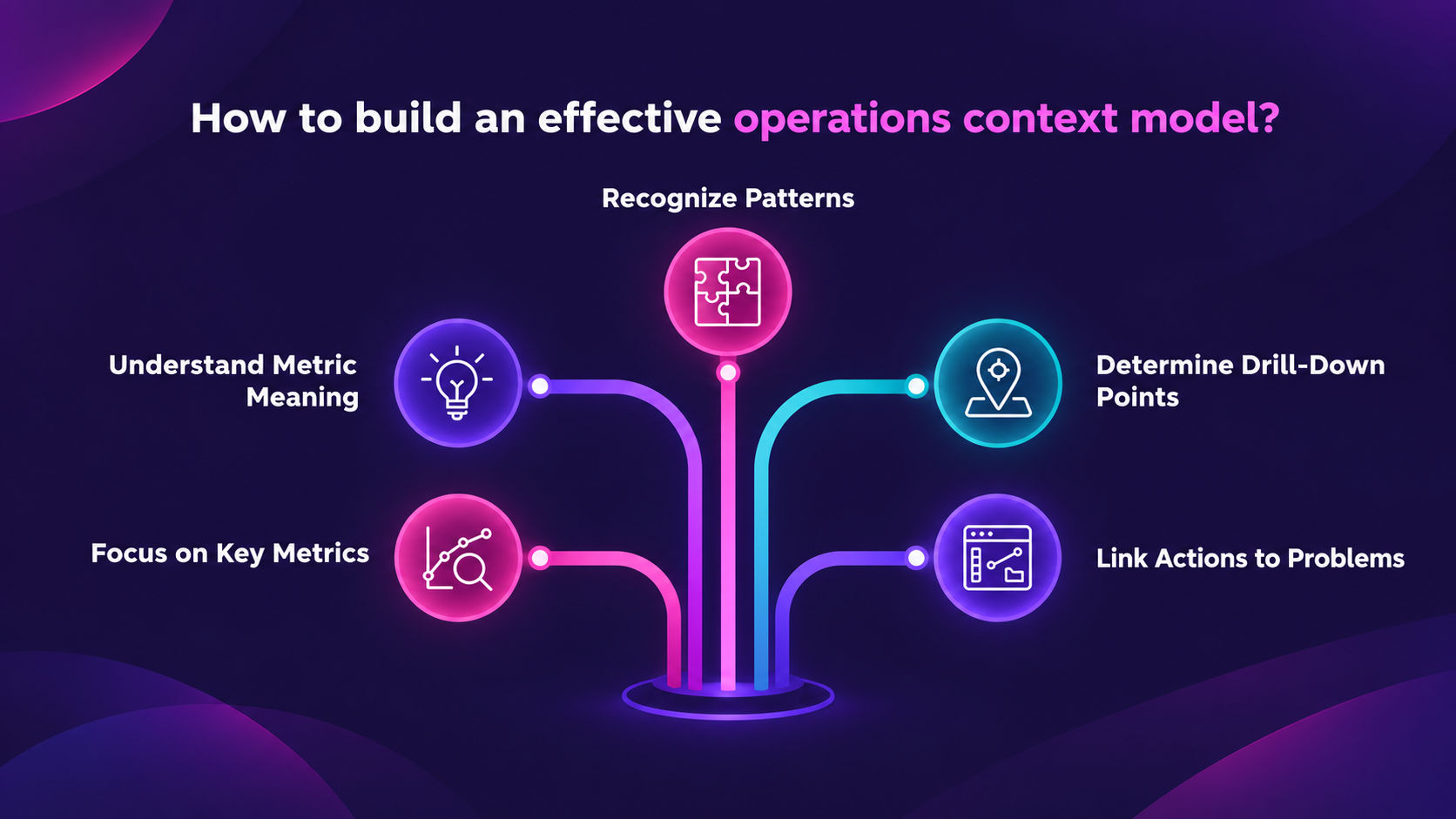
For performance management, that comes down to five things:
- What metrics matter, and which ones are noise.
- What each metric means when it moves, up or down.
- What patterns to watch for across locations and periods.
- Where to drill when a number looks wrong.
- What kinds of actions tend to fix what kinds of problems.
This is the part that is hard to build and easy to underestimate, and here is the number that proves it. There is a study I come back to constantly: 85 to 95% of the context behind any question you ask is not in the question itself.
It is tribal knowledge. Held by people. Undocumented. A context model is where that knowledge finally gets written down and made runnable, and that, not model size, is the real answer to the black-box AI trust problem. Every conclusion traces back to a rule you can inspect.
Let me make this concrete, because I lived it. I spent a week in Houston with the district managers, regional managers, and COO of the largest pawn chain in the United States, walking through their Power BI in eleven stores. Seven hours of recordings. Their COO had twenty-seven years in the business and knew it cold. The people on the front line did not. That gap is the whole problem.
Their CEO said something I quote all the time. If you asked three different people what the company's “death spiral” pattern looked like, you would get three different answers. Same data. Three interpretations. A context model collapses that into one consistent, defensible reading, which is what agentic analytics is supposed to do once it is grounded in real business logic. Here is the clearest I have ever said it:
What we've done is figured out the right questions to ask, how to ask them, how to structure the context model, and then how to build a harness that can leverage the context model to deliver AI performance management. That's probably the most articulate I've ever been about this.
Why it has to be maintained
One more thing, because it is where most people expect the catch. A context model is not a one-time build. Context decays. Conditions shift, new patterns surface, and last year's interpretation logic quietly goes stale.
Sounds like a treadmill. It is not, and this is the part I want operators to hear clearly. The work is front-loaded, then it shrinks:
- The stable logic gets codified once: the metrics that rarely move, the patterns that hold all year.
- After that, attention goes only to what is new or different this cycle.
- The model gets more accurate over time, not more expensive to run.
That is why I treat a context model less like software you install and more like a human-in-the-loop discipline. People review what changed. The system carries everything that did not. What you get is an asset that compounds, which is the exact opposite of a dashboard that goes stale the morning after you build it. That staleness is the core limitation of KPI dashboards in the first place, and it is the reason I stopped believing dashboards alone would ever be enough.
Where Scoop fits
Everything I have described is what we built Scoop on: a context model for performance management. My team sits with your operators, captures how they actually read the numbers, codifies that logic, and runs it across every location, every cycle. Then a report arrives with what changed, why, and what to do about it.
It sits on top of the BI stack you already own. Nothing gets ripped out. If you want to see how that interpretation layer works in practice, that is where I would start.
- Built on your data, not ours.
- Your best operator's judgment, running everywhere, automatically.
Every location diagnosed. Every cycle.
Scoop is AI performance management for distributed businesses. It diagnoses performance at every location, every cycle, and hands every manager a clear action plan.
- Every location, every cycle
- Role-specific action plans
- No prompting required
Frequently asked questions about context models in AI
What is a context model in AI?
A context model is the structured framework that tells an AI system what information it needs, how to organize it, and how to use it to solve a specific problem. Unlike a generic knowledge dump, a context model has a point of view. It is designed for a particular use case and optimized to produce reliable, consistent outputs.
- It is purpose-built, not general.
- It produces the same answer to the same question every time.
What's the difference between a context model and a data model?
A data model defines how information is stored in a database: the structure of records, relationships, and fields. A context model defines how an AI system understands a domain: what concepts matter, how they relate, and how the AI should reason about them.
- SaaS applications are built on data models.
- AI applications are built on context models.
Why can't you just give AI all your company documents?
You can, and it is better than nothing. But an unstructured knowledge dump produces unpredictable outputs. For operational decisions, where consistency, accuracy, and governance matter, you need a context model that is specific to your use case, structured for navigation, and designed to produce the same reliable answer every time.
- Unstructured input means inconsistent output.
- Operational decisions need answers you can audit and repeat.
How does a context model capture tribal knowledge?
Through a structured extraction process: interviews with senior operators, analysis of how they interpret data, and documentation of the patterns, exceptions, and decision rules they apply. That knowledge is then organized into a context model the AI can navigate systematically, rather than depending on one person being in the room.
- Capture the operator's interpretation logic, not just their data.
- Structure it so the AI can run it consistently.
Does a context model need to be updated over time?
Yes. Business conditions change, new patterns emerge, and the context needs to reflect them. But once the stable elements are codified, the metrics that rarely change and the patterns that hold year-round, ongoing maintenance focuses only on what is new or different. The model gets more accurate over time, not more burdensome.
- Front-load the stable logic once.
- Maintain only what changed each cycle.
Is a context model the same as augmented analytics?
Not quite. Augmented analytics is the broader category of AI that enhances analytical work. A context model is the specific structure that makes that AI reliable for one business and one purpose. You can read more on the category in our augmented analytics platform overview.
- Augmented analytics is the category.
- A context model is what makes it trustworthy for your operation.