Why dumping documents into an AI won't save you
Why unstructured AI can't be trusted
Feeding a pile of documents into a general-purpose AI does not give it judgment. It gives it a search box over unstructured text.
The model will answer confidently, but it does not know how your business runs, which numbers matter, or what a bad week actually looks like. A pile of stuff is not a context model.
This is the problem Scoop was built to solve. Before the fix, the problem needs to be clear: unstructured AI produces answers a leader cannot defend. Here is why.
What does "dumping documents into an AI" actually mean?
It usually means retrieval-augmented generation: you load reports, PDFs, wikis, and past emails into a vector database, then let a large language model pull relevant chunks to answer questions.
It is a real technique, and for a help desk or a policy lookup it works. The trouble starts when leaders expect it to interpret a distributed business.
A retrieval setup retrieves.
It does not reason about your operation the way a seasoned operator does. Three things go wrong the moment you ask it to run the business:
It has no ranking of what matters
Every document looks equally important, so a stray footnote can outweigh the metric that actually drives the P&L.
It has no thresholds
It cannot tell a 2% comp dip that is noise from a 2% dip that signals a store in trouble.
It has no sequence
A good operator checks things in a deliberate order. A vector search has no order at all.
Every location diagnosed. Every cycle.
Scoop is AI performance management for distributed businesses. It diagnoses performance at every location, every cycle, and hands every manager a clear action plan.
- Every location, every cycle
- Role-specific action plans
- No prompting required
Why unstructured context produces lies
Because without structure, the model guesses. It fills the gap between what you asked and what you meant with whatever the text nearby suggests, and it presents that guess in the same confident tone as a fact.
For a COO reviewing 40 locations, an answer you cannot trust is worse than no answer, because someone still has to check it.
The founder who built the approach behind Scoop watched this happen firsthand across manufacturing and tech companies.
People asked reasonable questions and the model returned something plausible and wrong, over and over, because the real question carried assumptions the words never stated:
It's amazing how much of what people were asking wasn't actually in the question they were asking. There's an implicit assumption that AI is going to magically know what you're actually asking, but generic AI doesn't really know that.
Scoop does not hand a leader a smarter chatbot. It captures how the best operator interprets the business and runs that logic across every location, every cycle, with the evidence attached to every conclusion. The rest of this piece explains the difference between the pile and the method, and where Scoop fits.
What is a context model, and how is it different from a pile of documents?
A context model is the encoded logic of how your best operator interprets the business: what they check first, which thresholds trip an alarm, which signals they act on and which they ignore.
It is not a folder of files. It is the ordered reasoning that turns those files into a decision. The documents are raw material. The context model is the method.
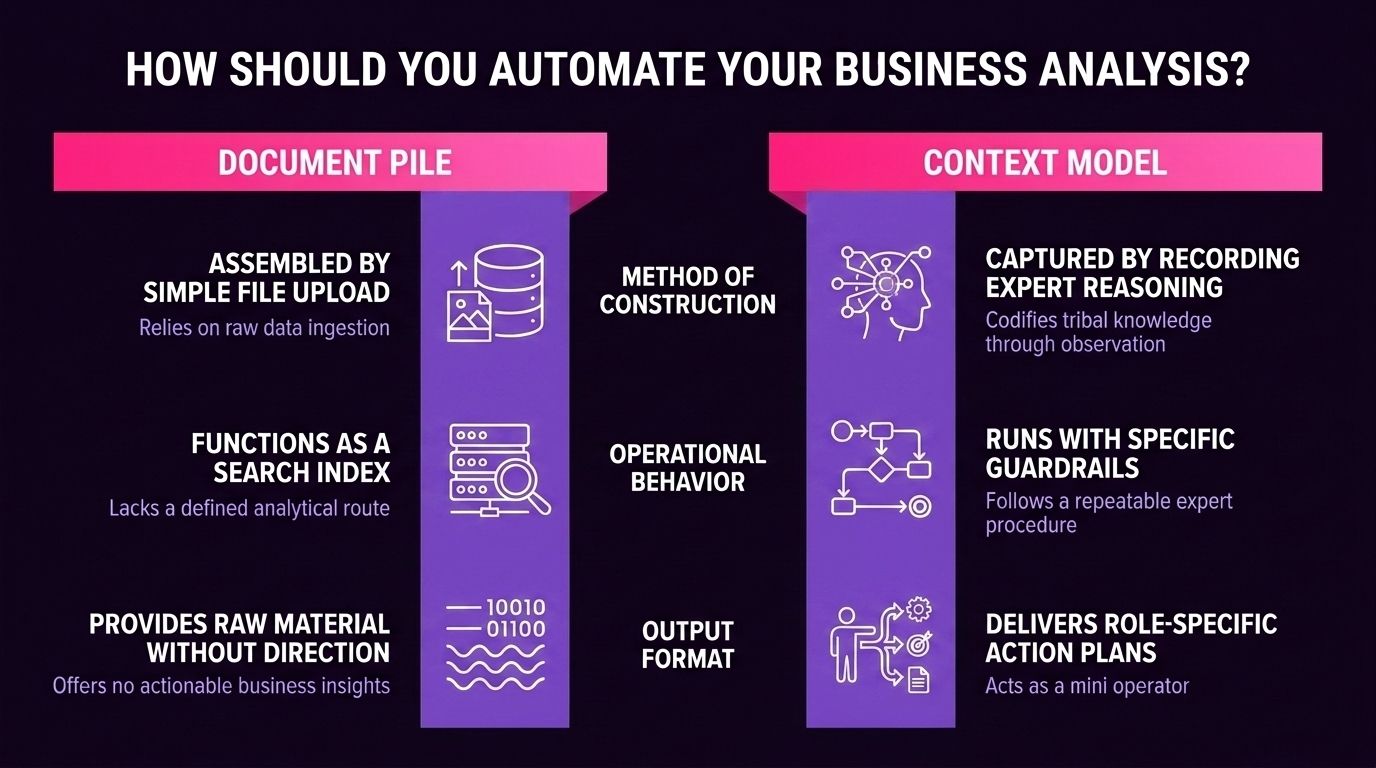
The difference shows up in how the two are built. A document pile is assembled by upload. A context model is captured by sitting with the person who runs the business and recording how they think. The canonical way to describe it:
If I took a tape recorder and recorded everything you thought as you looked at the BI and described your analyses, can we then stick that into the system so it could go do that on your behalf?
That recording becomes a repeatable procedure, not a search index.
And it runs with guardrails, so the system investigates the way a specific expert would rather than wandering wherever the text pulls it. As the founder puts it, this is not AI let loose:
We do not let AI just sort of run off on its own. It's very structured, based on how, if you took your very best manager and analyst and had them go through and really pick apart one thing, what would be the route they go.
A pile of documents has no route. A context model is the route, written down once and run everywhere.
Scoop is what builds that context model and runs it. It codifies your best operator's judgment during a hands-on setup, then screens every location on schedule and delivers a role-specific action plan.
One operator described the result as a mini version of that person in a box, scanning and analyzing every week on their behalf. That is the shift from a three-layer architecture that passes the business-logic test, not a chatbot that improvises.
Codify what your best operators already know.
Scoop captures your operators' tribal knowledge, screens every location automatically, and delivers role-specific action plans. Nobody writes a prompt. The plan just arrives.
- Codified tribal knowledge
- Automatic screening
- Action plans, not dashboards
Document pile vs. context model, side by side
The two approaches look similar on a slide. They behave nothing alike in production:
Why does this matter more for distributed businesses?
Because scale multiplies the cost of an unreliable answer.
One store, one manager, one gut check is manageable. Forty locations reviewed every week is not, and that is precisely where leaders reach for AI to cover ground they cannot cover by hand.
If the AI improvises, it improvises 40 times, and the errors compound across the portfolio before anyone notices.
Distributed operators feel a second pressure at the same time: flat teams and compressed timelines.
One quality leader described it plainly, and it is the reason a reliable layer matters, not a clever demo:
More from less. Nobody has time. Everybody wants more from less.
Doing more from less only works if the extra output is trustworthy. A document pile gives you volume without reliability, which is the opposite of what a stretched team needs.
This is the gap that separates a real AI analyst from a chatbot bolted onto a file share.
Scoop is built for exactly this. It pairs the structured layer with the systems you already run, which the existing BI stack playbook lays out in detail. Scoop sits on top of your Power BI, Tableau, or warehouse and adds the interpretation and action layer, without ripping anything out.
How Scoop keeps the AI aligned with your business
Scoop keeps the AI honest by constraining it to a defined method instead of an open field.
Scoop screens every location on a schedule, flags the ones that trip a criterion, investigates each flag with a fixed set of probes, and rolls the findings up by role.
Every step is auditable, so a conclusion arrives with the evidence attached rather than as a confident assertion you have to trust on faith.
Three properties make Scoop's structured approach trustworthy:
It is repeatable
The same logic runs every cycle, so a healthy week and a bad week are judged on the same standard.
It is governed
The system follows the operator's route, with human-in-the-loop review, rather than running wherever the text leads.
It is durable
The judgment lives in the model, so it does not walk out the door when a tenured manager retires.
Live in weeks. Not months.
We connect to your data, codify your playbook, and train your team. You see a working pilot before anyone commits to a full rollout.
- Connect your data
- Codify your playbook
- Pilot before rollout
The takeaway for leaders
A document pile answers questions.
Scoop runs your business the way your best operator would, everywhere, every cycle. The first is a search box. The second is a method.
Only one of them earns a place in a decision a C-suite leader has to defend.
Generic AI is real infrastructure, and it is not going away. But infrastructure is not the application.
If you want AI that manages performance across a distributed operation, the structure is the product, and Scoop is the company building it, betting the whole category on it. Pile of stuff, or structured judgment. That is the choice.
Frequently asked questions about why dumping documents into an AI won't save you
Is retrieval-augmented generation useless, then?
No. RAG is a solid technique for lookup tasks like policy search, documentation, and support. It becomes unreliable when leaders expect it to interpret and run a distributed operation, because retrieval has no ranking, thresholds, or sequence. Use it for lookup. Do not mistake it for judgment. Scoop adds the ranking, thresholds, and sequence that lookup lacks.
What makes a context model different from fine-tuning a model on our data?
Fine-tuning adjusts how a model writes. A context model encodes how your operator thinks: the order they check things, the thresholds that trip an alarm, the signals they act on. It is a procedure, not a writing style, and Scoop runs it the same way every cycle so results stay consistent across locations.
Do we have to replace Power BI or Tableau to use Scoop?
No. Scoop sits on top of your existing BI and data warehouse. Your data stays in your environment, your dashboards stay in place, and Scoop adds interpretation and a recommended action for each location. It is additive, not a migration.
How is the operator's logic captured without turning it into another data project?
Scoop's team sits with your operators and records how they interpret their reports, then encodes that reasoning. Think of it as a tape recorder for judgment. The output is a repeatable method, delivered as a report that arrives automatically, not a tool your team has to configure.
Why can't we just prompt a general AI better?
Better prompting helps at the margins, but it cannot supply the business context the model never had. The gap is not phrasing. It is the missing structure: what matters, in what order, against which thresholds. Scoop builds that structure once, so it does not have to be re-typed into every prompt.