
If the answer was silence, or worse, "I'll get the data team to pull a report by Friday," you aren't alone.
Here is a surprising fact: The healthcare industry generates approximately 30% of the world's data volume, yet nearly 97% of that data goes unused. For business operations leaders, this gap represents millions in lost revenue, burnt-out staff, and suboptimal patient care.
It’s time to close that gap.
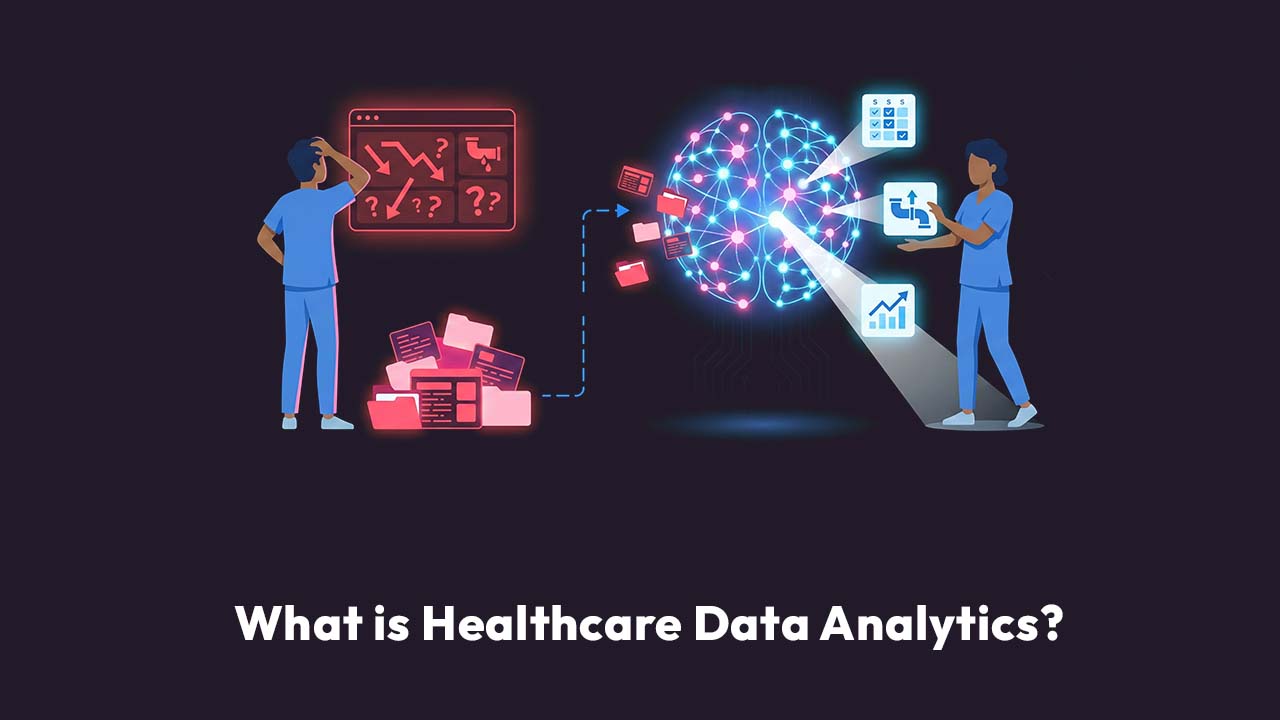
What is Healthcare Data Analytics?
Healthcare data analytics is the systematic process of transforming raw medical, financial, and operational data into actionable insights. It combines historical records, real-time streams, and predictive modeling to answer critical business questions, enabling leaders to optimize staffing, reduce costs, and improve patient outcomes without relying on guesswork.
Beyond the Buzzwords
At its core, healthcare analytics is about moving from "what happened?" to "what should we do?"
Most organizations are stuck in the first phase. They have descriptive analytics—charts that tell you your ED wait times increased by 15% last month. That is useful, but it is effectively an autopsy of your performance. It tells you you’re bleeding, but not how to stop it.
The real power lies in prescriptive analytics—systems that not only predict a surge in patient volume next Tuesday but recommend exactly how many nurses to schedule to handle it. This is where the industry is heading, and it is where operations leaders find their biggest wins.
The Four Pillars of Healthcare Intelligence
To truly grasp the landscape, you need to understand the four types of analytics available to you:
- Descriptive: What happened? (e.g., "We had 400 admissions last week.")
- Diagnostic: Why did it happen? (e.g., "Admissions spiked because of a localized flu outbreak.")
- Predictive: What will happen? (e.g., "We expect a 20% surge in respiratory cases next month.")
- Prescriptive: How can we make it happen (or stop it)? (e.g., "Increase respiratory therapy staffing by 10% on weekends.")
Why Business Operations Leaders Are Prioritizing Analytics
You might be thinking, "I'm an ops leader, not a data scientist. Why do I need to know how the sausage is made?"
Because in 2025, operations is data.
The days of managing a hospital or clinic network by "walking the floor" and gut instinct are over. The margins are too thin, and the complexity is too high. You need a "check engine" light for your entire organization.
1. Crushing Operational Inefficiencies
We have seen it firsthand: a hospital staffing its ED based on historical averages rather than predictive demand. The result? Nurses are overworked on Tuesday nights and sitting idle on Thursday mornings.
By implementing robust healthcare analytics, you can align resources with actual demand.
- Staffing: Predict patient inflow to optimize shift schedules.
- Asset Utilization: Track usage rates of expensive equipment (like MRI machines) to prevent bottlenecks.
- Patient Flow: Identify exactly where discharge processes stall to free up beds faster.
2. Stopping the Financial Bleed
Denials management is often a game of "catch-up." Analytics changes the rules. instead of chasing denied claims, predictive models can flag claims before submission that have a high probability of rejection based on payer-specific rules.
- Fact: Predictive analytics can reduce denials by up to 90% by catching coding errors pre-submission.
3. The "Why" Behind the "What"
This is the biggest frustration for leaders. You see a metric dip, but you don't know the root cause. Traditional BI tools give you a dashboard; they don't give you an explanation.
This is where next-generation platforms like Scoop Analytics are changing the game. instead of just showing you a chart of declining revenue, Scoop’s Domain Intelligence investigates the underlying data to tell you, "Revenue is down 4% because high-margin elective surgeries in the West Wing were cancelled due to a shortage of anesthesiologists."
Real-World Applications: From Theory to Practice
Let’s look at how this plays out in the real world.
The "Bed Traffic Control" Center
One large hospital network was struggling with ED overcrowding. Patients were waiting hours for a bed, while beds on upper floors sat empty due to slow turnover.
The Fix: They implemented a real-time analytics command center.
The Result: By integrating EMR data with housekeeping status updates, they reduced bed turnover time by 45 minutes. That might sound small, but at scale, it effectively "created" 20 new beds without building a single room.
Predicting No-Shows
Clinic operations die by no-shows. A missed appointment is lost revenue that cannot be recovered.
The Fix: A predictive model analyzed patient demographics, weather patterns, and transportation data to score the likelihood of a "no-show" for every appointment.
The Result: High-risk patients received automated Uber Health ride offers or double-reminder calls. The no-show rate dropped by 22%.
Comparing Old vs. New Approaches
The "Hidden" Traps You Might Be Falling Into
Implementing analytics isn't just about buying software. It's about avoiding the pitfalls that have tanked millions of dollars in IT projects.
Trap 1: The Data Silo Nightmare
Your EMR doesn't talk to your CRM. Your HR system is on a different server than your financial software.
The Mistake: Trying to build a massive, multi-year "Data Warehouse" to unify everything before running a single analysis.
The Solution: Use an agile platform that connects disparate sources instantly. Scoop Analytics, for example, allows you to blend data from Salesforce, your SQL database, and Excel files in a single view without a massive engineering project.
Trap 2: The Dashboard Death Spiral
Have you ever asked for a report and received a 40-page PDF of charts? That isn't insight; that's noise.
The Mistake: confusing "more data" with "better decisions."
The Solution: Focus on Domain Intelligence. You don't need more charts; you need a system that understands your business logic. You need a tool that knows that a "readmission" is defined differently for a heart failure patient than for an orthopedic patient.
Trap 3: Ignoring the "Last Mile"
The "Last Mile" in analytics is the gap between a data insight and a human decision. If your fancy ML model predicts a staffing shortage but the nurse manager never sees it, the insight is worthless.
The Solution: Democratize the data. Give your frontline managers tools they can actually use—like a chat interface where they can ask, "Show me the staffing forecast for next week," and get a plain-English answer.
FAQ: Common Questions on Healthcare Analytics
Q: Do I need a team of data scientists to use modern analytics?
A: Not anymore. While traditional tools required Python or R experts, platforms like Scoop utilize a 3-Layer AI Architecture to act as your "Citizen Data Scientist." The system handles the complex data prep and ML modeling (using robust algorithms like J48 decision trees) and then translates the results into business language you can understand.
Q: Is healthcare data analytics secure?
A: Absolutely. It must be. Look for platforms that are SOC 2 Type II certified and offer granular role-based access control. You should never have to trade security for speed.
Q: How quickly can we see ROI?
A: With the right tool, ROI can be realized in weeks, not years. By identifying a single process bottleneck—like an OR scheduling inefficiency or a recurring billing error—you can often pay for the analytics investment ten times over in the first quarter.
Q: Can analytics really improve patient care, or is it just about money?
A: They are inextricably linked. Efficient operations are safer operations. A nurse who isn't overworked because of better staffing models makes fewer errors. A patient who doesn't wait 6 hours in the ED has a better outcome. Analytics provides the operational stability that makes clinical excellence possible.
Conclusion
The era of "intuition-based" healthcare management is over. As an operations leader, your ability to leverage healthcare data analytics will be the defining factor in your organization's success—and your own career.
You don't need to build a massive data science team. You don't need to wait two years for a data warehouse. You just need to start asking the right questions and equipping your team with the tools to answer them.
Don't let your data sit in the dark. Turn on the lights.