
Why Multi-Location Businesses Lose Operational Knowledge Every Time Someone Leaves
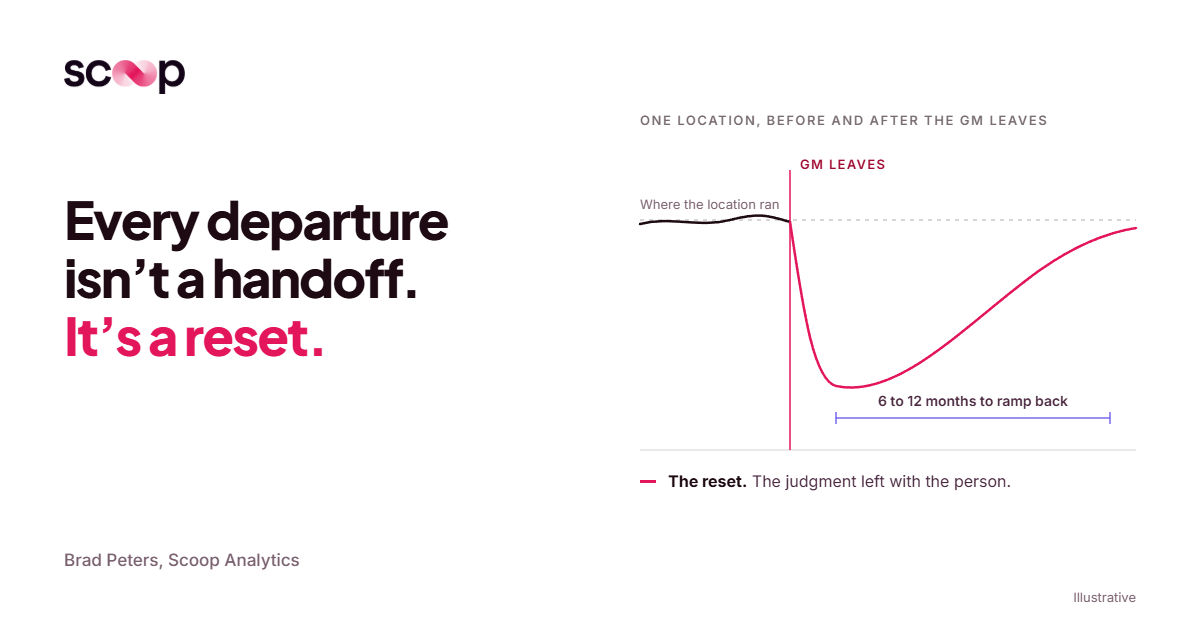
Every time a strong GM leaves, the location resets. Brad Peters on why operational knowledge loss is structural, and how to keep judgment in every unit.
Operational Knowledge Loss in Multi-Location Businesses
Multi-location businesses lose operational knowledge every time someone leaves because it was never captured. It lives in the heads of the best GMs and operators:
- The questions they ask
- The patterns they recognize
- The thresholds they act on
When that person quits or gets promoted, the location starts over, which makes this a structural problem, not a training problem.
The CEO of a large multi-location retail chain once told me what his single biggest business risk was.
Not a competitor. Not the economy. Losing his COO.
That COO had 27 years in the industry. He knew the business like the back of his hand. The people on the front lines didn't.
I've spent twenty years building BI, and I've watched the same pattern in every distributed business I've worked with. Here's what I've learned about why the knowledge keeps walking out the door, and why the usual fixes don't keep it in.
What is operational knowledge loss in a multi-location business?
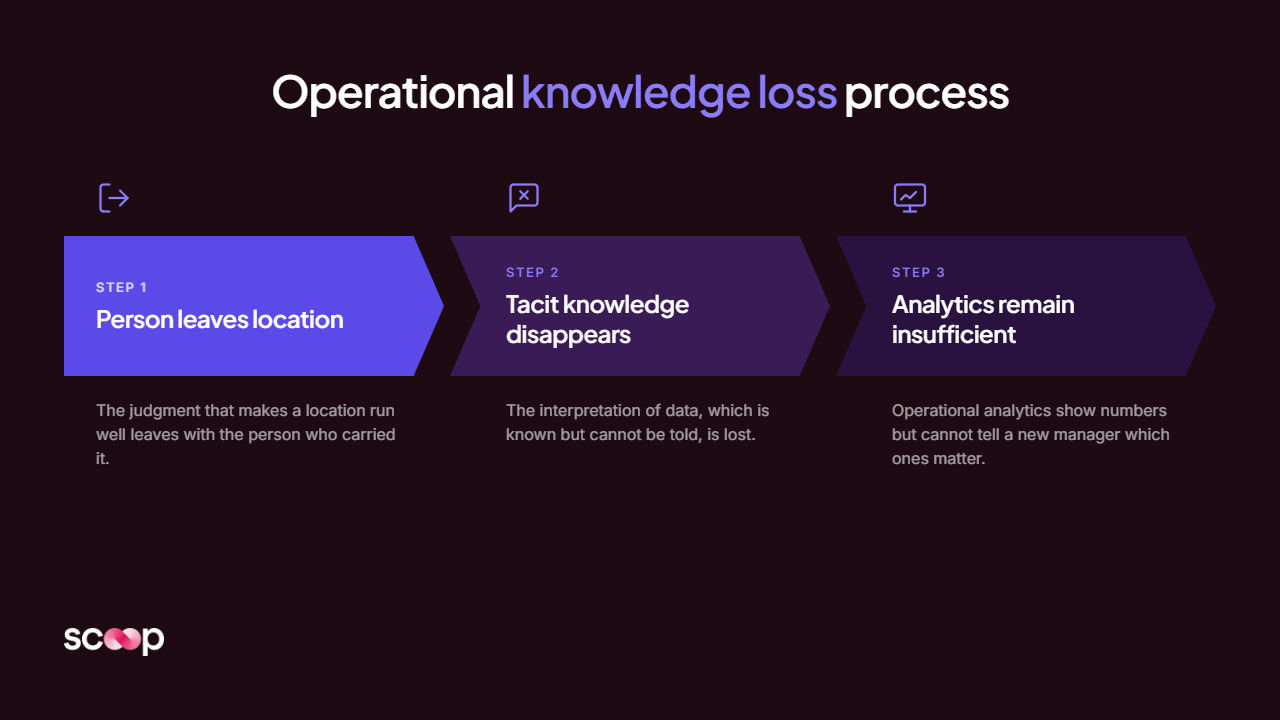
Operational knowledge loss is what happens when the judgment that makes a location run well leaves with the person who carried it.
Not the SOP binder. Not the POS data. The interpretation.
Philosophers have a name for this kind of knowing: tacit knowledge. Michael Polanyi summed it up in one line: "We can know more than we can tell."
Every operator I meet can measure operational performance down to the shift. The numbers aren't what's missing. What's missing is what the best person in the building does with them:
- What they check first: The two or three numbers they open before anything else on Monday morning.
- What "healthy" means here: A founder who runs a hotel management group told me a housekeeper at a midscale, limited-service property turns about 12 to 12.5 rooms per eight-hour shift. A GM who knows that staffs to forecast occupancy instead of calling the whole crew in and sending half of them home after two hours.
- Which signals are noise: The inventory spike that's just seasonality, versus the same spike that says a store is about to crater.
- What to do next: The fix they'd push, and the one they'd skip because the store can't control it.
Your operational analytics can show every one of those numbers. It can't tell a new manager which ones matter this week.
What causes operational knowledge loss in multi-location businesses?
Operational knowledge loss starts long before anyone resigns. The knowledge was never written down, so when the person leaves there is nothing to hand over.
I've said this to every operations leader I've talked to, and none of them has argued:
"Operations people understand the business. They're not technologists. They have intuition, they've seen trends and patterns, they know what questions to ask. That sits in their heads, and organizations don't write that down."
That isn't negligence. It's how this kind of knowledge forms:
- It's built by repetition, not instruction: 27 years of watching stores rise and fall doesn't compress into a training deck.
- It's inconsistent, even at the top: That retail chain's CEO told me that if he asked three different managers what the "death spiral" meant, he'd get three different answers.
- The basic terms were never defined: Every district manager used the phrase "out-of-balance store." Nobody had ever written down what it actually meant.
- Writing it down is painful: So it stays on next quarter's list, forever.
The research matches what operators feel. Panopto's workplace knowledge study found that 42% of institutional knowledge is unique to the person in the role. When that person leaves, nobody else can do that part of the job.
It's the same reason most BI projects fail. The people building the reports rarely carry the operator's context, so the reports answer questions nobody was asking.
Every departure isn't a handoff. It's a reset.
Find the daypart gap before the week closes.
Scoop identifies daypart gaps, labor inefficiency, and food cost issues across every location, every cycle. Then it tells each manager exactly what to do about it.
- Daypart gaps
- Labor and food cost
- Manager-ready actions
Why does manager turnover hit distributed operators harder?
Manager turnover hurts distributed operators more because they have more seats where judgment matters, and those seats empty faster than almost anywhere else in the economy.
The numbers are brutal:
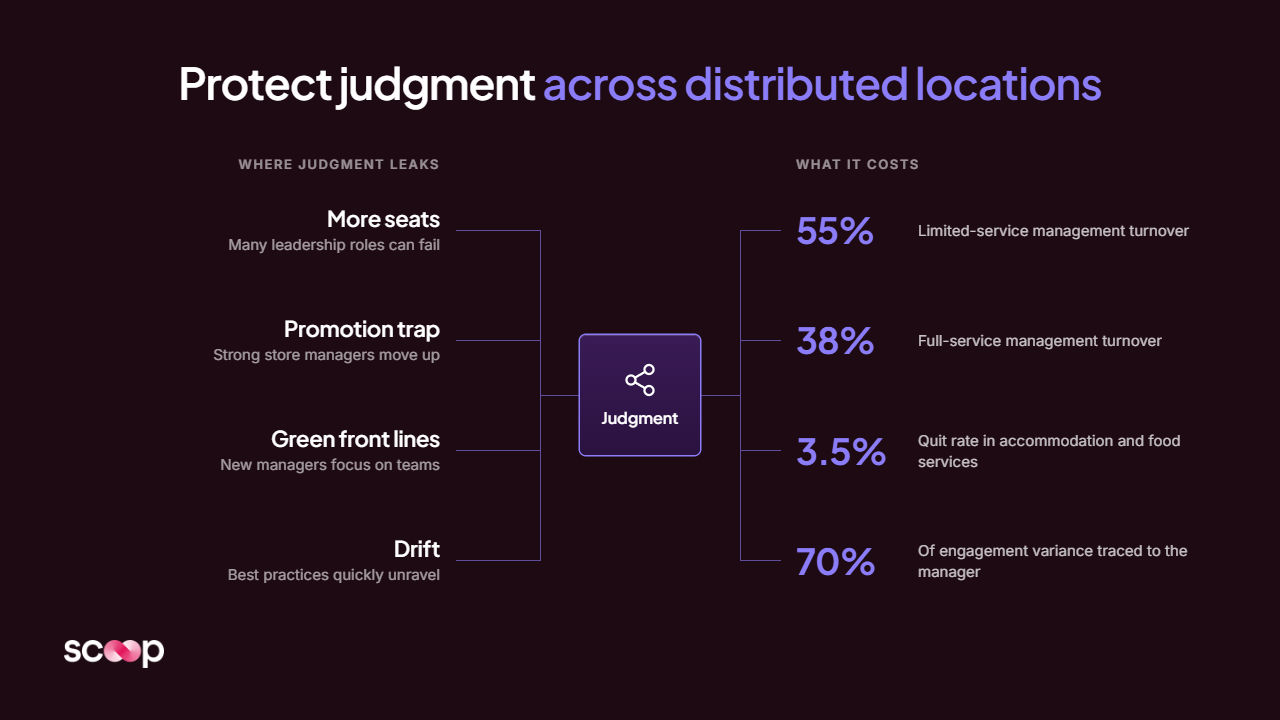
- Black Box Intelligence put limited-service restaurant management turnover at 55% in Q3 2024, up from 45% in 2019. Full-service management turnover reached 38%, up from 31%.
- In August 2026 alone, 3.5% of accommodation and food services workers quit, according to the Bureau of Labor Statistics. That's the highest rate of any industry, and nearly double the 1.9% across all industries.
- Gallup estimates that managers account for at least 70% of the variance in employee engagement across business units. In a multi-unit business, the manager effectively is the location.
Then the structure of a distributed business makes it worse:
- More seats: A 60-location group isn't protecting one leadership team. It's protecting 60 GMs and the district layer above them, and each one is a single point of failure.
- The promotion trap: The best store managers become district managers. Which means the store that ran best is now run by someone new.
- Green front lines: At that same chain, many store managers are brand new. Their focus is on their teams and their customers, and reading reports is a skill that comes later in the job.
- Drift: The hotel group founder described it perfectly. You push a best practice out to a property, and "five days later, some things can unravel."
One of the chain's senior leaders put the math plainly:
"There's one person in our organization who can look at these reports and see what's going to happen in six months. We have 1,200 locations. He can't get to all of them."
It's also why retail store diagnostics take so long. When the person who could read a store in five minutes moves up or moves on, every underperforming location turns into a weeks-long investigation.
Hotels feel it through their owners first. Hospitality performance management comes down to catching drift before the owner call does it for you.
What does it actually cost when a strong GM leaves?
The replacement bill is the smallest line item in the cost of GM turnover. The real cost is the months a location runs without the judgment, and the mistakes that surface after the new manager has supposedly ramped.
Start with what you can see. Black Box's workforce data puts the average hard cost of replacing a restaurant GM at $16,770 for separation, replacement, and training. Gallup's replacement cost research puts the full cost of replacing a leader or manager at about 200% of salary.
Then comes the part nobody budgets for. In my experience, it's six, nine, typically 12 months before a new manager becomes remotely productive.
That's not a study. It's what I've watched happen in store after store.
The most expensive cost is the lag. Operators at that retail chain call it the death spiral: a store gets aggressive, inventory builds, the team discounts to clear it, then pulls back too hard. Revenue falls off four to six months later.
A new manager can start that cycle in month two. You see it in month six, right about when you thought they'd finished ramping.
Here's the full bill for one GM departure:
- Replacement: Recruiting, separation, and training.
- Ramp: Six to 12 months of decisions made by rule of thumb.
- Lag: Mistakes from the ramp that surface after it ends.
- Coverage: District and regional time pulled into one location.
- Crew churn: Black Box data reported by FSR magazine links GM turnover to hourly turnover. When the GM goes, the crew often follows.
If you measure business performance only against last month's P&L, a reset location can look fine for a quarter. Standard anomaly detection flags the revenue drop when it lands, not the inventory build four months earlier that caused it.
Give every franchisee a personal ops advisor.
Scoop gives franchisors visibility into every location and gives franchisees an ops advisor of their own. Same standard, every unit, without adding corporate headcount.
- Visibility across every unit
- An advisor per franchisee
- No added headcount
Why don't training, SOPs, and dashboards fix it?
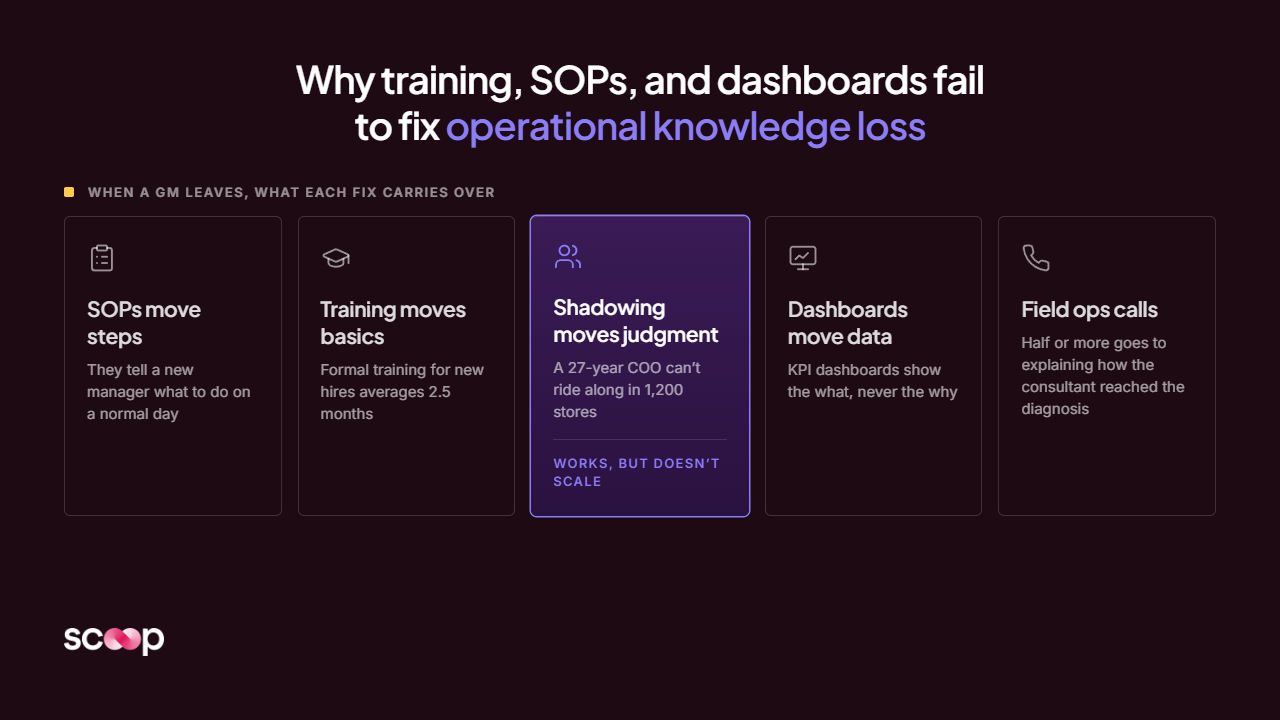
Training, SOPs, and dashboards transfer tasks and data. What leaves with the GM is interpretation, and none of the usual fixes carry it.
Here's what each one actually moves:
- SOPs move steps: They tell a new manager what to do on a normal day. They don't say when the numbers mean the normal day is over.
- Training moves basics, then stops: The same Panopto research found formal training for new hires averages 2.5 months, while getting fully up to speed can take up to six. And the person writing the training is rarely the person who knows the most.
- Shadowing moves judgment one person at a time: A 27-year COO can't ride along in 1,200 stores.
- Dashboards move data: Something goes up or down, and that just begs the question of why. KPI dashboards show the what, never the why.
- Field ops calls move conclusions, slowly: The COO of a multi-location franchise concept told me that in an hour-long call with a franchisee, half or more goes to explaining how the consultant reached the diagnosis. Only the rest is left for what to do about it.
That's the gap between monitoring analytics and investigation. Monitoring tells the new GM a number moved. Only the person who left knew why.
What would it take to stop the reset?
Stopping the reset means capturing operator judgment while the person is still in the building, in a form that runs whether or not they are.
The question I ask every COO is the same:
"If I took a tape recorder and recorded everything you thought as you looked at your BI reports, could we stick that into a system so it could do that on your behalf?"
That sounds simple. Doing it well takes five things:
- Capture from the operator: The COO, the best district manager, the GM everyone calls when a store goes sideways. Not whoever owns the reporting.
- Capture in context: Tacit knowledge usually transfers only through close interaction and trust, so you sit with operators in front of their real reports, in their real stores.
- Structure it. Screens, thresholds, investigation paths, and what each result means.
- Run it everywhere, every cycle: Not a binder. This is where AI investigation earns its keep, applying the same logic to every location on a schedule.
- Keep people in the loop: Operators review the output, mark what's wrong, and the corrections go back in. A human-in-the-loop approach is how operators come to trust it.
There's a byproduct nobody expects. Once the judgment is written down in plain English, it becomes the training material for the next person in the seat.
What does an AI version of the COO in every location look like?
Scoop co-founder Neil Shepherd put it in one line on a strategy call with a multi-location operator: "An AI version of the COO in every location." That's what we built Scoop to be.
As Neil describes it, Scoop encodes a COO's judgment on how to run the business, using the dashboard data you already have, for every location. It's knowledge infrastructure for AI performance management. Not another analytics tool.
Here's how Scoop works once our team has sat with your operators and recorded how they think:
- Screen: Every location, every cycle, against the same screens your best operators use: year-over-year deviations, balance between key metrics, early warning patterns.
- Investigate: When a screen trips, Scoop spawns an investigation into that location, typically 15 to 30 probes deep.
- Find the driver: Machine learning compares 10 to 20 variables at once against a healthier period to find what actually changed.
- Synthesize and roll up: Results are interpreted with your business's own context, scored from critical to healthy, and rolled up from store to district to region.
- Deliver: A report arrives with what changed, why, and what to do. Nobody logs in.
It sits on top of your existing BI stack. Power BI, Tableau, or the warehouse stays exactly where it is.
At that retail chain, it runs across about 1,200 stores every two weeks. We built it from 11 store visits with the full management chain and seven hours of recordings of how they read their Power BI. Junior staff now catch patterns a 20-year veteran would catch.
The COO hasn't been replaced. His judgment just shows up in the stores he won't get to this year.
What should a COO do before the next GM gives notice?
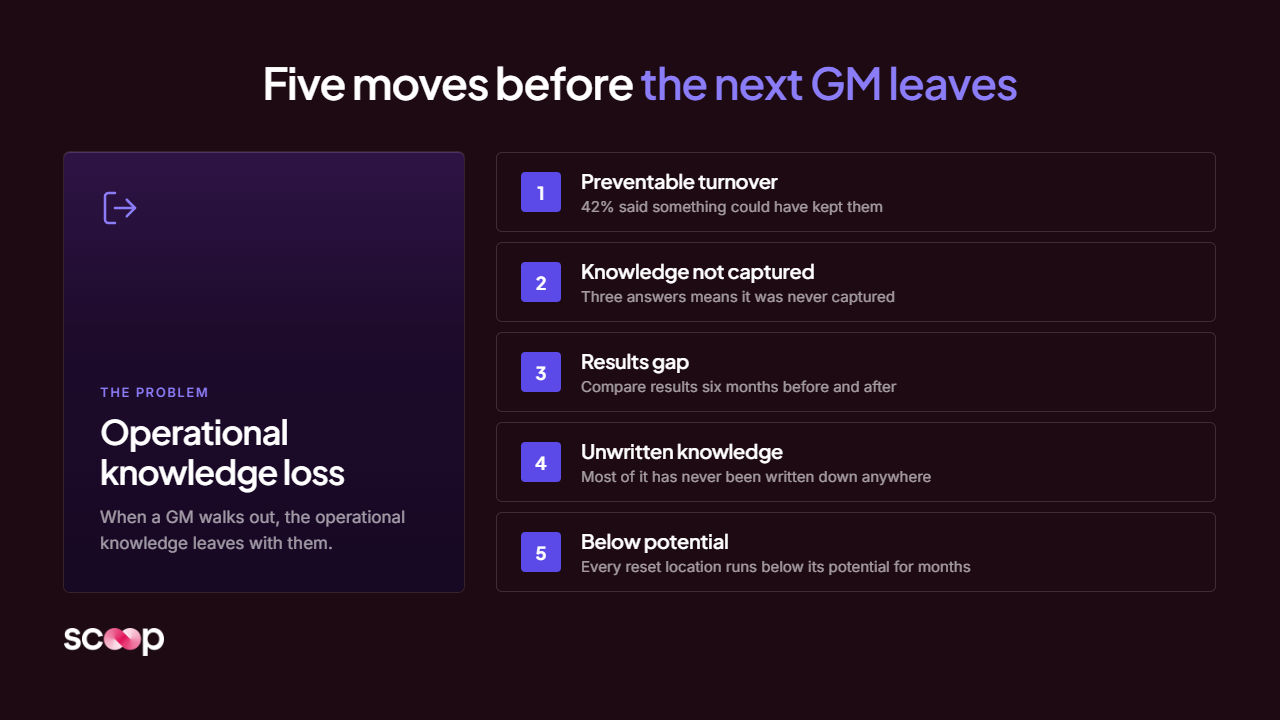
Find out where your operational knowledge lives before it leaves. Some turnover is preventable: Gallup found that 42% of employees who quit said their manager or organization could have done something to keep them. A lot of it isn't.
Five moves for this quarter:
- Name the five people whose departure would hurt most: Rank by what they know, not by title.
- Run the three-answer test: Ask three managers to define your most important internal term, your version of "out of balance" or "opportunity store." Three answers means it was never captured.
- Pull your last ten GM changes: Compare each location's results six months before and after. That gap is what knowledge loss costs you.
- Record one Monday review: Sit your best operator in front of last week's report and record every word. Most of it has never been written down anywhere.
- Decide what should run without them: Then build it, before a resignation letter makes the decision for you.
Step four is also where every Scoop implementation starts: a working session with your operators, then a pilot on your own data within weeks.
This isn't an HR project. It's the most direct lever on operational efficiency a distributed business has, because every reset location runs below its potential for months.
I told a retail consultant recently what I think the real job is: making sure whatever you build "continues to operate well after you're gone." That's what AI performance management means to me.
Not a better dashboard. A business that stops forgetting.
What do operators ask most about operational knowledge loss?
What is tribal knowledge in operations?
Tribal knowledge is the unwritten judgment experienced operators use to run a location: what they check first, which thresholds matter, which signals they ignore. It's built over years of pattern recognition and usually lives only in their heads. Scoop codifies tribal knowledge by recording how operators read their own reports and turning that into logic that runs at every location.
How long does it take a new manager to become productive?
In my experience, six to 12 months for a new GM or store manager in a multi-location business. Panopto's research found formal training averages 2.5 months but reaching full speed can take up to six, and that's in office roles with documented processes. The ramp usually shows up in your retail analytics as slow drift in labor, conversion, and comp sales at that one location.
How do franchise operators retain institutional knowledge?
Most rely on field ops consultants who carry best practices from unit to unit, which means the knowledge still lives in a handful of heads. The durable fix is capturing how your best consultant diagnoses a unit and running that diagnosis on every unit before the call. That's the core of franchise performance management: the call starts at what to do, not at how you got there.
Why does performance variance widen after a GM leaves?
The new manager inherits the data but not the interpretation, so decisions default to rules of thumb. Some of those decisions don't hit results for months, which is why the damage often shows up a quarter or two after the change, not the week after. Diagnostic analytics that runs every cycle catches the early signals instead of the lagging ones.
Can AI replace an experienced operator?
No, and it shouldn't try. AI can apply an operator's codified judgment to every location, every cycle, but it needs that operator to define the judgment and review what comes back. Human-in-the-loop AI is the model, because the whole idea is to scale people, not replace them.
One performance view across the whole portfolio.
Scoop gives operating partners a consistent performance view across every portfolio company, finding value creation opportunities without adding overhead to the deal team.
- Consistent portfolio view
- Value creation signals
- No added overhead
Get insights like this every week
Analytics, ops strategy, and product updates. No noise.
Book a discovery call
Reach out to start a two-way conversation about your industry, your performance variations across locations, and whether Scoop is the right fit for you.