
How do PE-backed roll-ups benchmark location performance when every clinic has a different tech stack?
Roll-ups with 23 different clinic systems can still benchmark every location. Brad Peters on why judgment, not software, is what needs standardizing.
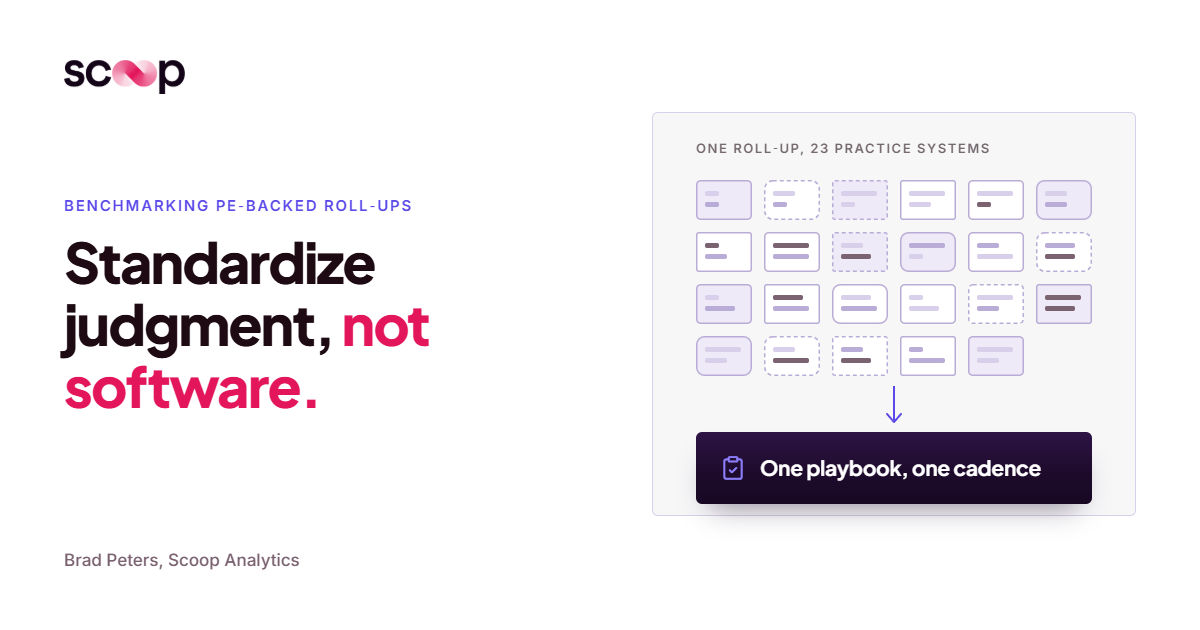
Benchmarking Roll-Up Locations Across Mixed Tech Stacks
PE-backed roll-ups benchmark location performance across a mixed tech stack by standardizing judgment, not software. That means one written playbook for how to read a clinic's numbers and one review cadence, applied read-only on top of whatever each clinic already runs. System consolidation can continue in parallel. It just should not be the gate.
I recently sat in on a call with the founder and CEO of a PE-backed medical aesthetics roll-up. He has been operating clinics under private equity ownership for most of a decade.
He told us that at one point his company was running 23 different practice management systems at the same time. Every clinic named its fields differently. The mapping, in his words, was "just a disaster."
I've spent most of my career building analytics platforms, and I'll give you my honest take. The tech stack problem is real. It's also the wrong place to spend most of your energy, and it's the same trap behind a lot of the value add in private equity that never shows up in the numbers.
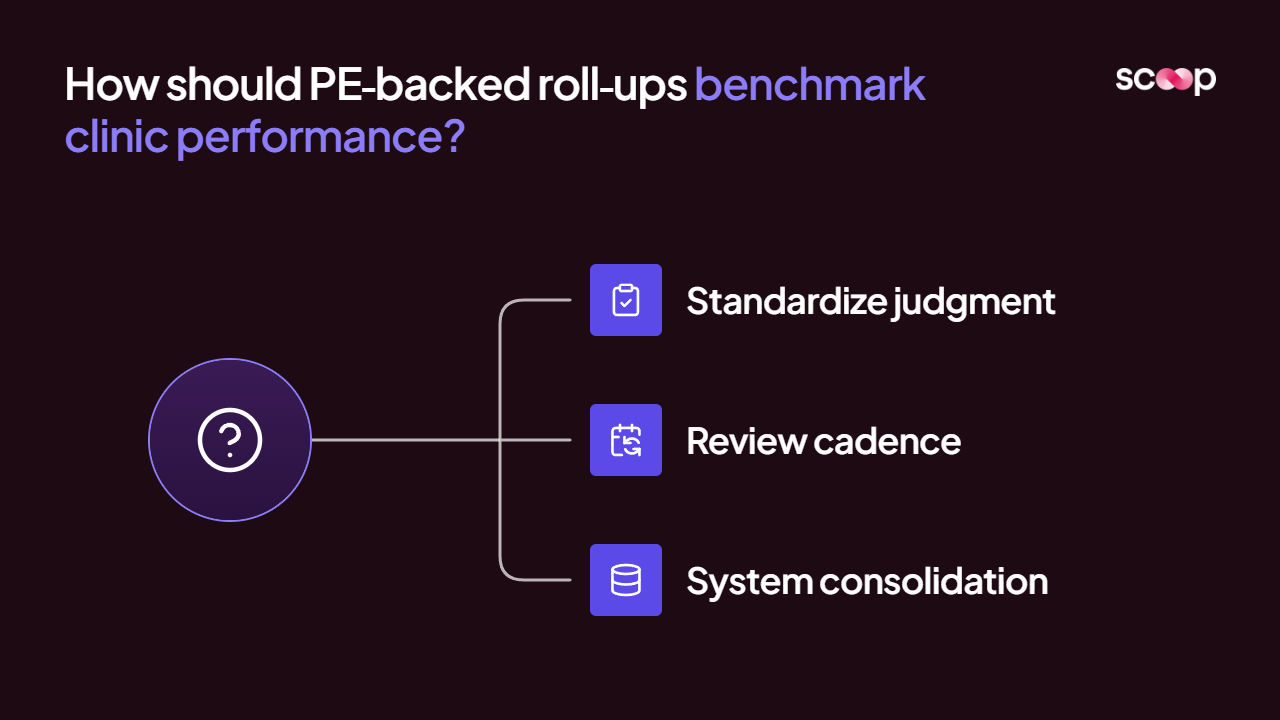
Why does a mixed tech stack make benchmarking so hard?
It breaks the comparison before anyone looks at a number. When 23 systems each define a visit, a provider, a treatment, or a rebooking slightly differently, "clinic 4 versus clinic 19" is no longer apples to apples.
Here is how that founder explained why his sector has it worse:
"In the dental space, it's easy. There are, like, two to three practice management systems that everybody uses. For something like ours, it's a smaller industry, so there was never anybody who rose to [the top]. So we had, at one point, 23 different practice management systems."— Founder and CEO
The numbers back him up:
- Dental is concentrated: Dentrix alone is used by more than 35,000 practices, with an estimated 25 to 30% share of the US market.
- Aesthetics is fragmented: The American Med Spa Association counted 10,488 med spas in 2023. 81% are single-location, and only 3% are owned by private equity.
- Every acquisition is a new stack: When the target is a single-location independent, it arrives with its own software, its own naming conventions, and its own idea of what "good" looks like.
Built for the businesses that run everywhere at once.
Scoop exists to bring best-in-class operational diagnostics to every distributed business, not just the ones big enough to staff a team for it. Meet the people building it.
- Operator-first by design
- Built for distributed teams
- Diagnostics, not dashboards
Why isn't system consolidation the answer?
Because it takes longer than the thesis can wait. Consolidating systems is the right long-term move. Making it the precondition for benchmarking is where roll-ups get stuck.
My cofounder Neil heard the conventional view from an operating partner who has worked inside two large PE firms.
His first order of business on any roll-up: put proper systems in, an ERP, a CRM, clean data. Only then would he layer anything on top. "This would come after, right?"
I understand the instinct. Here is the math that worries me:
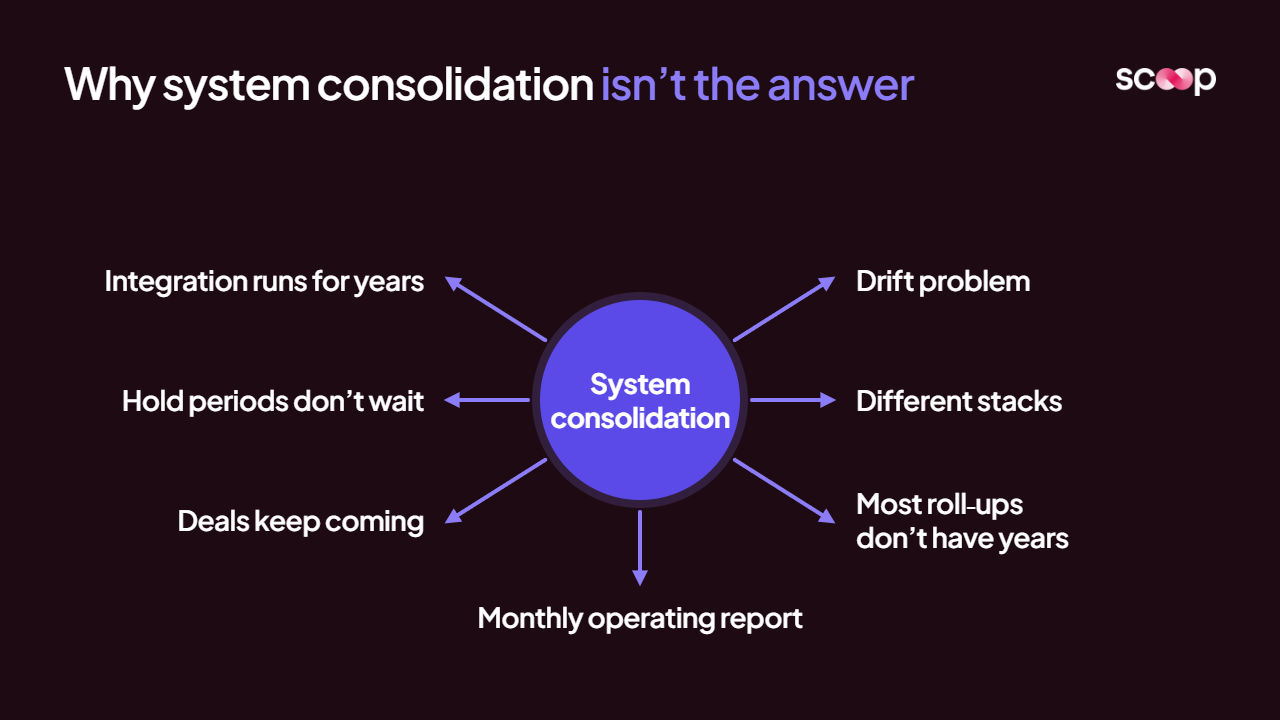
- Integration runs for years. BCG lays out post-merger technology integration in three horizons, and the last one runs from years two or three out to years four and five.
- Hold periods don't wait. That same operating partner put a typical exit window at three to five years, and admitted it is often longer now.
- The deals keep coming. Add-ons made up 74.1% of US PE buyouts by count in Q3 2025, according to PitchBook. Every add-on resets the harmonization clock.
The founder I spoke with has gotten there. His team chopped 23 systems down, built the pipeline, and now produces a monthly operating report with commentary. "It's taken us years to get there," he said.
Most roll-ups don't have years, and most don't have his team.
The pattern is not unique to clinics. HVAC, car wash, restaurant, and retail roll-ups all inherit a different stack with every deal. The question is the same: do you wait for the plumbing, or do you start managing the business?
While the migration runs, each clinic keeps operating its own way. That is the drift problem every multi-location operator fights, and a roll-up starts with more of it than anyone.
What does consistent location benchmarking actually require?
It requires the same standard of judgment applied to every location, every cycle. Not the same software. That is the distinction I'd ask every operating partner to sit with.
Judgment standardization comes down to four things:
- A shared definition of good: What a healthy clinic looks like on labor, provider productivity, rebooking, and same-store revenue.
- Shared thresholds: At what point a gap becomes a flag, and when a flag becomes an escalation.
- A shared cadence: Every clinic reviewed every cycle, not just the ones someone has time for.
- A shared response: The same playbook for what a district manager does when a specific flag shows up.
A shared dashboard doesn't get you there. It's the reason dashboards don't work for most multi-location operators: they show what happened and leave the reading to whoever opens them.
That founder said something on our call that stuck with me: "A lot of organizations don't know how poorly they're doing this, or don't know what good looks like." That is a judgment gap, not a data gap.
It also matters for the return. Bain found that buy-and-build deals relying on multiple arbitrage alone averaged a 1.4x MOIC, while those with a strategic rationale behind margin improvement averaged 2.2x.
Operational improvement is the thesis. You can't improve what you can't consistently read.
Where does the judgment gap show up in a roll-up?
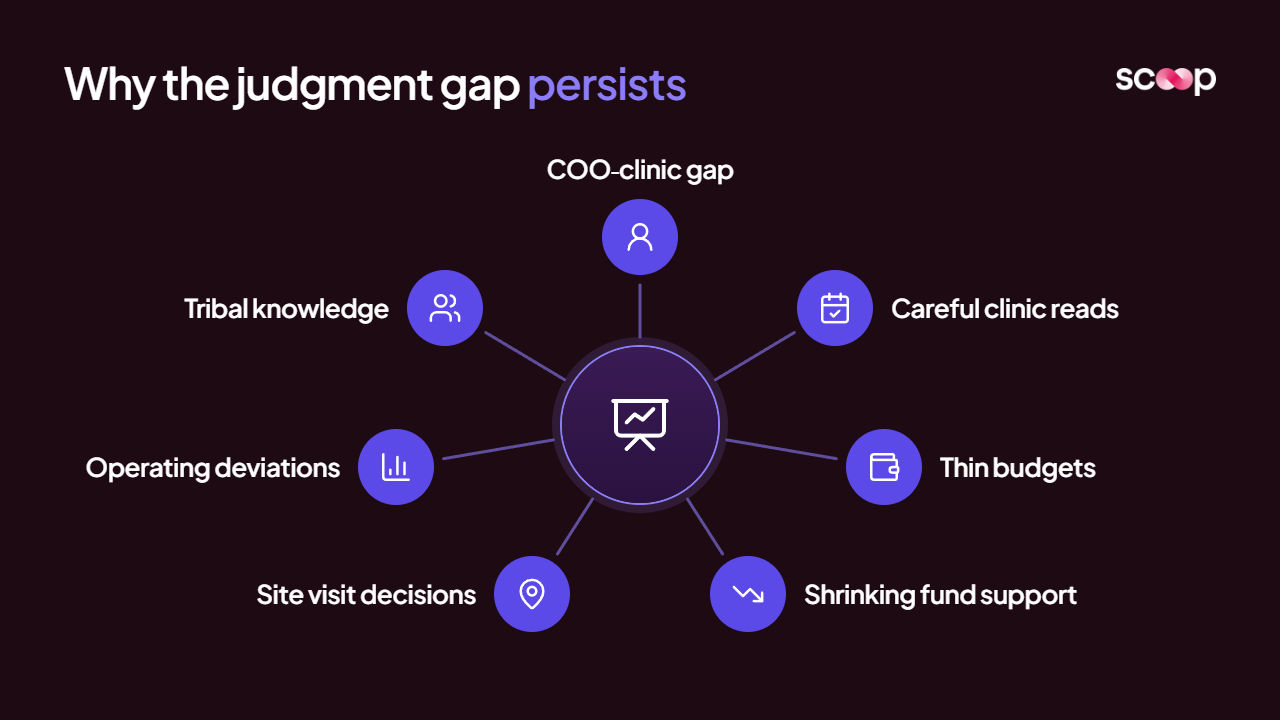
It shows up between the COO and the clinic. The COO can look at a location and know what's wrong. The district managers in between are still eyeballing individual clinic reports.
The same founder gave a perfect example. Before closing one acquisition, his team looked at the clinic's numbers and saw it carrying 40% more labor than it should have had. They told the owner the deal would require bringing labor down before close, because every new dollar of revenue was getting its margin compressed.
That is exactly the read you want on every clinic, every month. Here is why it usually doesn't happen:
- The math doesn't work. A 30-clinic platform on monthly reviews needs 360 careful clinic reads a year. The COO is not doing 360 of anything.
- Budgets are thin. He pointed out that when each location only produces around $300,000 a year in earnings, you have to roll up 30 of them to build something meaningful, and there is little left over for central analytics.
- Fund support is shrinking. He described smaller funds, and big funds acting like small ones, that no longer provide the data scientists their portfolio companies used to lean on.
Someone building portfolio analytics at a healthcare-focused PE firm described the job he's trying to do to Neil: understand how clinic one is performing versus clinic 23, decide "what are the six site visits I need to go do this week," and know what is driving the problem before he walks in.
Even if you have one central person watching macro trends, nobody is looking at the individual operating deviations of each clinic and where each one specifically could be better. The tribal knowledge that spots a labor problem sits with a handful of senior people.
How do roll-up operators standardize performance review without replacing source systems?
They capture how their best operator reads the business, then run that logic on top of the data they already have. That's what we built Scoop to do.
The capture is hands-on. Our team sits with the COO and senior operators while they walk through their reports. The way I describe it: "If I took a tape recorder and recorded everything you thought as you looked at the BI and described your analyses, can we then stick that into the system so it could go do that on your behalf?"
Neil puts it more simply: Scoop encodes a COO's judgment on how to run the business, using the dashboard data that already exists, for every location.
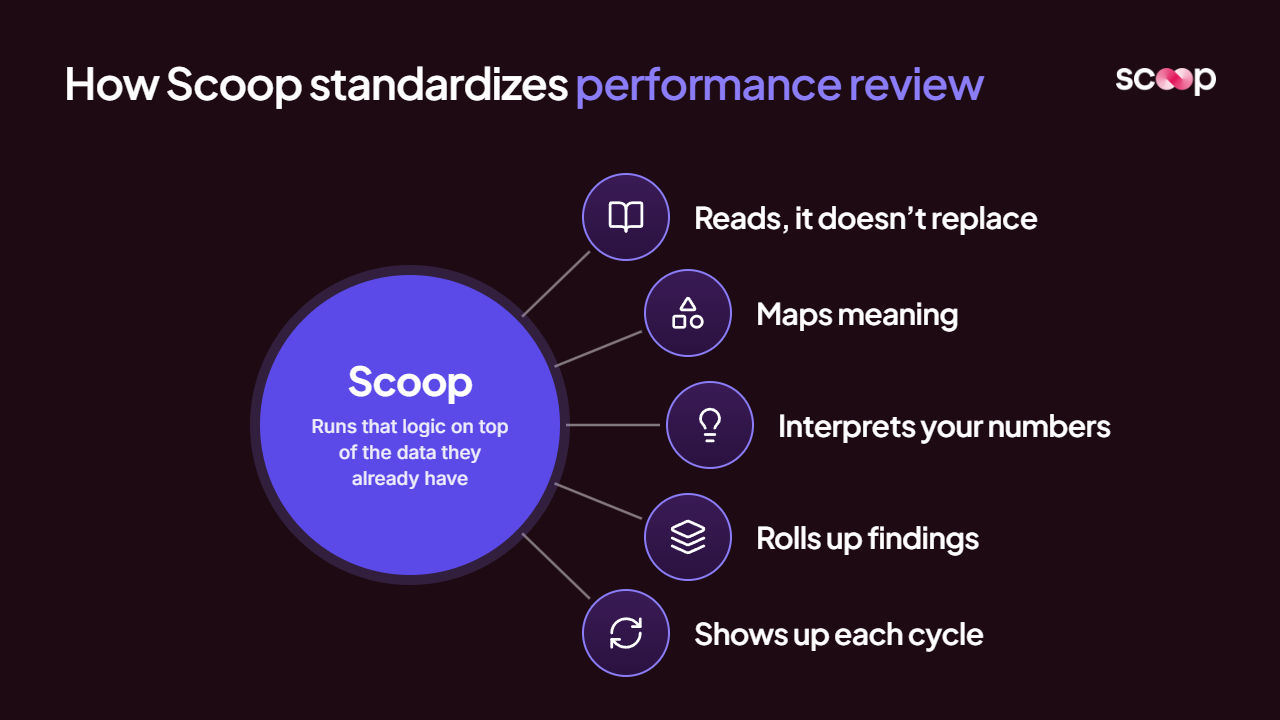
Here is what that means for a roll-up with a mixed stack:
- It reads, it doesn't replace: Scoop works read-only from your existing BI tools and warehouse. It doesn't write back, and nobody rips out a practice management system.
- It maps meaning, not everything: A semantic layer maps what each clinic's fields mean against the playbook. AI makes that matching far easier than it was three years ago, which the founder confirmed: "Acquisitions three years ago look different than they do now."
- It interprets your numbers: Scoop doesn't compute the figures. Your systems produce them. Scoop reads them the way your COO would, running 50 to 70 diagnostic drill-downs per location, with the AI choosing where to look next.
- It rolls up: Findings go from clinic to region to platform, so the operating partner and the clinic director see the same story at different altitudes.
- It shows up: A report arrives each cycle with what changed, why, and what to do. Nobody logs in.
What should an operating partner do in the first 90 days after an acquisition?
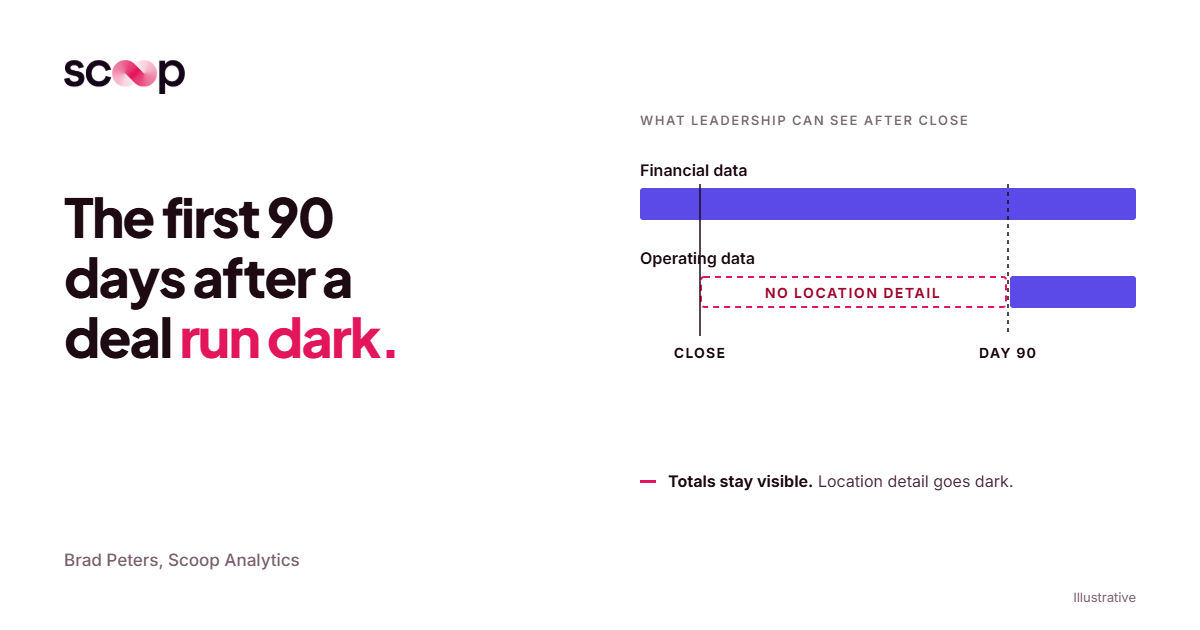
Start the review on day one, and let the systems catch up. The founder said the heavy mapping lift happens in the first 90 days, with financial integration starting before close and operating metrics following once the clinic's system is connected.
Use that window differently:
- Write down the playbook first. What does your best operator check first on a new clinic? Labor, provider productivity, rebooking, same-store trend? Capture it before the next deal closes.
- Map only what the playbook reads. You don't need every field from every system. You need the handful your operating standard depends on, mapped consistently.
- Benchmark at the provider level too. That roll-up sends every injecting provider a monthly pulse report on how they're doing against the mean. Clinicians are competitive. Peer comparison is something they ask for.
- Put every clinic on the same cadence. New acquisitions enter the same review cycle as the clinics you've owned for five years.
- Consolidate systems on their own timeline. Keep the migration plan. Just stop making the operating review wait for it.
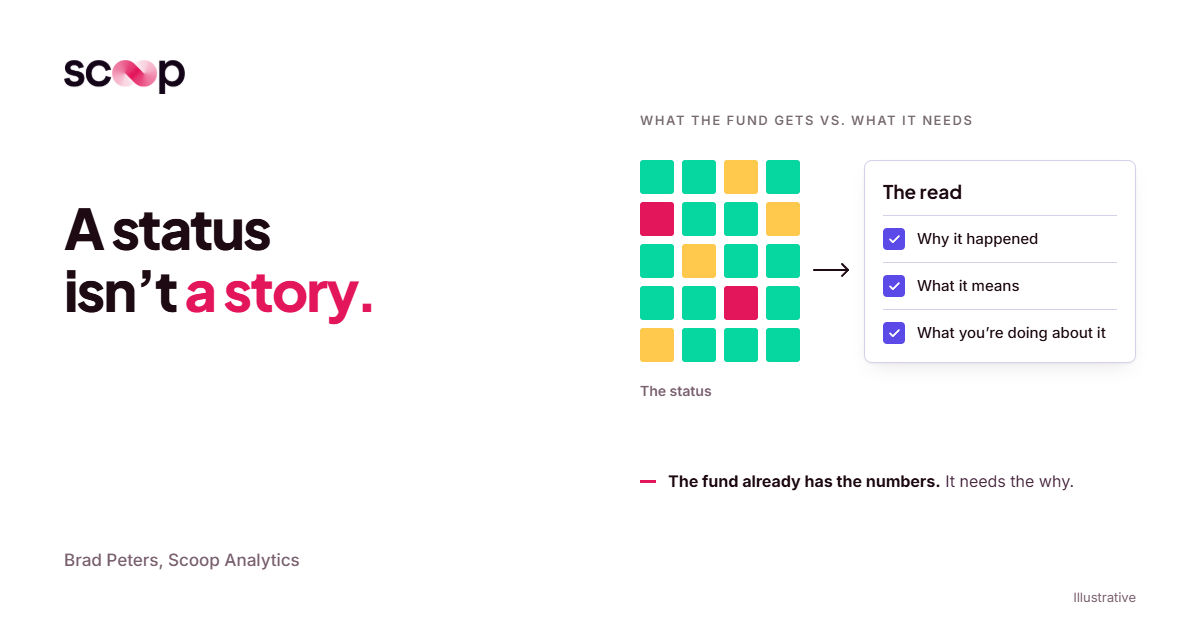
Scoop scales your operating playbook to every clinic this way, with a working pilot in as little as four weeks. That changes the conversation with the fund, too. Instead of a red, yellow, or green status, the monthly report explains why a clinic moved and what the team is doing about it.
The systems will get standardized eventually. The judgment can be standardized now.
Every location diagnosed. Every cycle.
Scoop is AI performance management for distributed businesses. It diagnoses performance at every location, every cycle, and hands every manager a clear action plan.
- Every location, every cycle
- Role-specific action plans
- No prompting required
Frequently asked questions
Can you benchmark locations before data is fully normalized?
Yes. You need the fields your operating playbook depends on mapped consistently, not a fully harmonized data estate. Clinics can enter the same review standard while their source systems are still being migrated, and the operating partner's portfolio visibility improves from the first cycle.
What metrics matter most for clinic-level performance in a PE roll-up?
The ones your best operator already checks, which is exactly the operational knowledge a roll-up loses when that person leaves. In the aesthetics roll-up described here, the review covers:
- Labor relative to revenue, the line that flagged a 40% overage before one close
- Same-store performance against the rest of the platform
- Each injecting provider's results against the mean
How long does it take to get consistent benchmarks across acquired locations?
On the traditional path, the founder put the heavy mapping lift for a new clinic at roughly the first 90 days. With judgment standardized on top of existing data:
- A working pilot can run on a four-week implementation timeline.
- Each new acquisition joins the same review cycle once its key fields are mapped.
- System migration continues on its own schedule.
Does this replace our BI tools or practice management systems?
No. Scoop sits on top of your existing practice management systems, warehouse, and BI tools and reads from them. It adds the interpretation and action layer, which is why it pairs with whatever existing BI stack each clinic already has:
- Read-only access, no write-back
- No data migration or rip-and-replace
- Reports delivered automatically each cycle
Get insights like this every week
Analytics, ops strategy, and product updates. No noise.
Keep reading
What happens to operational visibility in the 90 days after an acquisition?
The Red/Yellow/Green Trap: Why PE Operating Reports Need a Story, Not a Status

How do PE operating partners get real-time visibility into portfolio company performance?
Book a discovery call
Reach out to start a two-way conversation about your industry, your performance variations across locations, and whether Scoop is the right fit for you.