
Why is this store down? A five step check
Any ops leader can list why a store might be missing plan. The hard part is checking the list in the right order, before the cause moves on. Here is the order that gets to the root cause fastest.
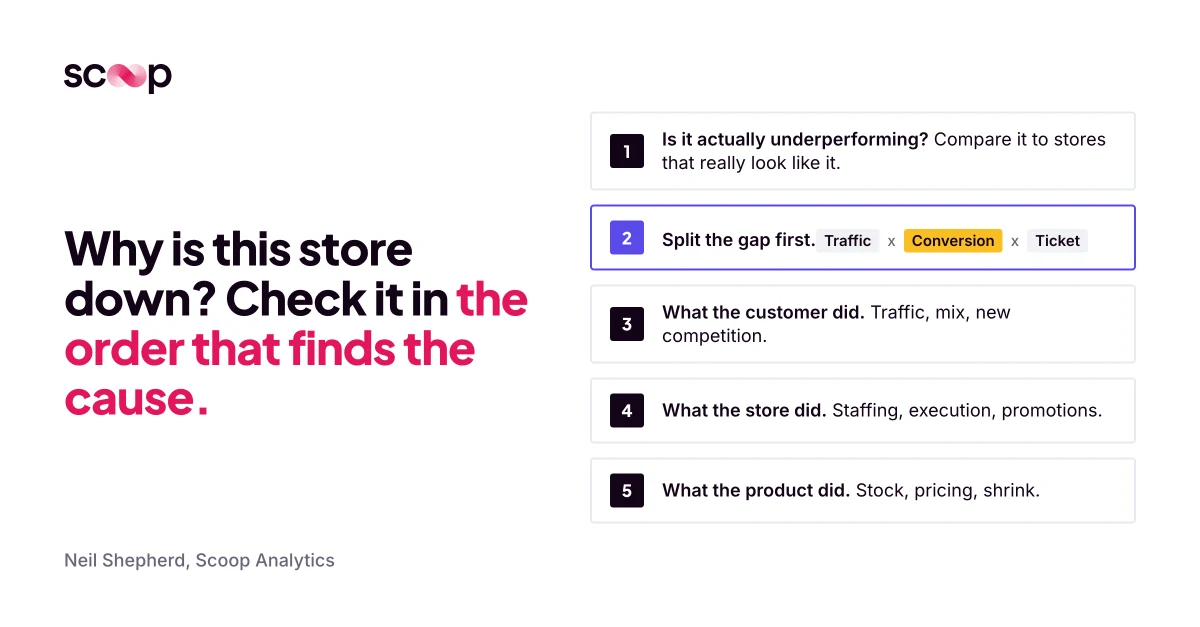
Ask any good ops leader why a store is missing plan and you'll get the list in about five minutes: staffing, inventory, pricing, a promotion that didn't land, a new competitor, execution on the floor. Nobody needs a consultant for the list. What makes the difference is checking it in the right order, so you get to the root cause before the moment to act has passed.
A strategy leader at a $12 billion multi location chain put it well: "It is usually death by 1,000 cuts. A lot of small things, not one or two really big things." In most soft stores it's three or four causes at once. Here's the order that gets there fastest.
1. Is it actually underperforming?
Compare the store to peers that genuinely look like it: the same format, a similar trade area, a similar mix. Plan and last year tell you it's down, not whether it's underperforming. A store that was understaffed last year looks fine against itself.
2. Split the gap before anything else
Sales are traffic times conversion times average ticket. Knowing which one moved cuts the list in half. Fewer people coming in points one way; the same people buying less points somewhere very different.
3. What the customer did
Traffic, a shift in customer mix, new local competition. Check traffic against peer stores in the same weeks before blaming the store. If the whole trade area is down, the store may be doing fine.
4. What the store did
Staffing, execution on the floor, how a promotion was run. This is usually where conversion breaks. In Zipline's 2026 survey of 227 retail leaders, insufficient staffing was the top cause of failed store execution, cited by 51%, and only 36% said most initiatives are executed correctly and on time.
5. What the product did
Inventory mix, supply timing, pricing, shrink. Don't take the system's stock number at face value. In one study of nearly 370,000 store inventory records, 65% didn't match what was physically there, so a store can look fully stocked on paper while the shelf is empty.
The list is easy. The cadence is hard.
None of this is difficult for a good analyst. It's slow. In our experience a thorough manual diagnosis takes two to four weeks once you count pulling the data and chasing the questions it raises, and a senior analyst can do a proper job on three to five stores a week. So the diagnosis gets rationed to the stores already in obvious trouble, and by the time the answer arrives the cause has often moved on.
The judgment to run this check already exists in most chains. The opportunity is to run it on every store, every cycle, and hand each manager a short brief: what's off, the likely root cause, and what to do this week.
The obvious next question is whether the fix worked, which is where most store programs quietly fall down. That's the next piece.
Which of these steps does your team usually skip?
Get insights like this every week
Analytics, ops strategy, and product updates. No noise.
Keep reading
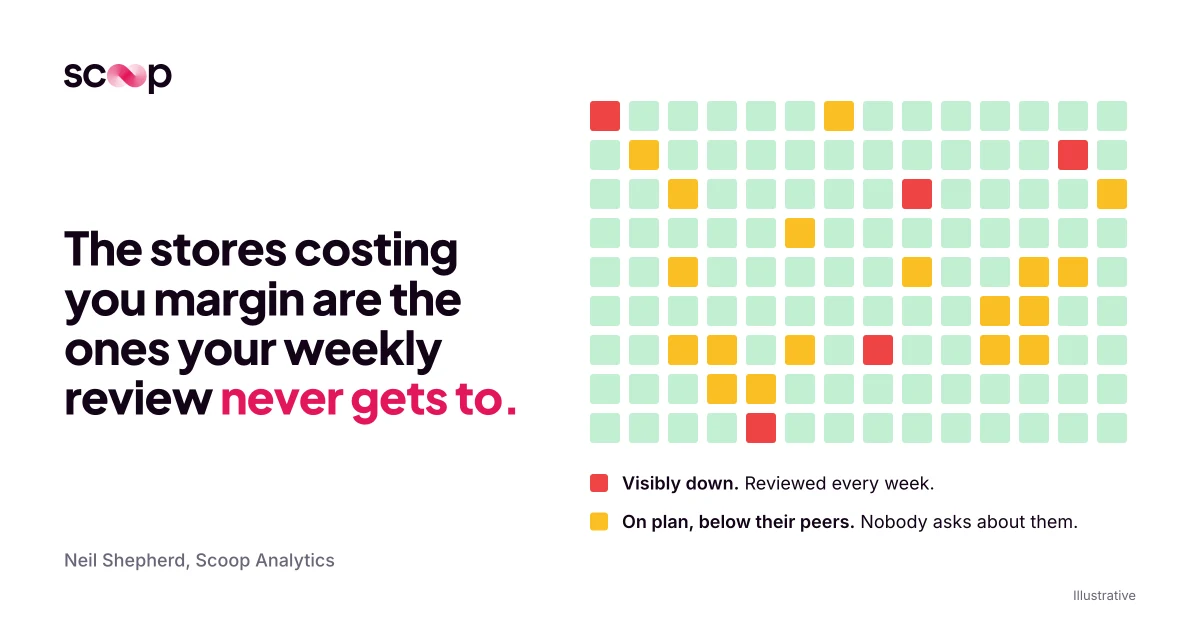
The stores costing you margin are the ones your weekly review never gets to

Why Retail Store Diagnostics Take So Long

5 Dashboard Blind Spots a Multi-Store Retail COO Showed Me This Week
Book a discovery call
Reach out to start a two-way conversation about your industry, your performance variations across locations, and whether Scoop is the right fit for you.