CDP vs. CDM: The Analytics Your Customer Journey Needs
The Origin of a Better Solution
Fast forward to today, and the same need exists—only amplified by scale, technology, and competition. Businesses are swimming in tools and data but still lack a clear, actionable picture of the customer journey. And this is where the debate begins:
Do you need a Customer Data Platform (CDP), or do you need something smarter—Customer Dialog Management (CDM) powered by analytics?
Let’s dive into what this means, why CDPs fall short, and how forward-thinking businesses can revolutionize their approach to understanding customers.
1. What’s a CDP and Why Does It Fall Short?
A CDP—Customer Data Platform—is built to centralize and unify customer data. Think of it as a massive, complex data hub that pulls information from various sources (CRM, web analytics, marketing automation tools, etc.) and creates a “single customer view.”
At its core, a CDP:
- Matches and cleans up disparate customer data.
- Creates unified profiles for marketing execution.
- Allows you to trigger automated campaigns based on pre-defined rules.
The problem? CDPs are static. They centralize your data but don’t tell you anything about the journey.
As I’ve said before: “The CDP really is just a data thing. It’s hooking up wires and seeing what comes out. But it’s not doing any analysis.”
A CDP alone can’t answer critical questions like:
- What influences customers to convert from one state to another?
- Why do some customers drop off at Stage B while others progress to Stage C?
- How do you measure and improve the entire customer journey over time?
To address these questions, you need more than a CDP. You need analytics that map, measure, and analyze the customer’s state at every step.
2. Introducing CDM: A Smarter Way to Understand the Journey
Customer Dialog Management (CDM) takes the foundational idea of a CDP and transforms it into something actionable. It’s not just about storing data—it’s about analyzing and snapshotting your customers’ journey over time.
Here’s how CDM works:
- Map the Customer Journey: Every interaction is tracked and tied to a customer “state” (e.g., Lead Created → Qualified → Engaged → Closed Deal).
- Snapshot States Over Time: Unlike static data platforms, CDM snapshots where customers are in their journey every day.
- Analyze Changes and Transitions: By comparing customers who moved from State A to State B, you can pinpoint why they progressed—or why they stalled.
- Influence the Journey with Insights: With analytics, you can refine your strategies, messaging, and targeting to guide customers toward conversion more effectively.
Imagine this: You can look back at a customer’s journey and identify exactly what worked—a webinar they attended, a sales call they received, or a marketing email they clicked. Then, you can answer the holy grail of marketing and sales: What moves customers forward, and why?
3. CDP vs. CDM: Key Differences
To break it down further, here’s how CDPs and CDMs differ:
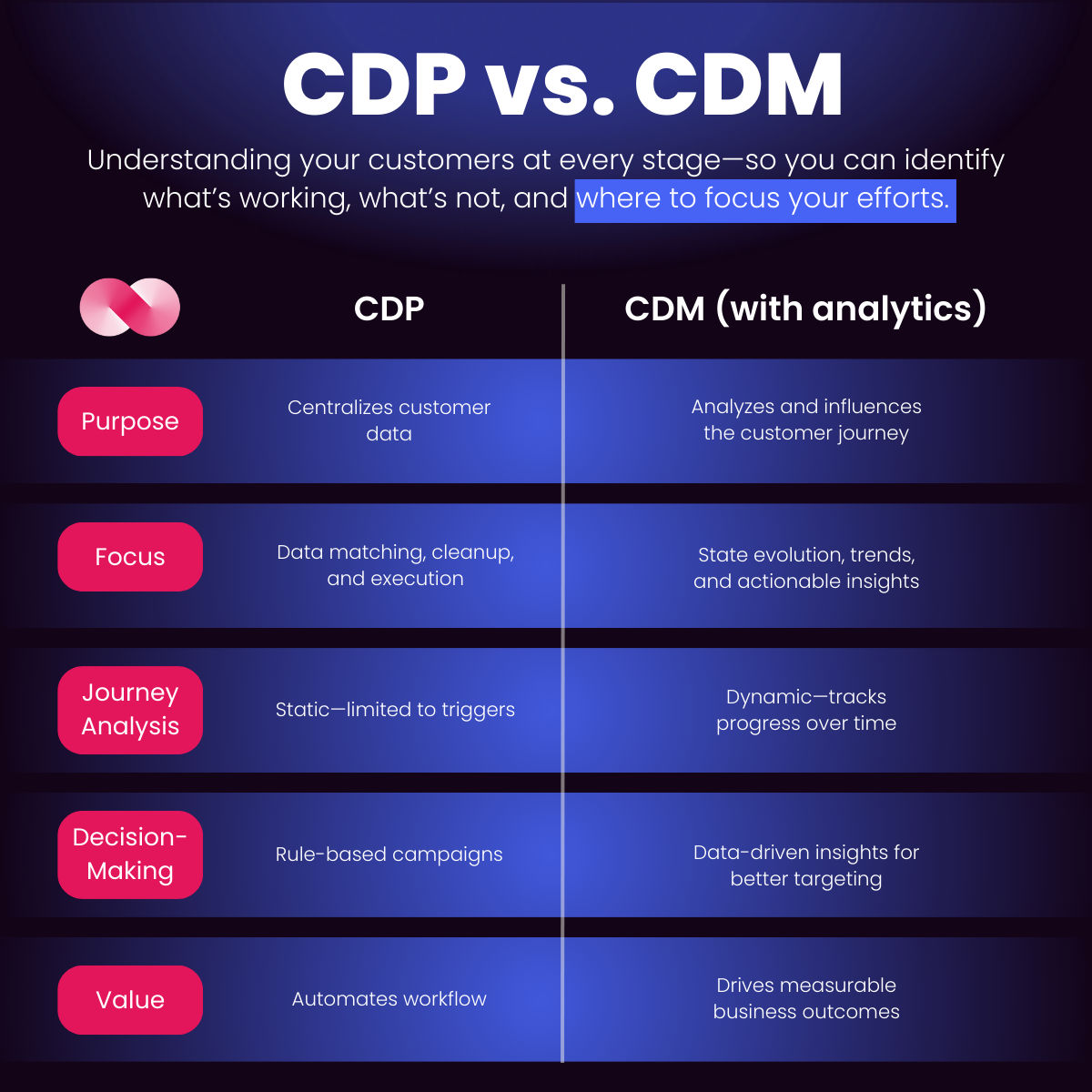
With a CDP, you’re managing data. With CDM, you’re managing the dialog with your customers—understanding their journey and improving it with real-time analytics
4. Why Analytics is the Core of Customer Dialog Management
At the heart of CDM is analytics. A CDP tells you who your customers are, but analytics tells you:
- Where they’ve been.
- Where they’re headed.
- What you can do to influence their next step.
For instance, let’s say you’re in Marketing Ops. You’ve spent time and budget driving leads through campaigns. With a CDM approach, you can:
- Tie cost data (spreadsheets, marketing automation tools) to campaign performance.
- Snapshot leads at every touchpoint: first email, webinar registration, product demo.
- Analyze why leads in State A converted to State B.
This isn’t just about visibility—it’s about accountability. Marketing teams have to prove their value to non-marketing leaders. You need to tie spend to results, and a lightweight analytics approach makes that possible without crazy amounts of money or effort.
5. How Scoop Revolutionizes Customer Dialog Management
Here’s the reality: Building a traditional CDP is expensive, time-consuming, and still doesn’t give you what you need. Scoop changes the game by combining:
- Data Integration: Connect customer data across CRMs, marketing tools, and financial data sources.
- State Snapshotting: Automatically track customers’ states at any point in time.
- Powerful Analytics: Identify trends, measure journey progress, and understand what drives conversion.
Whether you’re in Revenue Ops, Marketing Ops, Sales Ops, or Finance, this lightweight approach means you don’t need a massive infrastructure to gain clarity. You get actionable, real-time insights that help you drive results faster.
The Future of Customer Analytics
The future of business intelligence isn’t just about data. It’s about insights, action, and dialog. CDPs gave us a foundation—but the future lies in Customer Dialog Management powered by analytics.
With CDM, you’re not just storing data; you’re understanding customers, influencing their journey, and proving the value of your efforts.
Why stop at a CDP when you can have the full picture? Understanding the customer journey—every state, every touchpoint, and every decision—is the key to driving smarter business outcomes.
At Scoop, we’re redefining what’s possible for teams that want to make data actionable. It’s time to go beyond static tools and start building dynamic, data-driven customer dialogs that transform the way you work.
Read More:
- 5 Steps to Building a Lightweight CDP for Your Team
- Data Analysis Challenges: What I Learned from a Customer Success Analyst This Week
- The Top Customer Success Signals You’re Missing—And How AI Analytics in Slack Finds Them First
- What Happens When Your Customer Data Can Talk Back?
- Why Customer Usage Drops: Pattern vs. Metric