
What Is a Customer Data Platform (CDP)? A Complete Guide
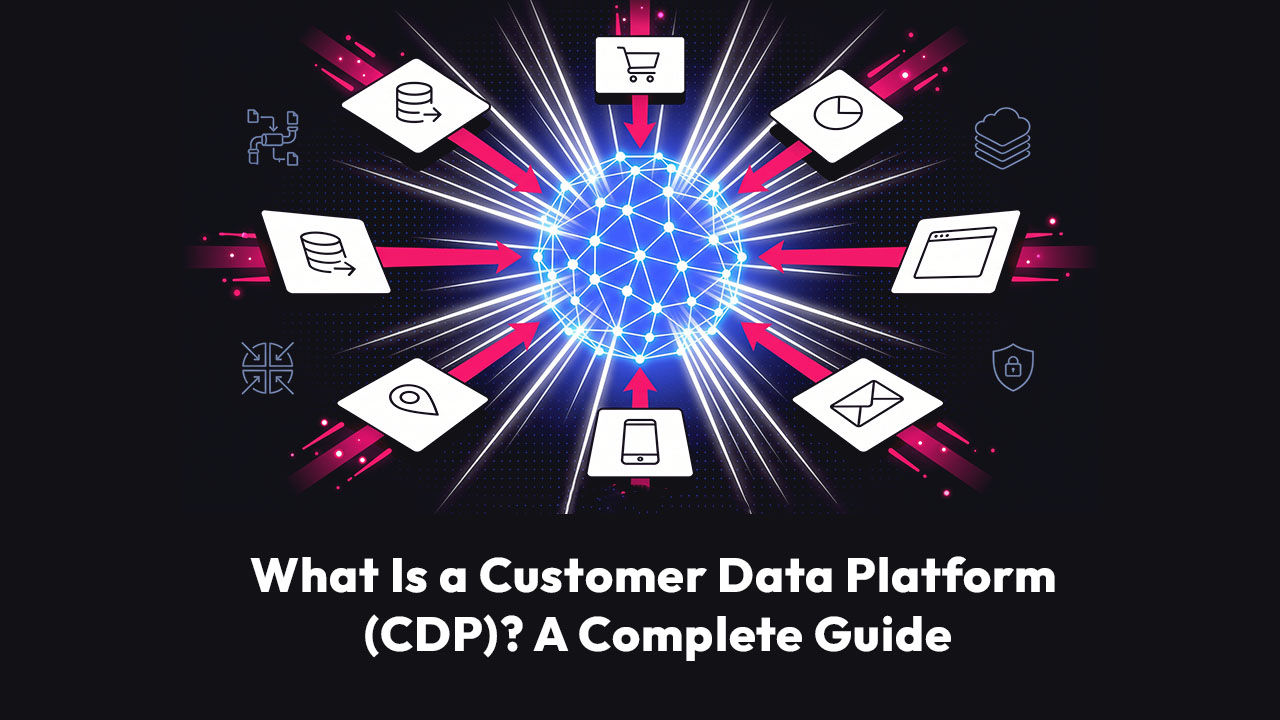
A customer data platform (CDP) is software that collects customer data from every source your business uses, unifies it into a single profile per person, and makes that data available for analysis, segmentation, and action — in real time, without engineering support.
Why Does This Topic Keep Coming Up?
Because most businesses are drowning in data and starving for insight.
Your CRM knows who bought. Your email tool knows who opened. Your ad platform knows who clicked. But none of them talk to each other — and your team is left stitching spreadsheets together at midnight trying to figure out what's actually happening.
"Unifying customer data from different marketing and advertising systems is the only way brands will be able to eliminate blind spots and make every customer interaction matter."— Rob Tarkoff, EVP, Oracle Cloud CX
That's the exact problem a CDP was built to solve.
Try It Yourself
What Is a Customer Data Platform (CDP)?
The term was coined by analyst David Raab in 2013. The CDP Institute defines it as:
"Packaged software that creates a persistent, unified customer database accessible to other systems."
Gartner expands on this:
"A marketing technology that unifies a company's customer data from marketing and other channels."
In plain terms: a CDP takes the fragmented data living across all your tools and builds a complete, always-updating picture of every customer.

Three things every CDP must do:
- Collect — Ingest data from every source: CRM, email, website, ads, point-of-sale, social
- Unify — Resolve identities across sources into one persistent customer profile
- Activate — Make those profiles available for campaigns, analytics, and AI decisions
How Is a CDP Different From a CRM or DMP?
This is where most people get confused. Here's the quick breakdown:
Quick Comparison
CDP vs. CRM vs. DMP — What's the Difference?
Three tools that handle customer data — but for very different purposes.
| Feature | CDP | CRM | DMP |
|---|---|---|---|
| Primary Purpose | Unify all customer data for analysis and activation | Manage sales relationships and interactions | Target anonymous ad audiences |
| Data Type | First-party, behavioral, transactional, demographic | First-party (known contacts only) | Third-party, anonymous |
| Identity | Persistent, cross-device profiles | Known contacts (email, phone) | Cookie-based — expires in ~90 days |
| Real-Time | ✓ Yes | ⚡ Limited | ⚡ Near real-time (bidding) |
| AI Capabilities | Segmentation, prediction, decisioning, autonomous agents | ⚡ Basic lead scoring | Lookalike modeling only |
| Privacy Impact | ✓ Minimal — first-party | ✓ Minimal | ✗ High — cookie deprecation |
| Primary Users | Marketing, analytics, ops, AI teams | Sales, customer service | Advertising teams |
| Example Vendors | Salesforce Data Cloud, Adobe RT-CDP, Treasure Data | Salesforce CRM, HubSpot | Oracle BlueKai (sunset), Lotame |
Want to go deeper? Explore what is business intelligence or see Scoop in action.
"A CRM is designed for sales. A CDP is designed for the full customer picture — including behavior your sales team never sees."
The simplest way to remember it: your CRM knows what your team did with a customer. Your CDP knows what the customer actually did.
What Data Does a CDP Work With?
A CDP is built to handle the full range of customer data types:
- Behavioral data — page views, clicks, session duration, app usage
- Transactional data — purchases, returns, order history
- Demographic data — name, location, firmographic details
- Campaign data — email opens, ad impressions, conversion events
- Customer service data — support tickets, NPS scores, chat transcripts
"The most reliable customer data is first-party data — collected directly from your customers' own interactions. It's more accurate, more compliant, and fully under your control."
Most enterprise CDPs today prioritize first-party data as third-party cookies phase out and privacy regulations like GDPR and CCPA tighten across the globe.
How Does a Customer Data Platform Work?
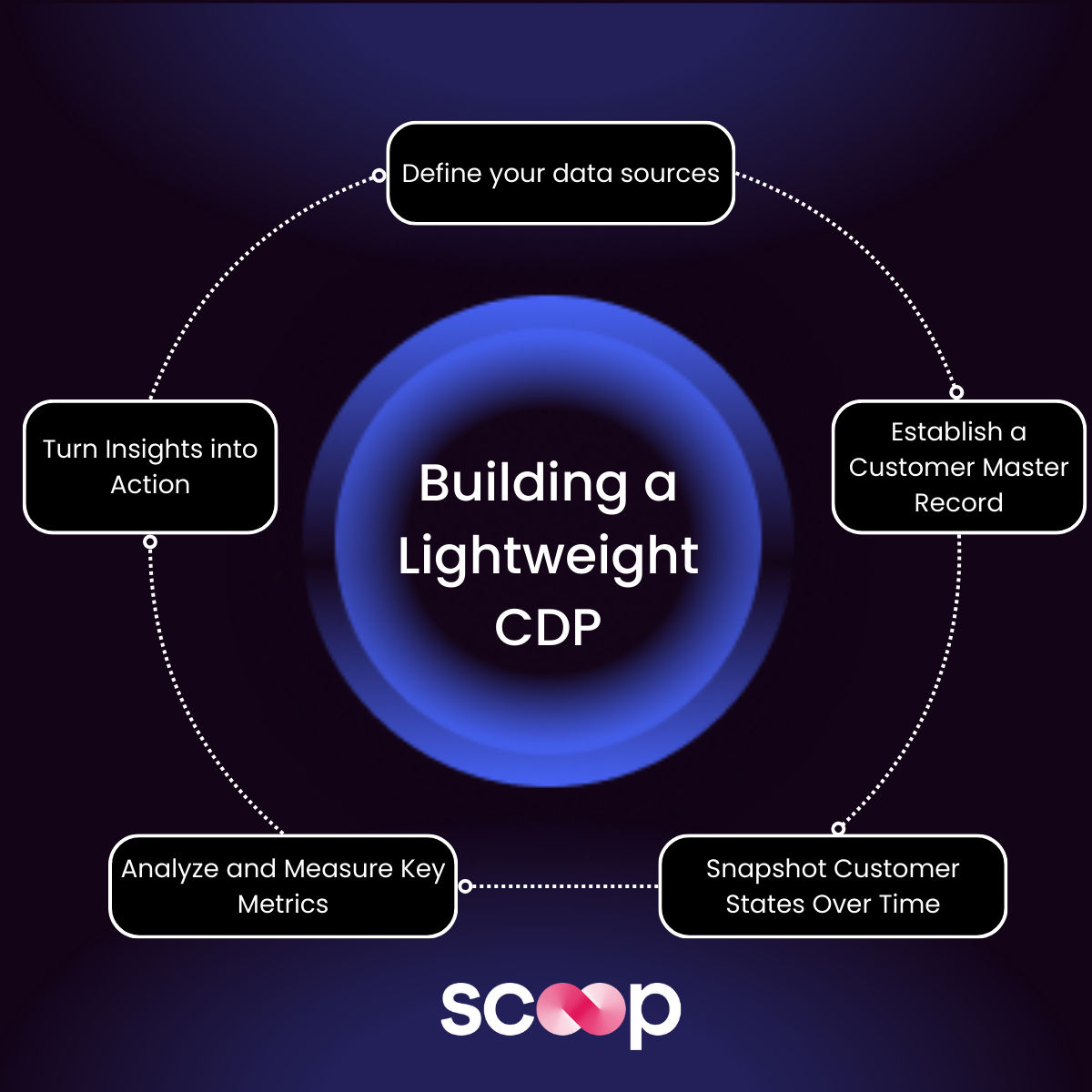
Think of it as a four-stage loop:
1. Ingest
The CDP connects to every system generating customer data — your CRM, email platform, ecommerce tools, analytics stack, and more. Data flows in continuously through APIs, SDKs, and native connectors.
2. Unify
Raw data arrives with different identifiers — email addresses, device IDs, loyalty numbers, cookie IDs. Identity resolution stitches these into a single persistent customer profile using:
- Deterministic matching — exact identifier matches (same email = same person)
- Probabilistic matching — behavioral patterns and fuzzy logic for anonymous sessions
3. Decide
This is where CDPs diverge. Basic platforms let marketers build manual rule-based segments. Advanced CDPs apply machine learning to determine the optimal action for each customer automatically — including predictive analytics like churn likelihood, purchase probability, and lifetime value scoring.
4. Activate
Profiles are pushed to your engagement tools — email, SMS, paid ads, personalization engines — so every message is based on the complete picture, not a fragment of it.
"When the collect → unify → decide → activate loop runs in seconds inside a single platform, the CDP becomes a learning system. Each interaction makes the next one smarter."— CDP Institute, 2026
What Are the Key Benefits of a CDP?
For Marketing Teams
- Build precise audience segments without waiting for IT
- Personalize campaigns based on real behavioral history
- Measure true attribution across every channel
- Suppress existing customers from acquisition spend
"Brands using CDP-driven personalization typically see 15–30% higher email revenue compared to batch-and-blast campaigns."
For Ops and Analytics Teams
- One source of truth for every team: marketing, sales, customer success, finance
- Eliminate hours spent reconciling reports from different systems
- Surface patterns that siloed data would never reveal
For Executives
- Understand the complete customer journey — from first touchpoint to renewal
- Make investment decisions based on unified, accurate data
- Reduce the cost and risk of fragmented data infrastructure
Common CDP Use Cases
Here's what teams actually use CDPs for day to day:
- Customer segmentation — Group customers by behavior, value tier, churn risk, or lifecycle stage
- Omnichannel personalization — Deliver consistent, relevant messaging whether someone is on your website, in your app, or walking into a store
- Churn prediction and retention — AI models identify at-risk customers before they leave
- Ad spend optimization — Suppress converted customers, build high-value lookalike audiences
- Customer journey analytics — See exactly where customers drop off and why
- Compliance and consent management — Centralize data privacy controls and fulfill GDPR/CCPA deletion requests from one place
"A CDP doesn't just show you what your customers did — it shows you what they're likely to do next."
For ecommerce and retail teams specifically, this plays out in product recommendations, cart abandonment flows, loyalty program triggers, and post-purchase sequences — all driven by the same unified profile.
What Are the Types of CDPs?
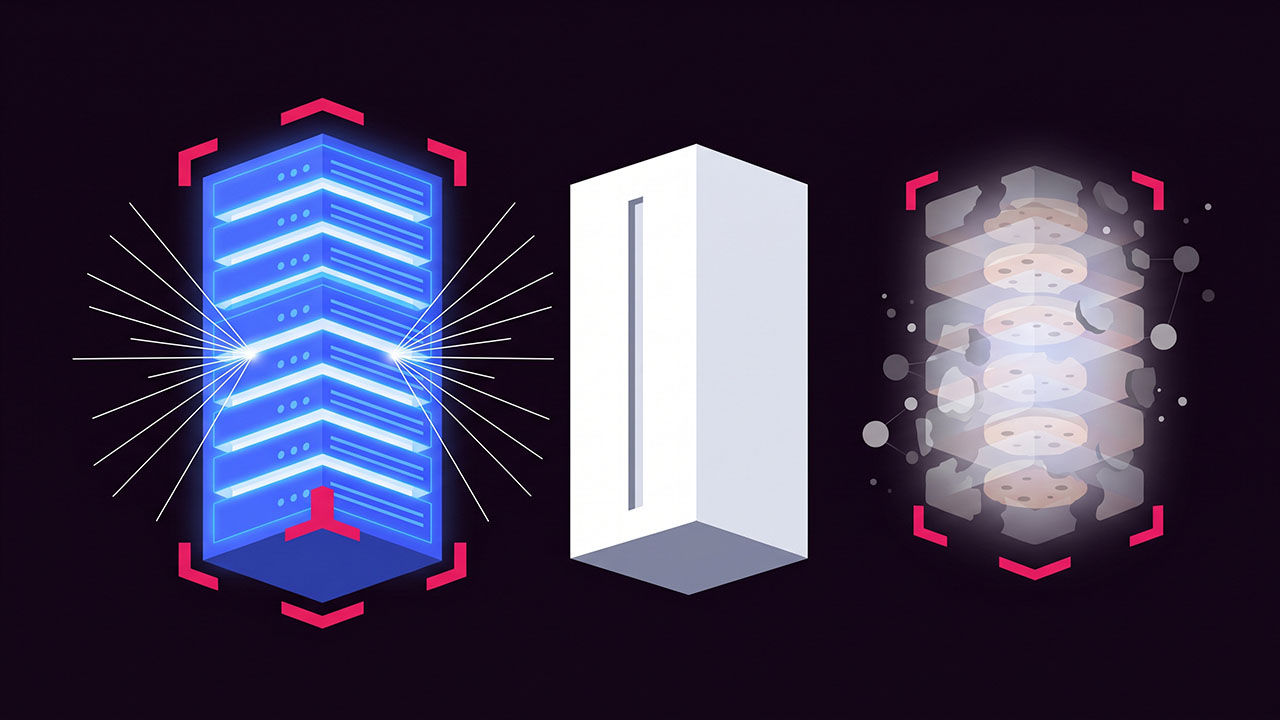
The market has matured into three distinct architectural generations:
**Stage 1 — Packaged CDPs (2016–2018)**Proved the category by unifying data into persistent profiles. Batch-only, rule-based, built for human-operated campaigns. Vendors like early Salesforce Data Cloud and Adobe Real-Time CDP.
Stage 2 — Composable CDPsAssembled best-of-breed tools on top of data warehouses. Engineers loved the control. Trade-off: the feedback loop slows across vendor boundaries, and every activation sync copies customer PII to external tools.
Stage 3 — Agentic CDPsBundle CDP + messaging + AI into one platform. The Forrester CDP Wave identifies this as the fastest-growing segment. AI agents run the collect → decide → activate loop continuously while humans set strategy and guardrails.
The Investigation Gap: What CDPs Still Miss
Here's something most CDP guides won't tell you.
A CDP excels at telling you what your customers did. It's genuinely excellent at that. But most platforms stop there.
They don't tell you why revenue dropped at one location and not another. They don't tell you why a specific customer segment churned after three months. They don't investigate — they report.
"Dashboards show you what happened. Intelligence tells you why — and what to do next."
Understanding that gap is the starting point for monitoring vs. investigation analytics — and why forward-thinking ops teams are layering autonomous investigation capabilities on top of their unified data foundation.
That's where platforms like Scoop Analytics come in. Scoop connects to your existing data sources — CRM, ERP, spreadsheets, SaaS tools — and runs continuous automated investigations across your business metrics.
Instead of just surfacing unified customer profiles, it screens for anomalies, runs multi-hypothesis tests, and delivers root cause analysis your team can act on.
It's business intelligence with investigation built in — not just another layer of dashboards.
"Your AI doesn't know your business — not without context. Data without business rules is just noise."— Scoop Analytics
And for retail teams managing hundreds of locations, that difference between reporting and investigation is worth millions.
How to Choose a CDP: 5 Questions to Ask
Before you start evaluating vendors, get clear on your use cases. Then assess platforms against these five criteria:
- Does it update profiles in real time? Batch-only CDPs are fine for weekly campaigns. For AI-driven personalization, you need sub-second freshness.
- Can it handle your data volumes? Scalability varies wildly between small-business and enterprise platforms.
- How does it handle identity resolution? Deterministic only? Probabilistic? Both matter for accuracy.
- What's the feedback loop? Can the platform close the loop between what it sends and what happened — automatically?
- Does it support your compliance requirements? Enterprise CDPs should include built-in GDPR and CCPA controls, right-to-be-forgotten workflows, and data governance tools. Check Scoop's security posture as a benchmark for what good looks like.
Try It Yourself
Frequently Asked Questions
What is a customer data platform in simple terms?
A CDP is software that pulls customer data from all your tools — CRM, email, ads, website, POS — and combines it into one complete, always-updated profile per customer. That unified profile is then used to power segmentation, personalization, and business intelligence across your organization.
What's the difference between a CDP and a CRM?
A CRM tracks your team's interactions with customers — calls, emails, deals. A CDP tracks everything the customer does across every channel, including behavior your team never sees. A CRM is designed for sales. A CDP is designed for the full customer picture.
Is a CDP only for marketing?
No. While CDPs started in marketing, modern platforms power analytics, customer success, finance, and executive reporting. Any team that needs a complete view of customer behavior can benefit from unified customer data.
Do I need a data team to use a CDP?
Enterprise CDPs often require some technical setup, but modern platforms are built to give non-technical users direct access to segmentation, reporting, and activation tools.
Business intelligence analytics built on top of a CDP can make insights self-serve for the whole organization.
How does a CDP handle data privacy?
CDPs centralize consent management and privacy preferences, making it easier to comply with GDPR, CCPA, and other regulations. Enterprise platforms include right-to-be-forgotten workflows, consent tracking, and automated data deletion — all from a single system.
How is a CDP different from a data warehouse?
Data warehouses like Snowflake or BigQuery store data for analysis. They don't include native real-time profile serving, identity resolution, or campaign activation. A CDP is the operational layer on top — it connects, activates, and closes the feedback loop.
Conclusion
A customer data platform is no longer a nice-to-have. It's the foundation that makes every other marketing, analytics, and AI investment smarter.
Quick recap:
- A CDP unifies customer data from every source into persistent, real-time profiles
- It's different from a CRM (which manages relationships) and a DMP (which targets anonymous audiences)
- The real competitive edge comes when CDP data feeds autonomous investigation — not just dashboards
- Choosing the right platform depends on your use cases, data volumes, and feedback loop requirements
If your team is ready to move from scattered data to unified intelligence, request a free demo and see how Scoop connects your existing data sources into a foundation your whole business can act on.
Looking to go deeper? Explore what is business intelligence, understand descriptive vs. predictive analytics, or see why Scoop Analytics stands out from traditional BI tools.
Get insights like this every week
Analytics, ops strategy, and product updates. No noise.


Book a discovery call
Reach out to start a two-way conversation about your industry, your performance variations across locations, and whether Scoop is the right fit for you.