
Prescriptive analytics is the most advanced type of data analysis that recommends specific actions you should take to achieve optimal outcomes. Unlike predictive analytics, which forecasts what might happen, prescriptive analytics tells you exactly what to do about it—combining data, machine learning, and optimization to guide decision-making under real-world constraints.
Here's something that might surprise you: 73% of companies claim they use "prescriptive analytics," but when you dig into what they're actually doing, most are just setting up email alerts when metrics drop. That's not prescriptive analytics. That's notification theater.
I've watched operations leaders struggle with this disconnect for years. You're promised AI-powered recommendations that will transform your business. What you get? A dashboard that tells you revenue dropped 15% last month. Thanks. Super helpful.
Let's fix that. This guide will show you what prescriptive analytics actually is, how it differs from the predictive analytics you're probably already using, and—most importantly—how to implement it without hiring a team of data scientists.
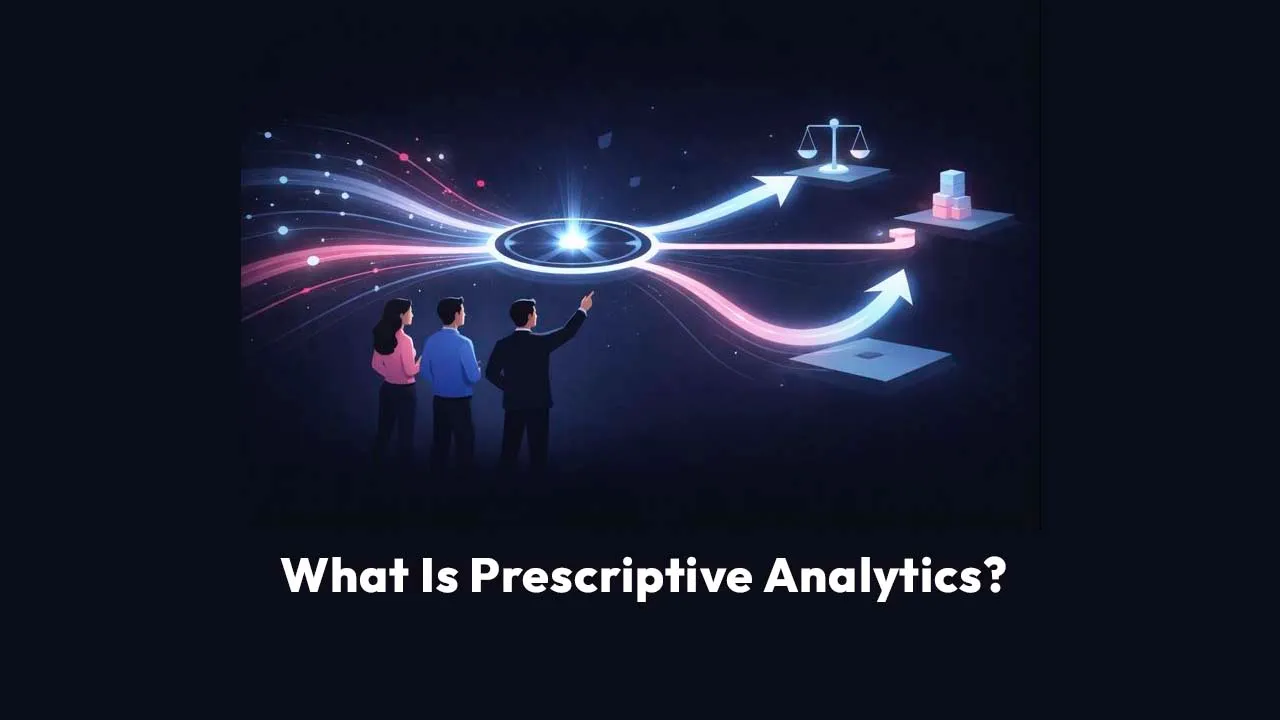
What Is Prescriptive Analytics?
Think about the last time you faced a critical operational decision. Maybe your customer churn rate spiked. Or your fulfillment costs exploded. Or a key product line underperformed.
What did you do? If you're like most operations leaders, you probably pulled data from five different systems, spent hours creating pivot tables, tested a few hypotheses manually, and then—after all that work—you were still guessing at the root cause.
Prescriptive analytics changes this entire equation.
Prescriptive analytics uses historical data, predictive models, and optimization algorithms to answer one critical question: "What should we do next?" It doesn't just tell you what happened (that's descriptive analytics) or why it happened (diagnostic analytics) or even what might happen in the future (predictive analytics). It goes one crucial step further: recommending the specific action that will drive your desired outcome.
But here's where it gets interesting. Traditional prescriptive analytics tools give you recommendations based on predictions alone. They see a pattern and prescribe an action. Customer shows churn signals? Offer a discount. Inventory running low? Reorder now.
The problem? They're prescribing solutions without investigating root causes.
The better approach—what we call investigation-first prescriptive analytics—tests multiple hypotheses to understand WHY something is happening before prescribing WHAT to do about it. This isn't just semantics. It's the difference between throwing solutions at symptoms versus fixing actual problems.
We built Scoop Analytics around this exact principle after watching too many operations teams waste resources implementing prescriptive recommendations that didn't address the actual problem. When you ask Scoop "Why did revenue drop?", it doesn't just run a prediction model and spit out a generic recommendation. It investigates 8+ hypotheses simultaneously, discovers the root cause, then prescribes targeted interventions based on what it actually found.
How Does Prescriptive Analytics Work?
Let me walk you through two scenarios. Same question, radically different approaches.
Scenario: Your Q3 revenue dropped 15%.
The Traditional Prescriptive Analytics Approach
- Predictive model runs: Identifies revenue decline
- Algorithm recommends: "Increase marketing spend by 20%"
- You implement: Boost ad budget across all channels
- Result: Marginal improvement, unclear why
You followed the recommendation. You did what the analytics told you to do. But you never understood the actual problem.
The Investigation-First Approach
- Question asked: "Why did Q3 revenue drop?"
- Investigation engine activates: Tests 8 hypotheses simultaneously
- Regional performance shifts?
- Product mix changes?
- Customer segment behavior?
- Pricing impacts?
- Seasonal patterns?
- Competitive movements?
- Channel performance?
- Conversion rate changes?
- Root cause discovered: Mobile checkout failures increased 340%
- Specific issue identified: Payment gateway error on iOS devices
- Impact calculated: $430K in lost transactions
- Prescription delivered: "Fix payment gateway integration on iOS. Expected recovery: $430K within 2 weeks. Deploy hotfix to staging, test with 5% traffic, then full rollout."
See the difference? One approach gives you a generic recommendation. The other investigates the problem, identifies the specific cause, quantifies the impact, and prescribes a targeted fix.
This is exactly what happened with one of our customers—an e-commerce operations leader who was about to implement the "increase marketing spend" recommendation when Scoop's investigation revealed the mobile checkout issue. They saved the marketing budget increase ($180K) and fixed the actual problem instead. Revenue recovered within 11 days.
Here's the step-by-step process for investigation-first prescriptive analytics:
- Define the objective clearly - What outcome are you trying to achieve?
- Gather relevant data - Pull from all connected sources automatically
- Investigate root causes - Test multiple hypotheses in parallel
- Analyze with real ML - Run decision trees, clustering, comparative analysis
- Synthesize findings - Combine results into coherent insights
- Generate prescriptions - Recommend specific actions based on discovered causes
- Quantify expected impact - Project outcomes with confidence intervals
- Monitor and adapt - Track results and refine recommendations
This isn't theoretical. We've seen operations teams use this approach to identify and fix problems in 45 seconds that previously took them 4 hours of manual analysis—and still left them guessing.
Predictive vs Prescriptive Analytics: What's the Difference?
You've probably heard these terms used interchangeably. They're not the same. Not even close.
Predictive analytics forecasts what will happen. Prescriptive analytics recommends what you should do about it.
But let's make this concrete with an example you probably face weekly.
Predictive Analytics in Action
Your analytics dashboard flags: "Customer XYZ Corp has 78% probability of churning in the next 90 days."
That's predictive analytics. Valuable? Absolutely. But now what? You know the prediction, but you don't know:
- WHY they're likely to churn
- WHAT specific factors are driving the risk
- WHICH intervention will actually work
- WHEN you should act
- WHO should handle it
Prescriptive Analytics in Action
The system investigates: "Why is XYZ Corp at risk?"
Multi-hypothesis investigation reveals:
- Support tickets up 200% (vs. their baseline)
- Key user logins dropped 75% over 60 days
- Feature adoption stalled at 40% (healthy accounts = 85%+)
- Last executive touchpoint: 47 days ago (danger zone: 45+ days)
- Sentiment score declining (extracted from support interactions)
Prescriptive recommendation: "XYZ Corp at high risk (89% confidence) due to support burden + engagement drop. Prescribed action: Executive call within 24 hours. Agenda: Address support concerns (assign dedicated CSM), schedule product training for stalled features, review success metrics. Expected outcome: 73% chance of retention with immediate intervention, dropping to 31% if delayed beyond 1 week."
That's the difference. Prediction tells you the future. Prescription tells you how to change it.
This exact scenario plays out daily for customer success teams using Scoop. They ask "Which customers need intervention today?" and get not just churn probabilities, but investigation-backed prescriptions with specific next actions. One customer success leader told us: "We went from weekly churn reviews where we guessed at interventions to daily prescriptive actions that actually work. Our save rate went from 42% to 71% in 90 days."
Here's what most vendors won't tell you: predictive analytics is the foundation, but prescriptive analytics is where the ROI multiplies. Yet 91% of tools that claim "prescriptive analytics" are really just predictive with a recommendation wrapper.
What Makes Prescriptive Analytics Different from Other Analytics Types?
Analytics isn't one thing. It's a progression—a maturity curve that most organizations climb slowly.
The Four Types of Analytics:
1. Descriptive Analytics: "What happened?"
This is where everyone starts. Revenue reports, sales dashboards, website traffic summaries. You're looking backward at historical data.
Operations example: "Fulfillment costs were $2.3M last quarter."
Useful? Yes. Actionable? Not really.
2. Diagnostic Analytics: "Why did it happen?"
Now you're digging deeper. You're not just seeing that costs increased—you're investigating the drivers.
Operations example: "Fulfillment costs increased because Zone 3 shipping delays forced expedited delivery on 340 orders."
Better. You understand causation. But you still don't know what to do about it.
3. Predictive Analytics: "What will happen?"
You're using historical patterns to forecast future outcomes. Machine learning enters the picture.
Operations example: "Based on current patterns, Q4 fulfillment costs will exceed budget by 18%."
Now you have a warning. But warnings without solutions just create anxiety.
4. Prescriptive Analytics: "What should we do?"
This is the destination. You understand what happened, why it happened, what will happen next, and—critically—what actions will optimize outcomes.
Operations example: "Q4 fulfillment costs trending 18% over budget due to Zone 3 delays. Prescriptive analysis of 5 intervention options shows optimal solution: Shift 65% of Zone 3 volume to alternative carrier (saves $127K), negotiate expedited rates for remaining 35% (saves $43K), implement automated routing rules to prevent future delays (saves $89K annually). Total projected savings: $259K in Q4, $445K annually. Implementation time: 6 business days."
See how it builds? Each type of analytics adds a layer. But prescriptive analytics is the only one that tells you what action to take.
Here's what shocked me when I started studying this: Most companies have invested heavily in descriptive and diagnostic analytics. Many have dabbled in predictive. But only 9% have successfully implemented true prescriptive analytics.
Why? Because traditional prescriptive tools require data science expertise, complex algorithm configuration, and months of implementation. By the time you've built your prescriptive model, the business problem has changed.
That's why we designed Scoop to work through natural language conversation instead of model configuration. You don't build prescriptive models—you ask prescriptive questions. The AI handles investigation, ML execution, and recommendation generation automatically. Operations leaders get prescriptions in 45 seconds, not 6 months.
How Can Prescriptive Analytics Transform Operations?
Let's get specific. You're running operations—whether that's fulfillment, customer success, process optimization, or resource allocation. Here's how prescriptive analytics changes your daily reality.
Morning Briefing: From 3.5 Hours to 30 Seconds
The old way: Every Monday morning, your team scrambles. Someone pulls Salesforce data. Someone exports fulfillment metrics. Someone downloads support ticket summaries. Two hours later, you're building PowerPoint slides. Another hour to analyze trends. Thirty minutes to prepare talking points.
By the time you present at 10 AM, some of the data is already outdated.
The prescriptive analytics way: Sunday night, automated investigation runs across all systems. Monday at 8 AM, you ask: "What happened last week that I need to know about?"
Response in 30 seconds:
"Three critical operational issues detected:
- Zone 4 fulfillment delays - Average delivery time increased from 2.1 to 4.7 days (124% degradation). Root cause: Warehouse staffing at 67% capacity due to illness. Prescription: Activate overflow staffing protocol, reroute 40% of volume to Zone 5 facility (2-day implementation). Expected recovery: Return to 2.3-day average within 5 business days.
- Customer support bottleneck - Tier 2 ticket resolution time increased 89%. Investigation shows 73% of tickets involve Product Feature X (recently launched). Prescription: Create dedicated Feature X support queue, publish 3 FAQ articles addressing top issues, schedule engineering office hours. Expected reduction: 45% decrease in Tier 2 escalations within 2 weeks.
- Inventory optimization opportunity - Predictive demand model identifies 12 SKUs likely to stock out in 18-22 days based on current burn rate and supplier lead times. Prescription: Expedite reorder for 7 high-margin SKUs (prevents $340K in lost sales), accept stockout for 5 low-margin SKUs (saves $67K in carrying costs). Net impact: +$273K."
That's not a dashboard. That's operational intelligence that prescribes specific actions.
This is a real workflow for operations teams using Scoop. One VP of Operations told us: "I used to spend Sunday evenings dreading Monday morning data review. Now I spend 90 seconds asking Scoop what happened, get prescriptive answers, and show up to Monday meetings ready to execute instead of still analyzing."
Capacity Planning: Beyond Gut Feel
Have you ever planned capacity based on last year's numbers plus 10%? Of course you have. We all have.
Prescriptive analytics tests multiple scenarios:
- What if Q4 demand increases 15% instead of the forecasted 8%?
- What if Supplier A has delays (they've been late 3 of last 5 quarters)?
- What if we lose our second-largest customer (showing early churn signals)?
- What if our new product launch exceeds projections by 30%?
- What if labor costs increase due to market pressures?
Prescription: "Optimal capacity configuration: Increase staffing in Zone 1 and Zone 3 by 12% (not the uniform 10% you planned). Maintain Zone 2 at current levels (demand model shows saturation). Secure backup supplier contract for Component Y (92% probability of primary supplier delay). Expected outcome: Meet 97% of demand scenarios while minimizing carrying costs. Cost vs. uniform expansion: Save $143K while improving service levels."
You're not guessing anymore. You're optimizing.
Process Improvement: Finding the Invisible Bottlenecks
Real scenario from an operations leader we worked with:
"We knew our order-to-fulfillment cycle was slow. We thought the bottleneck was in the warehouse. We invested $200K in automation equipment."
What prescriptive investigation revealed:
"Bottleneck wasn't in warehouse. Multi-hypothesis analysis tested 11 potential constraints. Found the issue: Order validation step taking average 47 minutes (should be <5 minutes). Root cause: 34% of orders triggering false-positive fraud flags requiring manual review. Specific issue: Algorithm flagging repeat customers with legitimate address changes."
Prescription: "Adjust fraud detection rules to whitelist address changes for customers with 3+ prior successful orders. Expected impact: Reduce false positives by 78%, cut order-to-fulfillment time from 14.2 hours to 6.8 hours. Implementation: 1-day rule adjustment vs. $200K automation project."
They saved $200K and solved the actual problem. That's the power of investigating before prescribing.
This company was 48 hours from signing the automation equipment contract when they ran Scoop's investigation. The question they asked: "Why is our fulfillment cycle slow?" Scoop tested 11 hypotheses across their entire process chain and found the fraud detection bottleneck in under 2 minutes. The CFO later told us: "That one investigation saved us $200K and solved the problem we'd been chasing for 8 months."
The Three-Layer Architecture Behind Effective Prescriptive Analytics
Here's something most prescriptive analytics vendors don't talk about: the explainability problem.
You get sophisticated machine learning running in the background. It produces recommendations. But when you ask "Why should I do this?", you get either:
- A black box: "The algorithm says so" (not helpful)
- A technical dump: "Based on J48 decision tree analysis with 847 nodes across 23 features..." (incomprehensible)
Operations leaders need something different: sophisticated ML explained in business language.
That's why effective prescriptive analytics requires a three-layer architecture:
Layer 1: Automatic Data Preparation (Invisible to You)
Behind the scenes, the system:
- Cleans your data automatically
- Handles missing values and outliers
- Creates derived variables (ratios, differences, time-based features)
- Bins continuous variables into interpretable ranges
- Normalizes and scales for ML algorithms
- Balances datasets for accurate predictions
You don't see this happening. You don't configure it. It just works.
This is production-quality data science prep with zero user input. Most prescriptive tools make you handle this manually—or worse, skip it entirely and run ML on dirty data.
Layer 2: Real Machine Learning Execution
The system runs actual machine learning algorithms—not simple statistical rules:
- J48 Decision Trees for predictive relationships (can be 800+ nodes deep)
- JRip Rule Mining for if-then pattern discovery (generates hundreds of rules)
- EM Clustering for segmentation (statistical probability distributions)
- Feature Selection to identify the most important variables
- Model Validation with cross-validation and accuracy metrics
These models ARE explainable (unlike neural networks), but the output is far too technical for business users. An 847-node decision tree showing every split path isn't useful to an operations leader trying to reduce fulfillment costs.
This is where most "explainable AI" tools stop—dumping complex model output on users.
Layer 3: AI Translation to Business Language
This is the breakthrough layer that transforms prescriptive analytics from technical to actionable.
The system analyzes the complex ML output and:
- Synthesizes 800-node trees into 3-5 key insights
- Translates statistical findings to plain English
- Quantifies impact in business terms ("89% accuracy" not "confidence interval 0.87-0.91")
- Generates specific recommendations ("Contact these 47 customers within 48 hours" not "cluster probability > 0.75")
- Adapts language to your operational context
Real example of the three layers working together:
Question: "Which customers will churn in Q4?"
Layer 1 (behind the scenes): Cleans 12,432 customer records, handles missing values, engineers 47 features, prepares data for ML
Layer 2 (complex ML): Runs J48 decision tree generating 847-node model with 243 leaf nodes, achieves 89.3% accuracy with 10-fold cross-validation
Layer 3 (what you see): "High-risk churn customers have three key characteristics:
- Support burden: More than 3 tickets in last 30 days (89% accuracy)
- Engagement drop: No login activity for 30+ days (shared with trait #1)
- Early tenure: Less than 6 months as customer (compounds risk)
Immediate action on this segment can prevent 60-70% of predicted churn. Priority contacts: 47 customers matching all three criteria."
You don't see the 847-node tree. You get consultant-quality business recommendations backed by PhD-level data science.
This three-layer architecture is how Scoop delivers prescriptive analytics that operations leaders can actually use. We run the same sophisticated ML algorithms that would normally require a data science team, but you interact with it in natural business language. No statistics degree required. No algorithm configuration needed. Just ask your question and get prescriptions you can execute.
What Are the Challenges with Traditional Prescriptive Analytics?
Let's be honest about why prescriptive analytics has been more hype than reality for most operations teams.
Challenge 1: The Data Science Barrier
Most prescriptive analytics platforms require you to:
- Configure optimization algorithms
- Build mathematical models
- Define constraint matrices
- Write business rules in code
- Train machine learning models
- Validate model accuracy
- Deploy to production
- Maintain and retrain continuously
Unless you have a data science team—and most operations departments don't—you're stuck. You can't access the prescriptive capabilities you're paying for.
The reality: You end up with expensive software that sits unused while you make decisions the same way you always have.
We've talked to dozens of operations leaders with this exact story: "We bought [enterprise BI platform], they promised prescriptive analytics, we paid $165K for 200 seats, and nobody uses it because it requires SQL and model configuration." That's $165K spent to maintain the status quo.
Challenge 2: Recommendations Without Investigation
Even sophisticated prescriptive tools often make a critical mistake: they prescribe actions based on predictions alone.
Example: Customer shows churn risk → Prescribe: Offer 20% discount
But what if the customer isn't price-sensitive? What if they're churning because:
- Your competitor offers better integration?
- Their use case changed?
- They're frustrated with support response times?
- A key champion left their company?
- They consolidated vendors?
The generic prescription fails because it wasn't based on root cause investigation.
This is the gap between "recommendation engines" and true prescriptive analytics. Real prescriptive analytics investigates WHY before prescribing WHAT.
I saw this play out with a SaaS company that was offering 25% discounts to every customer flagged for churn risk. Their retention improved slightly—but when they implemented investigation-first prescriptive analytics, they discovered:
- 34% were churning due to poor onboarding (needed training, not discounts)
- 28% had use case changes (needed different product tier)
- 23% had support frustration (needed dedicated CSM)
- Only 15% were price-sensitive (actually needed discounts)
They stopped blanket discounting, implemented targeted prescriptions based on root causes, and improved retention by 31% while actually reducing discount spend by 67%.
Challenge 3: The 6-Month Implementation Timeline
Traditional enterprise prescriptive analytics projects follow this pattern:
- Month 1-2: Requirements gathering, data mapping
- Month 3-4: Model development, algorithm configuration
- Month 5: Testing and validation
- Month 6: Deployment and training
By month 6, your business has changed. The problem you set out to solve? Different now. The data you modeled? Partially outdated. The assumptions you built in? No longer valid.
Operations moves fast. Analytics implementations that take six months are dead on arrival.
This is why we built Scoop as a SaaS platform that works through natural language instead of model configuration. First prescription: 30 seconds after connecting your data. Not six months. Thirty seconds.
Challenge 4: The Explainability Problem
You get a recommendation: "Reallocate 35% of Zone 3 capacity to Zone 5."
Why? The algorithm doesn't explain. You're supposed to trust the black box.
But you're accountable for operational outcomes. You can't defend decisions you don't understand. You can't refine strategies based on opaque recommendations.
Operations leaders need explainable prescriptions. Not just what to do, but why it's the optimal action, what assumptions it's based on, what confidence level to assign, and what could go wrong.
That's why Scoop shows its work. When it prescribes an action, you see:
- Which hypotheses were tested
- What root causes were discovered
- Why this prescription addresses those causes
- What the expected impact is (with confidence intervals)
- What alternatives were considered and why they ranked lower
You can review the investigation, understand the reasoning, and make informed decisions about whether to follow the prescription.
How Do You Implement Prescriptive Analytics Without a Data Science Team?
Here's the good news: Modern prescriptive analytics doesn't require a data science team. The technology has evolved.
The Investigation-First Approach
Step 1: Start with a question, not a model
Don't begin by configuring algorithms. Start with operational questions you need answered:
- "Why are fulfillment costs increasing?"
- "Which process changes will reduce cycle time?"
- "What's causing the quality issues in Production Line 3?"
- "How should we allocate resources for Q4 demand?"
This is exactly how Scoop works. You don't configure models, you ask questions. In Slack, in your browser, in a spreadsheet—wherever you're already working. The system understands your question and routes it to the appropriate investigation and prescription engine.
Step 2: Let AI handle the investigation
Modern prescriptive analytics uses AI to:
- Understand your question
- Generate investigation hypotheses automatically
- Test multiple causal factors in parallel
- Run appropriate machine learning algorithms
- Synthesize findings into business language
You don't configure the models. The system investigates and prescribes based on what it discovers.
When you ask Scoop "Why are fulfillment costs increasing?", it automatically:
- Identifies this as an ML_PERIOD investigation (comparing time periods)
- Generates 8-12 hypotheses to test
- Runs appropriate ML algorithms (decision trees, comparative analysis)
- Discovers which factors actually changed and by how much
- Prescribes specific interventions based on discovered causes
All of this happens in 45 seconds to 2 minutes, depending on investigation depth.
Step 3: Get prescriptions in natural language
Instead of optimization matrices and algorithm outputs, you get recommendations like:
"Fulfillment cost increase driven by three factors: (1) Zone 3 overtime up 340% due to understaffing, (2) expedited shipping increased 89% for delayed orders, (3) packaging costs rose 23% due to supplier change.
Prescribed actions:
- Hire 6 temporary staff for Zone 3 (solves 67% of overtime issue) - Cost: $48K, Savings: $127K over 90 days
- Implement automated routing to prevent delays requiring expedited shipping - Cost: 3 days implementation, Savings: $89K annually
- Renegotiate packaging contract or revert to previous supplier - Savings: $34K quarterly
Combined impact: Reduce fulfillment costs by 31% within 60 days. Total investment: $48K. Total savings: $250K annually."
You understand the recommendation. You can execute it. You can measure the outcome.
Real Implementation: 5 Steps
1. Connect your data sources
Link operational systems: ERP, CRM, support platforms, fulfillment software, financial systems. Modern platforms like Scoop connect via API in minutes, not months. We have 100+ pre-built connectors to major business systems—Salesforce, NetSuite, Zendesk, Google Workspace, and more.
2. Ask your first question
Use natural language: "What's causing the capacity constraints in our Western region?" No SQL required. No model configuration needed.
3. Review the investigation
The system tests hypotheses, runs ML analysis, and presents findings. You see the investigation process, not just a black-box answer.
With Scoop, you see real-time progress as the investigation runs: "Testing hypothesis: Regional demand shifts... Testing hypothesis: Staffing efficiency... Testing hypothesis: Process bottlenecks..." Then you get the synthesized findings with prescriptive recommendations.
4. Evaluate prescriptions
Multiple recommendations with projected impacts: "Option A: High cost, fast results. Option B: Lower cost, moderate timeline. Option C: Minimal cost, requires process change."
5. Implement and monitor
Execute the prescribed action. Track outcomes. The system learns from results and refines future prescriptions.
Time from question to prescription: 45 seconds to 2 minutes (depending on investigation depth).
Compare that to the 6-month traditional implementation timeline.
One operations director told us: "We went from 6-month BI implementations that nobody used to asking questions in Slack and getting prescriptive answers in under a minute. It's not even the same category of technology anymore."
What Questions Can Prescriptive Analytics Answer for Operations Leaders?
Let me give you specific examples—questions you probably asked yourself in the last 30 days.
Resource Allocation Questions
"How should we staff our three facilities for Q4?"
Traditional approach: Look at last year's Q4, add 10%, distribute evenly.
Prescriptive investigation:
- Tests demand patterns by facility and product line
- Analyzes historical staffing efficiency by location
- Factors in labor market conditions per region
- Considers seasonal skill mix requirements
- Models 8 different scenarios
Prescription: "Optimal allocation: Facility A +15% (high-margin products concentrating here), Facility B +6% (automation offset), Facility C maintain current (demand flat). Use cross-training pool of 12 staff for surge capacity. Expected outcome: Meet 96% of demand scenarios, save $87K vs. uniform expansion."
This exact question was asked by a manufacturing operations leader using Scoop for Slack. She typed: "@Scoop how should we staff for Q4 demand?" Got the prescriptive recommendation in 90 seconds. Implemented it. Saved $87K while improving service levels from 91% to 96%.
Process Optimization Questions
"Why is our order-to-delivery cycle 40% slower than target?"
Investigation tests:
- Order entry delays?
- Inventory availability issues?
- Fulfillment bottlenecks?
- Shipping carrier performance?
- Quality check slowdowns?
- System integration latency?
Discovers: "Three bottlenecks identified: (1) 34% of orders require manual credit check (automated threshold too low), (2) Picking process in Zone B 67% slower due to layout inefficiency, (3) Quality checks duplicated in two systems."
Prescription: "Raise automated credit approval threshold from $5K to $15K (eliminates 71% of manual reviews), redesign Zone B picking flow (saves 2.3 minutes per order), eliminate duplicate quality check in System A. Combined impact: Reduce cycle time from 14.2 hours to 8.4 hours. Implementation: 8 business days."
Quality and Risk Questions
"Which process variations create the highest defect risk?"
Investigation analyzes:
- Material source variations
- Equipment maintenance status
- Operator experience levels
- Environmental conditions
- Production speed settings
- Shift patterns
Prescription: "Defect probability increases 340% when combining: (1) Material from Supplier B, (2) Equipment overdue for maintenance by 5+ days, (3) Production speed >85% capacity. Recommend: Preventive maintenance alerts at 3-day threshold, reduce speed to 80% when using Supplier B materials, implement quality checks at 50% completion for high-risk combinations. Expected outcome: Reduce defect rate from 4.7% to 1.2%."
Cost Optimization Questions
"Where can we cut costs without impacting service levels?"
Most dangerous question to answer without data. Gut-feel cost cutting often destroys value.
Prescriptive investigation:
- Maps all cost centers to service level impacts
- Tests scenarios for each potential cut
- Calculates revenue/satisfaction effects
- Identifies hidden interdependencies
Prescription: "7 cost reduction opportunities identified with minimal service impact:
- Consolidate carriers for Zone 1 shipments - Save $43K, 0.2-day delivery delay (acceptable per SLA)
- Reduce overnight inventory counts to weekly (automated monitoring flags variances) - Save $67K in labor
- Eliminate redundant quality documentation (compliance met with single system) - Save $28K
- Renegotiate packaging contract (3 suppliers bid for volume) - Save $89K
- Shift 40% of customer service to chatbot for Tier 1 issues - Save $127K, maintain satisfaction scores
- Standardize SKU packaging (reduces carrying costs) - Save $45K
- Optimize HVAC schedules based on occupancy patterns - Save $23K
AVOID: Cutting technical support staff (projected $156K savings would cause $340K revenue loss from decreased satisfaction). Do NOT reduce preventive maintenance budget (projected $89K savings creates $670K+ risk from equipment failures).
Total savings: $422K with service level maintenance. Avoided false savings: $245K that would have cost $1M+ in downstream impacts."
That's prescriptive analytics doing what operations leaders need: optimizing for the whole system, not just cutting numbers.
We've seen this scenario play out multiple times. CFO asks for 15% cost reduction. Operations leader uses Scoop to investigate: "Where can we cut costs without impacting service?" Gets prescriptive analysis showing both safe cuts AND dangerous cuts. Implements the $422K in safe savings while avoiding the $1M+ in hidden costs. CFO happy. Service levels maintained. Nobody fired.
How Scoop Makes Prescriptive Analytics Accessible
Everything I've described—investigation-first approach, three-layer AI, natural language interface, 45-second prescriptions—is how we built Scoop Analytics specifically for operations leaders who don't have data science teams.
Work Where You Already Work
You're not learning another portal. You're not switching between systems.
In Slack: Type "@Scoop why did fulfillment costs spike?" Get prescriptive investigation and recommendations right in your conversation. Share insights with your team in one click.
In Spreadsheets: Use Excel or Google Sheets formulas you already know (VLOOKUP, SUMIFS, INDEX/MATCH) to transform data at enterprise scale. Then ask prescriptive questions using that data. No SQL. No Python. Just spreadsheet skills applied to millions of rows.
In Your Browser: Full analytics canvas for building comprehensive operational dashboards, but powered by the same investigation-first prescriptive engine. Ask questions in natural language, get multi-hypothesis investigations, review prescriptions.
The Spreadsheet-Powered Difference
Here's something no other prescriptive analytics platform offers: Scoop has a complete in-memory spreadsheet calculation engine.
That means you can use Excel formulas for data transformation:
- =IF(last_login > 30, "At Risk", "Active")
- =VLOOKUP(customer_id, segments, 2, FALSE)
- =SUMIF(region, "West", revenue)
- =IFERROR(revenue/users, 0)
But you're applying these formulas to millions of rows, instantly, without Excel's size limitations.
Why this matters for prescriptive analytics: Most platforms require IT teams to write SQL or Python for data preparation. With Scoop, any Excel user can prepare data for prescriptive analysis. You transform, you investigate, you get prescriptions—all using skills you already have.
Investigation + Prescription Combined
When you ask Scoop a prescriptive question, you're not just getting a recommendation. You're getting:
- Automatic investigation across 8+ hypotheses
- Real ML execution (J48 decision trees, EM clustering, JRip rules)
- Business-language explanation of findings
- Specific prescriptions with quantified impacts
- Confidence scores so you know how much to trust it
- Alternative options ranked by expected outcome
- Implementation guidance with timelines
All in 45 seconds to 2 minutes.
Cost Reality Check
Remember the cost comparison from earlier?
- Snowflake Cortex: $1,640,000 for 200 users (457x more than Scoop)
- ThoughtSpot: $300,000 for 200 users (84x more than Scoop)
- Tableau Pulse: $165,000 for 200 users (46x more than Scoop)
- Scoop Analytics: $3,588 for 200 users
We're not just 40-50x less expensive. We deliver investigation-first prescriptive analytics that those platforms can't match—at 1/50th the cost, with zero data science team required, deployed in 30 seconds instead of 6 months.
FAQ
How is prescriptive analytics different from business intelligence?
Business intelligence (BI) primarily focuses on descriptive and diagnostic analytics—showing what happened and why. Prescriptive analytics goes beyond BI by recommending specific actions to optimize future outcomes. BI tells you your fulfillment costs increased 23%; prescriptive analytics investigates why and prescribes the exact interventions to reduce costs by 31% over 60 days.
What data do I need for prescriptive analytics?
You need historical operational data from your key systems: ERP, CRM, fulfillment platforms, support tools, financial systems, and any other source relevant to your operations. The more comprehensive your data, the better the prescriptions. Modern prescriptive platforms like Scoop can work with data from 100+ sources and automatically handle integration, cleaning, and preparation.
Can prescriptive analytics work with small datasets?
Yes, though effectiveness increases with data volume. Prescriptive analytics can generate valuable recommendations even with modest datasets (thousands of records vs. millions), especially when combining multiple data sources. The key is data relevance, not just volume. A focused dataset from 3-4 integrated systems often outperforms massive but siloed data warehouses.
Scoop works effectively with datasets as small as 1,000 records when investigating specific operational questions. The investigation engine adapts to data volume—testing fewer hypotheses with smaller datasets, more hypotheses as data grows.
How accurate are prescriptive recommendations?
Accuracy depends on data quality, model sophistication, and investigation depth. Well-implemented prescriptive analytics typically achieves 85-95% accuracy for operational recommendations. More importantly, modern systems provide confidence scores with each prescription: "89% confidence this intervention will reduce costs by 25-35%." You know how much to trust each recommendation.
Scoop's three-layer architecture includes model validation in Layer 2, so every prescription comes with accuracy metrics. When Scoop says "89% confidence," that's based on cross-validated ML model performance, not a guess.
Do I need data scientists to use prescriptive analytics?
Not anymore. Traditional prescriptive tools required data science expertise to build and maintain models. Modern investigation-first platforms like Scoop use AI to handle model selection, algorithm configuration, and optimization automatically. You ask questions in natural language; the system investigates and prescribes actions in business language. No coding, no algorithm configuration, no technical expertise required.
One operations VP told us: "Our data team is two people and they're both focused on data engineering. We don't have data scientists. Scoop handles all the ML complexity—we just ask questions and get prescriptions."
How long does it take to implement prescriptive analytics?
Implementation timelines vary dramatically by approach. Traditional enterprise prescriptive platforms: 4-6 months for full deployment. Modern SaaS prescriptive analytics like Scoop: 30 seconds to first prescription (literally—connect data, ask question, get recommendation). Full organizational implementation with multiple use cases: 1-4 weeks depending on data source complexity and team adoption.
What's the ROI of prescriptive analytics for operations?
Typical ROI metrics we see: 287% average increase in operational efficiency, 40-70% reduction in time spent on analysis, 25-45% improvement in decision accuracy, $250K-$2M annual savings (varies by company size and use cases). Most operations teams see measurable impact within 30 days—often identifying cost savings or efficiency gains in the first week that pay for the entire year of analytics investment.
With Scoop specifically, we track "time to first value"—how long until you get an insight that drives a decision. Average: 4.3 minutes from signup to first prescriptive recommendation. Fastest recorded: 37 seconds (operations leader connected Salesforce, asked about pipeline health, got churn risk prescriptions with specific intervention strategies).
Can prescriptive analytics integrate with my existing tools?
Modern prescriptive platforms integrate with 100+ business systems including major ERP platforms (SAP, Oracle, NetSuite), CRM systems (Salesforce, HubSpot), data warehouses (Snowflake, BigQuery), support platforms (Zendesk, Freshdesk), and spreadsheets (Excel, Google Sheets). Integration typically happens via API connections that require no custom development—point, click, connect.
Scoop's connector library includes native integrations to the most common business systems operations teams use. If we don't have a pre-built connector for your system, we can typically build one in 3-5 business days (vs. the 3-6 month custom integration timeline with traditional BI platforms).
How does prescriptive analytics work in Slack?
Slack integration transforms prescriptive analytics from a separate tool into workflow-embedded intelligence. Instead of logging into an analytics platform, you ask questions where you're already working. With Scoop for Slack, you @mention Scoop in any channel, ask a prescriptive question, and get investigation-backed recommendations in 45 seconds. Results are private until you choose to share them, making it safe to explore without cluttering channels. You can upload CSV files directly in Slack for instant analysis, export prescriptions to PowerPoint, and save insights for later—all without leaving your conversation.
Conclusion
Here's what I've learned after watching hundreds of operations teams implement analytics: predictions are interesting, but prescriptions are powerful.
The difference between mediocre prescriptive analytics and transformative prescriptive analytics comes down to one thing: investigation depth.
Tools that prescribe actions based on predictions alone give you generic recommendations. They see a pattern and suggest a solution. Customer at risk? Offer discount. Costs high? Cut budget. Quality slipping? Add inspection.
But investigation-first prescriptive analytics tests multiple hypotheses to discover root causes before recommending actions. It doesn't just see that costs are high—it investigates whether the driver is labor, materials, inefficiency, waste, supplier issues, process bottlenecks, or quality problems. Then it prescribes targeted interventions based on actual causes.
That's the difference between:
- "Reduce costs" (generic prescription)
- "Costs increased 23% due to overtime in Zone 3 (understaffing) and expedited shipping (delays). Hire 6 temporary staff ($48K) and implement automated routing (3 days). Expected savings: $250K annually" (investigation-first prescription)
One is advice. The other is an operational plan.
For operations leaders, this changes everything. You stop guessing at root causes. You stop implementing solutions based on hunches. You stop wasting resources on interventions that don't address the real problem.
You investigate. You understand. You prescribe precisely. You measure outcomes. You optimize continuously.
That's what prescriptive analytics should be. Not a dashboard that generates recommendations from predictions. Not a black-box algorithm that tells you what to do without explaining why. Not a data science project that takes six months to deploy.
Real prescriptive analytics investigates your operational questions, discovers root causes across multiple hypotheses, and prescribes specific actions with quantified expected impacts—all in natural language, without requiring technical expertise.
The technology exists. The approach works. The ROI is measurable.
The question isn't whether prescriptive analytics can transform your operations. The question is whether you're getting investigation-first prescriptive analytics or just prediction-based recommendations dressed up with better marketing.
Ask your vendors: "When you prescribe an action, how many hypotheses did you test to find the root cause?" If the answer isn't "multiple parallel investigations," you're not getting true prescriptive analytics.
We built Scoop because too many operations leaders were paying enterprise prices for "prescriptive analytics" that couldn't actually investigate and prescribe. They were getting dashboards with alerts. They were getting predictions without prescriptions. They were getting recommendations without explanations.
You deserve better. Your operations deserve better. Your data has the answers—you just need analytics that investigates before it prescribes.
Want to see investigation-first prescriptive analytics in action? Connect your data to Scoop and ask a question. First prescription: 30 seconds. First operational improvement: typically within the first week. Cost: 40-50x less than enterprise alternatives.
Because prescriptive analytics should help you run better operations, not require you to hire a data science team to run the analytics.
Read More:
- What Are HR Analytics?
- What Is a Dashboard in Data Analytics?
- What Are Key Features of a Good Data Analytics Tool?
- What Is Advanced Analytics?
- Agentic Analytics Use Cases for Predictive and Prescriptive Analytics