
What is Enterprise Analytics?
What is enterprise analytics? Explore its four types, benefits, real business examples, platform features, and steps for turning company-wide data into action.
Enterprise Analytics: Benefits, Examples and Strategy
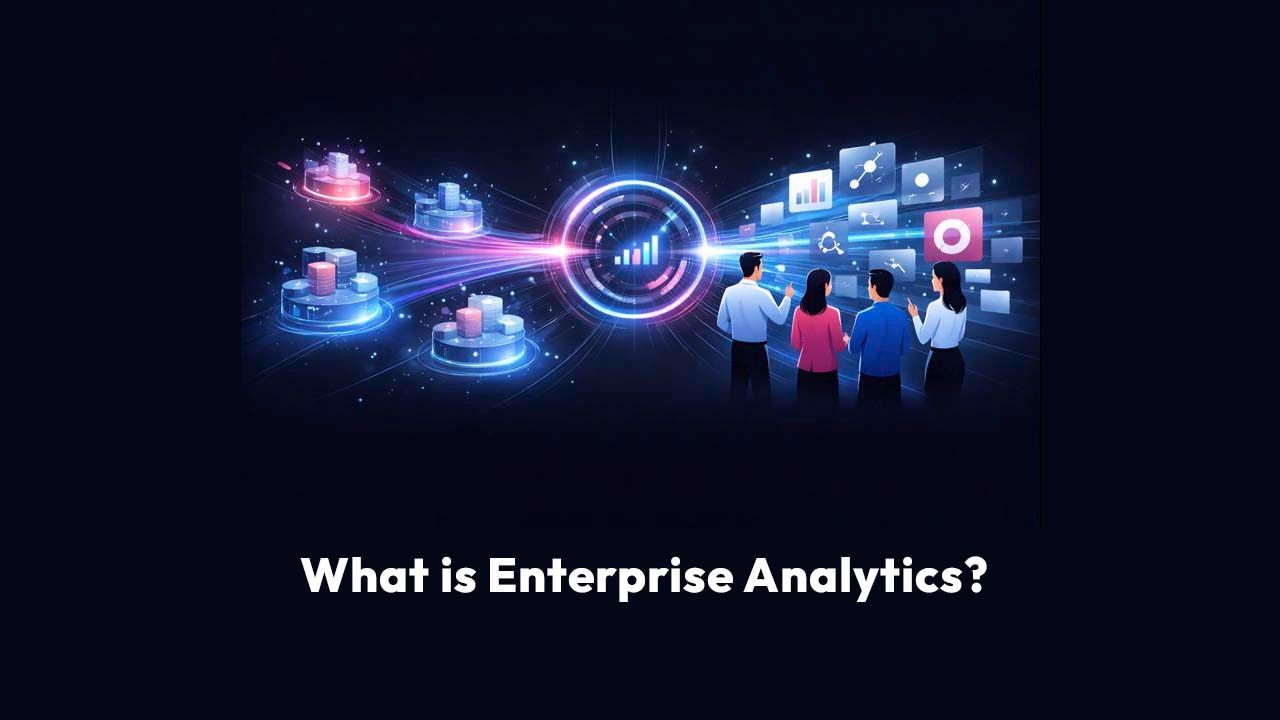
Enterprise analytics is the organization-wide practice of combining, governing, and analyzing data to make better business decisions. It connects information across departments, systems, and locations; applies descriptive, diagnostic, predictive, and prescriptive methods; and gives people a consistent view of performance. The goal is not simply more reporting, but reliable insights that lead to measurable action.
Consider a business operating 500 locations.
Corporate leadership sees total revenue growing. The regional dashboards look healthy. But underneath the company-wide numbers, some locations are losing customers, others are relying on discounting to maintain sales, and several are experiencing rising labor costs.
The data exists. The reports are accurate. But nobody has investigated every location deeply enough to see where performance is deteriorating.
This is the problem enterprise analytics is supposed to solve.
The challenge isn't just connecting the data. It's ensuring that the right people can interpret it, investigate what matters, and make consistent decisions across the organization.
And as businesses adopt more AI-powered analytics, that final step becomes even more important.

Why Is Enterprise Analytics Important?
Enterprise analytics helps organizations move from isolated departmental reporting to a consistent understanding of business performance.
Most large businesses already have more data than they can reasonably review. Finance maintains budgets and financial reports. Sales tracks pipeline and revenue. Operations monitors productivity, staffing, and inventory. Marketing measures acquisition and customer behavior.
Each department may have accurate information within its own system.
But accurate departmental reports don't automatically produce a complete picture of the business.
A retailer might see improving revenue in its financial reporting while its operations team sees declining transaction counts. Both findings can be correct. Together, they raise a more important question: Is the business growing because it has more customers, or because existing customers are spending more?
Enterprise analytics helps organizations connect those observations and investigate their implications.
The business benefits can include:
- Consistent performance measurement: Departments and locations use agreed-upon KPI definitions.
- Better operational visibility: Leaders can compare performance across business units without relying on disconnected reports.
- Faster investigation: Teams can identify unusual results and examine potential contributing factors.
- More informed planning: Forecasts and scenario analysis support resource allocation and strategic decisions.
- Greater accountability: Managers can connect recommendations, actions, and measurable outcomes.
However, these benefits aren't guaranteed simply by purchasing an analytics platform.
According to Gartner's February 2025 Chief Data and Analytics Officer survey, 30% of surveyed data and analytics leaders identified difficulty measuring the business impact of data, analytics, and AI as their top challenge.
Only 22% reported that their organizations had defined, tracked, and communicated business-impact metrics for most of their data and analytics use cases.
That distinction matters.
An organization can successfully deploy dashboards, analytical models, and AI applications without demonstrating that any of them improved business performance.
The real measure of enterprise analytics is what the business does differently because of the insight.
Every location diagnosed. Every cycle.
Scoop is AI performance management for distributed businesses. It diagnoses performance at every location, every cycle, and hands every manager a clear action plan.
- Every location, every cycle
- Role-specific action plans
- No prompting required
What Are the Four Types of Enterprise Analytics?
Enterprise analytics commonly includes four complementary approaches: descriptive, diagnostic, predictive, and prescriptive analytics.
Each answers a different business question.
Descriptive Analytics: Understanding Performance
Descriptive analytics summarizes historical and current business data.
It includes dashboards, financial statements, scorecards, operational reports, and KPI tracking.
For example, an operations dashboard might show revenue, labor costs, customer traffic, and inventory turnover across every location.
This establishes what happened and where performance differs from expectations.
Descriptive reporting is essential, but it doesn't necessarily explain the reasons behind those differences.
Diagnostic Analytics: Investigating What Changed
Diagnostic analytics examines possible explanations for performance variations.
It involves comparing segments, evaluating trends, investigating anomalies, and testing competing hypotheses.
Imagine a district experiencing declining revenue.
An experienced analyst might investigate transaction counts, average ticket size, pricing, promotional activity, inventory availability, and local market conditions.
Each answer determines which question should come next.
If revenue declined because transactions fell, the investigation follows a different path than it would if revenue declined because average transaction value fell.
That's why diagnosis requires more than a summary of the original dashboard.
It requires an investigation process that can follow the evidence.
Predictive Analytics: Anticipating Future Outcomes
Predictive analytics uses historical data, statistical techniques, and machine learning to estimate future outcomes.
Common applications include sales forecasting, demand planning, customer churn prediction, and equipment maintenance.
For example, a hospitality business might forecast room occupancy using booking history, seasonality, and local events.
Those forecasts can inform staffing and purchasing decisions.
However, predictions represent estimates, not guarantees.
A forecast also doesn't automatically establish why an outcome is expected. Understanding the underlying business factors may require additional diagnostic analysis.
Prescriptive Analytics: Evaluating Possible Actions
Prescriptive analytics uses analytical findings, business rules, optimization, or simulation to recommend potential actions.
A distribution business might compare alternative inventory allocations based on projected demand and transportation costs.
A hotel operator might evaluate different staffing plans against forecast occupancy.
Prescriptive systems can help narrow the options, but recommendations still require business context.
An action that works for one location may not be appropriate for another because of staffing constraints, local competition, regulations, or customer expectations.
For consequential operational decisions, human judgment remains important.

Enterprise Analytics vs. Business Intelligence: What's the Difference?
Enterprise analytics and business intelligence are closely related, and the terms are sometimes used interchangeably.
Business intelligence (BI) generally refers to the technologies and practices used to organize, query, analyze, and visualize business information.
Enterprise analytics describes the broader organizational capability of using that information consistently across functions, business units, and decision-making processes.
Business intelligence can be a central component of enterprise analytics. It isn't necessarily a separate or inferior approach.
Modern BI platforms such as Power BI, Tableau, and Looker can support enterprise-wide reporting, advanced analysis, and governed data access.
The important distinction isn't whether a company has dashboards.
It's whether the organization has developed the processes needed to interpret those dashboards and turn their findings into decisions.
Consider two businesses using the same BI platform.
The first distributes weekly dashboards to regional managers. Each manager decides which metrics deserve attention, investigates problems when time permits, and develops an independent action plan.
The second uses consistent metric definitions, systematic screening, documented investigation rules, and shared criteria for evaluating operational performance.
Both organizations have BI.
The second has a more repeatable process for translating analytical findings into decisions across the enterprise.
That is the difference that matters to an operations leader.
Codify what your best operators already know.
Scoop captures your operators' tribal knowledge, screens every location automatically, and delivers role-specific action plans. Nobody writes a prompt. The plan just arrives.
- Codified tribal knowledge
- Automatic screening
- Action plans, not dashboards
How Does Enterprise Analytics Work?
A functioning enterprise analytics system depends on more than one software application.
It combines data infrastructure, governance, analytical methods, business expertise, and operational processes.
1. Connect Data Across Business Systems
Enterprise data often resides in multiple applications, including:
- ERP and financial management systems
- CRM and sales platforms
- Inventory and supply chain applications
- Point-of-sale and transaction systems
- Workforce scheduling and HR systems
- Marketing and customer experience tools
- Data warehouses and cloud analytics platforms
The objective is to make relevant information available for analysis without creating unnecessary duplication or compromising security.
Organizations may use data pipelines, integration tools, warehouses, lakehouses, or other architectures depending on their existing infrastructure.
Not every company needs to rebuild its data environment to improve analytics.
In many cases, the priority is using its current infrastructure more effectively.
2. Establish Trusted Business Definitions
Combining data is only useful when the underlying metrics mean the same thing across the organization.
Consider the term "revenue."
Does it include refunds? Are discounts excluded? Are all locations using the same fiscal calendar? Does an international division convert currency before consolidation?
If different teams calculate the same metric differently, enterprise-wide comparisons become unreliable.
A governed semantic layer can help establish shared business definitions, relationships, and calculation rules.
It also helps analytical tools interpret business terms consistently.
This becomes particularly important when AI is involved.
A language model should not invent a new calculation for gross margin every time someone asks a question.
Business-critical numbers need to come from trusted data and governed calculations.
3. Apply the Right Analytical Methods
Once reliable data is available, teams can apply the appropriate analytical techniques.
These might include trend analysis, variance analysis, segmentation, forecasting, anomaly detection, and statistical modeling.
The method should follow the business question.
An executive reviewing quarterly profitability requires a different analysis from a district manager investigating why three stores missed their weekly sales targets.
A mature enterprise analytics program supports both without sacrificing consistency.
4. Investigate Important Performance Changes
This is where many organizations encounter a practical bottleneck.
Dashboards can identify the numbers that changed. Someone still needs to determine which changes matter and investigate them.
Suppose a retailer reports an increase in revenue but a decline in gross margin.
The first investigation might examine whether the margin decline is concentrated in particular stores, product categories, or periods.
The next question depends on what that investigation finds.
If the issue is concentrated in one product category, the analyst may examine pricing, discounting, product mix, and purchasing costs.
If the problem appears across the entire network, the investigation may instead focus on broader operational or financial factors.
The investigation needs to follow the evidence, not repeat the same generic explanation for every location.
5. Deliver Findings to the Right People
A corporate executive, regional director, and store manager don't need identical reports.
The executive needs to know which issues are systemic and where leadership attention is required.
A regional director needs to understand which locations are underperforming and whether they share common problems.
A store manager needs to know which operational issues require attention during the next shift or reporting cycle.
Enterprise analytics becomes more useful when findings are delivered according to each person's responsibilities and authority.
6. Track Actions and Business Outcomes
An analytical finding should not disappear after a report is delivered.
Organizations need a way to document what was recommended, which action was taken, and whether the relevant performance metric improved.
Not every improvement can be attributed to a single intervention. External conditions and other business changes may influence results.
But consistently tracking decisions and outcomes helps organizations evaluate which analytical processes deliver value.
That creates a cycle of continuous improvement rather than another collection of reports.

What Are the Benefits of Enterprise Analytics?
The value of enterprise analytics depends on the decisions an organization uses it to improve.
Better Visibility Across Departments and Locations
Shared business definitions and consistent reporting make it easier to compare performance across departments, regions, and locations.
Leaders can distinguish isolated problems from patterns that affect the wider organization.
Faster Identification of Operational Risks
Analytical screening can highlight deviations that might otherwise go unnoticed.
This gives managers an opportunity to investigate potential issues before they become larger or more expensive.
More Consistent Decision-Making
Documented analytical methods reduce dependence on individual interpretation.
Managers still apply judgment, but they're working from shared evidence and more consistent decision criteria.
Improved Resource Allocation
Forecasts, operational comparisons, and scenario analysis help businesses make informed choices about staffing, inventory, budgets, and investments.
More Measurable Performance Improvement
By connecting analytical findings to actions and outcomes, organizations can evaluate whether their analytics initiatives produce meaningful results.
The goal isn't simply faster reporting.
It's better decisions, delivered consistently enough to affect business performance.
Live in weeks. Not months.
We connect to your data, codify your playbook, and train your team. You see a working pilot before anyone commits to a full rollout.
- Connect your data
- Codify your playbook
- Pilot before rollout
Enterprise Analytics Examples Across Industries
The following examples illustrate how enterprise analytics can support recurring business decisions.
Retail: Identifying Underperforming Locations
A retailer operating hundreds of stores needs to understand performance at both the network and individual-store levels.
Traditional reporting might show which stores missed their sales targets.
Enterprise analytics can go further by examining transaction volumes, product mix, promotional activity, inventory availability, and other relevant factors.
Consider two stores with the same revenue decline.
One experienced reduced customer traffic. The other maintained traffic but experienced lower conversion because popular products were out of stock.
Those stores need different interventions.
Treating every revenue decline the same way would create unnecessary work and potentially ineffective decisions.
The benefit of enterprise analytics is identifying where performance differs and helping managers investigate what those differences mean.
Catch the store problem before it hits the P\&L.
Scoop screens every store, every cycle, for comp sales, conversion, labor, and inventory issues. Then it sends the action plan straight to the manager who owns the fix.
- Comp sales and conversion
- Labor and inventory
- Every store, every cycle
Hospitality: Connecting Occupancy to Profitability
A hospitality group can monitor occupancy, average daily rate, revenue per available room, staffing, and operating expenses across its properties.
But strong occupancy doesn't automatically mean strong profitability.
One hotel may have high occupancy and excessive labor costs. Another may be losing revenue because cancellations are increasing or room rates aren't aligned with demand.
Enterprise analytics helps leaders compare these patterns across properties.
Regional operators can then investigate the locations requiring attention, while individual general managers receive findings relevant to their specific operations.
Know it before the owner call.
Scoop monitors RevPAR, labor cost, and channel mix across every property, then surfaces what needs attention while there is still time to act on it.
- RevPAR and channel mix
- Labor cost monitoring
- Every property, every cycle
Manufacturing: Reducing Operational Disruptions
Manufacturing businesses can combine production, maintenance, inventory, and quality-control data to identify recurring operational problems.
For example, an organization might discover that production delays are concentrated on particular lines or during specific shifts.
Further analysis can investigate equipment reliability, material availability, staffing, and other contributing factors.
Predictive models may also estimate equipment failure risk, supporting maintenance planning.
However, an elevated risk score doesn't automatically mean a repair should be scheduled.
The final decision should consider the reliability of the forecast, the consequences of downtime, and the judgment of maintenance personnel.
Give every franchisee a personal ops advisor.
Scoop gives franchisors visibility into every location and gives franchisees an ops advisor of their own. Same standard, every unit, without adding corporate headcount.
- Visibility across every unit
- An advisor per franchisee
- No added headcount
Financial Services: Connecting Risk and Performance
Financial services organizations can use enterprise analytics to monitor risk indicators, customer behavior, operational costs, and financial performance.
Different departments may need to evaluate the same customer or business segment from different perspectives.
Governed data and access controls help ensure that authorized users can work with consistent definitions while protecting sensitive information.
Analytics can support fraud detection, customer retention analysis, profitability reviews, and operational planning.
The results still need appropriate oversight, particularly when decisions have financial, regulatory, or customer consequences.
One performance view across the whole portfolio.
Scoop gives operating partners a consistent performance view across every portfolio company, finding value creation opportunities without adding overhead to the deal team.
- Consistent portfolio view
- Value creation signals
- No added overhead
What Are the Biggest Challenges in Enterprise Analytics?
Building an enterprise analytics capability requires more than connecting data sources.
Organizations must address technical, operational, and organizational challenges.
Data Quality and Integration
Inconsistent records, missing information, and incompatible systems can undermine analytical reliability.
The problem becomes more serious when businesses use AI to interpret results.
In a February 2025 Gartner report on AI-ready data, 63% of organizations surveyed either lacked or were unsure whether they had the appropriate data management practices for AI.
The findings were based on a July 2024 survey of 1,203 data management leaders.
The lesson is straightforward: adding AI to unreliable data does not make that data trustworthy.
Inconsistent KPI Definitions
Different departments may use different calculations or reporting periods for the same metric.
This creates confusion and makes company-wide comparisons difficult.
Businesses need shared definitions, documented calculation logic, and clear accountability for maintaining those definitions.
Limited Access to Operational Expertise
A few experienced leaders often understand how to interpret performance better than everyone else.
They know which patterns deserve attention, which exceptions are normal, and what to investigate before making a recommendation.
But that expertise isn't always documented or available to frontline managers.
This creates a scalability problem.
The organization has data across every location, but its most experienced judgment is concentrated in a small number of people.
Our article on tribal knowledge in multi-location operations explains why capturing this knowledge is essential to making operational analysis repeatable.
Security and Governance
Enterprise analytics systems may handle sensitive financial, employee, and customer information.
Organizations need appropriate permissions, access controls, data lineage, auditability, and privacy practices.
AI-enabled analytics introduces additional requirements around evidence verification, generated explanations, and output governance.
Low Adoption and Change Management
A sophisticated analytics platform has limited value if the intended users don't incorporate it into their work.
Business teams need findings that are understandable, relevant, and connected to decisions they are responsible for making.
Training, clear ownership, and practical workflows are as important as technology.
Analytics That Don't Lead to Action
This is one of the most expensive challenges.
An organization can invest in dashboards, warehouses, AI tools, and dedicated analytical staff while still leaving managers responsible for figuring out what to do with the findings.
The business may have improved reporting without improving the process of making decisions.
Closing that gap requires a repeatable path from detection to investigation, recommendation, action, and measurement.

How to Build an Enterprise Analytics Strategy
An effective enterprise analytics strategy starts with business decisions, not software features.
Step 1: Identify the Decisions That Matter
Choose a small set of high-impact operational or strategic decisions.
For a multi-location business, that might include identifying stores at risk of missing targets, managing labor costs, or understanding why profitability differs across locations.
Define who owns each decision and how often it needs to be made.
Step 2: Audit the Existing Analytics Environment
Document the organization's data sources, dashboards, reporting processes, and known quality issues.
Identify overlapping tools and conflicting KPI definitions.
The objective isn't necessarily to consolidate everything into one platform.
It's to understand which capabilities already exist and which gaps prevent effective analysis.
Step 3: Establish Shared Definitions and Governance
Agree on the calculations, reporting periods, organizational hierarchies, and performance thresholds that matter.
Assign responsibility for maintaining them.
Without these foundations, even sophisticated analytical outputs can be misleading.
Step 4: Document How Experienced Operators Investigate Problems
Ask your best operational leaders what they check when a location misses its target.
What do they investigate first?
Which findings change the direction of the analysis?
What thresholds matter?
Which patterns are worth escalating, and which can be explained by normal business conditions?
These questions capture the operational expertise that turns reporting into useful investigation.
Step 5: Pilot a Repeatable Analytics Workflow
Start with a manageable group of locations, business units, or recurring decisions.
Compare the new analytical process with the organization's current approach.
Assess whether the findings are accurate, relevant, reproducible, and useful to the people receiving them.
For AI-powered systems, test what happens when data is missing, business definitions change, or the evidence does not support a confident conclusion.
Step 6: Measure Results and Scale
Define success before expanding the program.
Useful measures include:
- Time required to investigate performance issues
- Percentage of locations receiving consistent analytical coverage
- Number of findings that lead to relevant action
- Agreement between automated findings and expert review
- Changes in the business KPIs targeted by recommended actions
- Total cost of delivering and maintaining the analytical process
Business impact should be assessed against a meaningful baseline, accounting for other changes that may have influenced the results.
Once the process proves useful, expand it while maintaining the same standards for reliability and oversight.

What Should You Look for in an Enterprise Analytics Platform?
The best enterprise analytics platform isn't necessarily the one with the largest feature list.
It's the one that fits your existing infrastructure, supports the decisions your organization makes, and can deliver reliable results at the required scale.
When evaluating enterprise analytics tools, prioritize the following capabilities.
Data integration and compatibility: Can the solution work with your current ERP, CRM, data warehouse, BI platform, and other relevant systems without an unnecessary rebuild?
Consistent business definitions: Can the platform use governed KPIs, reporting calendars, and organizational hierarchies?
Analytical depth: Does it support investigation beyond a chart summary? Can users or automated workflows examine multiple possible explanations for a performance change?
Reproducibility and transparency: Can important calculations and conclusions be traced to their supporting data? Will the same business rules produce consistent results across reporting cycles?
Role-specific delivery: Can executives, regional leaders, and frontline managers receive information appropriate to their responsibilities?
Security and governance: Does the platform support appropriate data controls, access restrictions, audit trails, and organizational requirements?
Operational follow-through: Does the workflow stop at a report, or can the organization track actions and subsequent outcomes?
Total cost of ownership: Beyond licensing, consider data integration, implementation, maintenance, training, and—in AI-enabled systems—ongoing inference costs.
For many organizations, the most practical decision is not replacing the entire analytics stack.
It's determining which missing capability would make the existing investments more useful.
Your dashboards show what happened. Scoop says what to do.
Scoop adds the diagnostic and action layer your BI tools cannot: finding what needs attention across every location, and what to do about it. Your stack stays exactly where it is.
- Sits on top of your BI
- Diagnostic and action layer
- No migration required
How Is AI Changing Enterprise Analytics?
AI is expanding the ways businesses interact with their analytical systems.
Natural language interfaces can make it easier to explore data. Machine learning can help identify patterns, detect anomalies, and estimate future outcomes.
AI can also automate portions of the analytical process that previously required considerable manual effort.
However, generating a fluent explanation is not the same as conducting a reliable investigation.
A language model may produce a plausible interpretation without checking all relevant data, applying the right metric definitions, or testing alternative explanations.
That creates a particular risk in enterprise operations.
When a manager receives an incorrect number in a spreadsheet, the mistake may be visible.
When the same error appears inside a confident, professionally written AI report, it can be harder to recognize.
Organizations therefore need analytical systems that separate calculated evidence from generated explanations.
They also need structured methods for deciding which questions to investigate, how to evaluate findings, and when to withhold conclusions that lack sufficient support.
The goal shouldn't be to automate every business decision.
It should be to automate the analytical work that helps people make better decisions.

How Scoop Analytics Helps Enterprise Teams Move From Insight to Action
Most businesses don't need another dashboard telling them that a number changed.
They need to understand which changes matter, investigate them consistently, and help managers take the right next step.
That's the problem Scoop Analytics is designed to address.
Scoop is an AI-powered performance management layer that works with an organization's existing BI environment.
Rather than replacing the company's analytical infrastructure, it adds the operational investigation and action layer that conventional reporting often leaves to people.
The approach begins with experienced operators.
Capture the Judgment Behind Great Decisions
Every organization has people who understand its business better than anyone else.
They know which indicators matter, what constitutes a genuine performance problem, and what to investigate when a metric changes.
Scoop helps structure that knowledge into reusable investigation logic.
The result isn't simply a collection of documents or a prompt asking an AI model to think like a manager.
It's a defined analytical process built around the organization's own metrics, operating rules, and business context.
Investigate Performance Across Every Location
Once the relevant business logic is established, Scoop can apply it consistently across locations and reporting cycles.
The system screens performance, identifies issues requiring attention, and follows the appropriate investigation paths.
Different problems trigger different analyses.
A location experiencing declining transaction volume shouldn't automatically receive the same explanation as one experiencing lower margins because of discounting.
The findings are based on the relevant business data and the rules defined for the organization.
Deliver Findings That Managers Can Use
A regional manager needs to understand patterns across multiple locations.
A store manager needs to understand the operational issues within one location.
Scoop produces role-specific findings and action plans, allowing different management levels to work from consistent evidence while focusing on their own responsibilities.
Track Whether Actions Improve Performance
The process doesn't have to end when a recommendation is delivered.
Scoop's performance management approach includes tracking actions and subsequent results across reporting cycles.
This helps organizations move beyond recurring reports and establish a more accountable operational process.
Most importantly, it keeps human judgment where it belongs.
Scoop handles much of the repetitive analytical work. Managers remain responsible for evaluating recommendations and making operational decisions.
The objective is to scale your best people's judgment—not replace it.
Built for the businesses that run everywhere at once.
Scoop exists to bring best-in-class operational diagnostics to every distributed business, not just the ones big enough to staff a team for it. Meet the people building it.
- Operator-first by design
- Built for distributed teams
- Diagnostics, not dashboards
Enterprise Analytics Should Improve Decisions, Not Just Reporting
Enterprise analytics gives organizations the ability to understand performance across departments, systems, and locations.
But access to more data isn't the same as knowing what to do with it.
A company can have accurate dashboards, sophisticated forecasting models, and an expensive analytical infrastructure while still depending on a handful of experienced leaders to interpret the results.
That's the gap businesses need to close.
Modern enterprise analytics should make reliable information accessible, support meaningful investigation, preserve business context, and connect findings to decisions.
For distributed businesses, the next opportunity is to make the judgment of experienced operators available across every location and every reporting cycle.
Not by asking managers to become data scientists.
Not by replacing the BI systems they've already invested in.
And not by letting an AI model make every decision.
By giving managers the evidence, context, and guidance they need to act with confidence.
Scoop Analytics brings AI-powered performance management to distributed businesses by codifying experienced operators' judgment, investigating performance across locations, and delivering actionable findings through the existing BI environment.

Frequently Asked Questions About What is Enterprise Analytics
What is enterprise analytics in simple terms?
Enterprise analytics is the practice of using information from across an organization to make better decisions.
It connects data from departments, business systems, and locations, applies analytical methods, and helps people understand performance.
Effective enterprise analytics also connects findings to business actions and measurable outcomes.
What is an example of enterprise analytics?
A retailer analyzing sales, staffing, and inventory performance across hundreds of stores is an example.
Enterprise analytics can identify locations performing below expectations, compare possible contributing factors, and help managers determine which issues require attention.
Is enterprise analytics the same as business intelligence?
Not exactly, although the terms overlap.
Business intelligence provides the tools and processes used to report, visualize, and analyze business information.
Enterprise analytics describes the broader practice of applying those capabilities consistently across an organization, including governance, investigation, forecasting, and operational decision-making.
What are the main types of enterprise analytics?
The four main types are descriptive, diagnostic, predictive, and prescriptive analytics.
Descriptive analytics explains what happened. Diagnostic analytics investigates why. Predictive analytics estimates what may happen next. Prescriptive analytics evaluates potential actions.
Does enterprise analytics require artificial intelligence?
No.
Enterprise analytics can use traditional reporting, statistical methods, databases, and business intelligence tools without AI.
AI and machine learning can expand its capabilities, particularly in forecasting, anomaly detection, and analytical workflow automation.
Reliable data and appropriate governance remain necessary regardless of the technology used.
What is the difference between enterprise analytics and enterprise data analytics?
The terms are often used interchangeably.
Enterprise data analytics generally emphasizes analyzing organization-wide datasets.
Enterprise analytics can also refer to the supporting strategy, governance, technology, people, and workflows needed to turn that analysis into business decisions.
How do you measure enterprise analytics ROI?
ROI should be measured against business outcomes rather than dashboard usage alone.
Organizations can assess improvements in analytical coverage, time to diagnosis, operational efficiency, decision quality, and the performance measures targeted by interventions.
Those improvements should be compared with implementation and ongoing operating costs, using a meaningful baseline wherever possible.
Can enterprise analytics work with existing BI tools?
Yes.
Many enterprise analytics initiatives build on existing platforms, including data warehouses and business intelligence tools.
Organizations may add integration, governance, advanced analytics, or operational decision-support capabilities without replacing systems that already work.
Get insights like this every week
Analytics, ops strategy, and product updates. No noise.


Book a discovery call
Reach out to start a two-way conversation about your industry, your performance variations across locations, and whether Scoop is the right fit for you.