
Business Logic Text: The Missing Layer in Every AI Analytics Platform
Business logic text is the translation layer that converts complex machine learning output into clear, actionable business insights that anyone can understand and act on immediately. While most AI analytics platforms either dump technical statistical output on users or provide overly simplistic summaries, business logic text bridges the gap between rigorous data science and practical business decisions—delivering PhD-level analysis explained in plain English.

What is Business Logic Text?
Here's the uncomfortable truth: your company just spent $150,000 on an "AI-powered" analytics platform, and nobody's using it.
Not because your team is unsophisticated. Not because they don't value data-driven decisions. But because when they ask "Why did revenue drop last month?" the platform shows them an 847-node decision tree with statistical confidence intervals, correlation matrices, and p-values that require a PhD to interpret.
Or worse—it gives them a vague, ChatGPT-style response like "Revenue declined due to multiple factors including market conditions and customer behavior" that sounds intelligent but tells them absolutely nothing actionable.
Both approaches fail spectacularly. And both are missing the same critical component: business logic text.
Why Do Most AI Analytics Platforms Fail Business Users?
Most AI analytics platforms fail because they're built by data scientists for data scientists, creating a fundamental mismatch between technical output and business needs. When a business operations leader asks about declining conversion rates, they need specific factors, quantified impacts, and recommended actions—not statistical jargon or generic platitudes.
Let me show you what I mean.
A few months ago, I watched a customer success team at a major SaaS company struggle with their "state-of-the-art" business intelligence platform. They needed to identify which enterprise customers were at risk of churning. Reasonable request, right?
The platform ran a sophisticated logistic regression model. It calculated propensity scores. It generated beautiful visualizations. And then it presented results like this:
"Customer X has a churn probability of 0.73 with statistical significance at p<0.05. Primary features: support_tickets_normalized (coefficient: 2.34), login_frequency_z_score (coefficient: -1.87), tenure_months_log (coefficient: -0.94)."
The customer success manager stared at her screen. She had no idea what to do with this information.
Should she call Customer X today or next week? What should she say? Which specific issue should she address first? The AI analytics platform had done its job mathematically—the prediction was accurate. But it had completely failed at its actual purpose: helping humans make better decisions.
This is the gap that business logic text fills.
What Makes Business Logic Text Different from Regular AI Output?
Business logic text differs from standard AI output by prioritizing business context over technical accuracy metrics, translating complex algorithmic findings into specific recommended actions with quantified impacts. Instead of showing you the mathematical machinery, business logic text shows you what it means for your business and what you should do about it.
Think about how a great consultant works. They might use sophisticated analytical methods behind the scenes—regression models, cohort analysis, market basket analysis. But when they present findings to you, they don't walk you through their Excel formulas. They tell you:
"Your enterprise segment is contracting because customers who don't engage with Feature X within 30 days churn at 78% rates versus 12% for engaged users. Based on current patterns, you're losing $2.3M annually. Here are three specific interventions, ranked by expected ROI."
That's business logic text. Clear. Actionable. Quantified.
Now compare that to what most AI analytics platforms give you:
Bad Example (Technical Output):"J48 decision tree classification with 847 nodes achieved 89.3% accuracy using 10-fold cross-validation. Root node split on support_ticket_count > 3.5 with Gini impurity reduction of 0.127..."
Bad Example (Vague AI Summary):"Analysis suggests multiple factors contribute to customer churn. Engagement appears important. Consider improving customer experience."
Good Example (Business Logic Text):"High-risk churn customers share three specific characteristics: more than 3 support tickets in the last 30 days (89% accuracy indicator), zero login activity for 30+ days, and less than 6 months as a customer. Immediate intervention on the 47 customers matching all three criteria can prevent 60-70% of predicted churn, saving approximately $1.8M in annual recurring revenue. Priority action: Executive outreach within 48 hours."
See the difference? The third example uses the exact same sophisticated machine learning model as the first example—an 847-node J48 decision tree with 89.3% accuracy. But it translates that complexity into business language that drives immediate action.
This is exactly how Scoop Analytics approaches the problem. We run the same production-grade ML algorithms that data scientists use—J48 decision trees, JRip rule mining, EM clustering—but we've built an entire architectural layer dedicated to translating those complex outputs into business logic text that operations leaders can act on immediately.
How Does Business Logic Text Actually Work in AI Analytics?
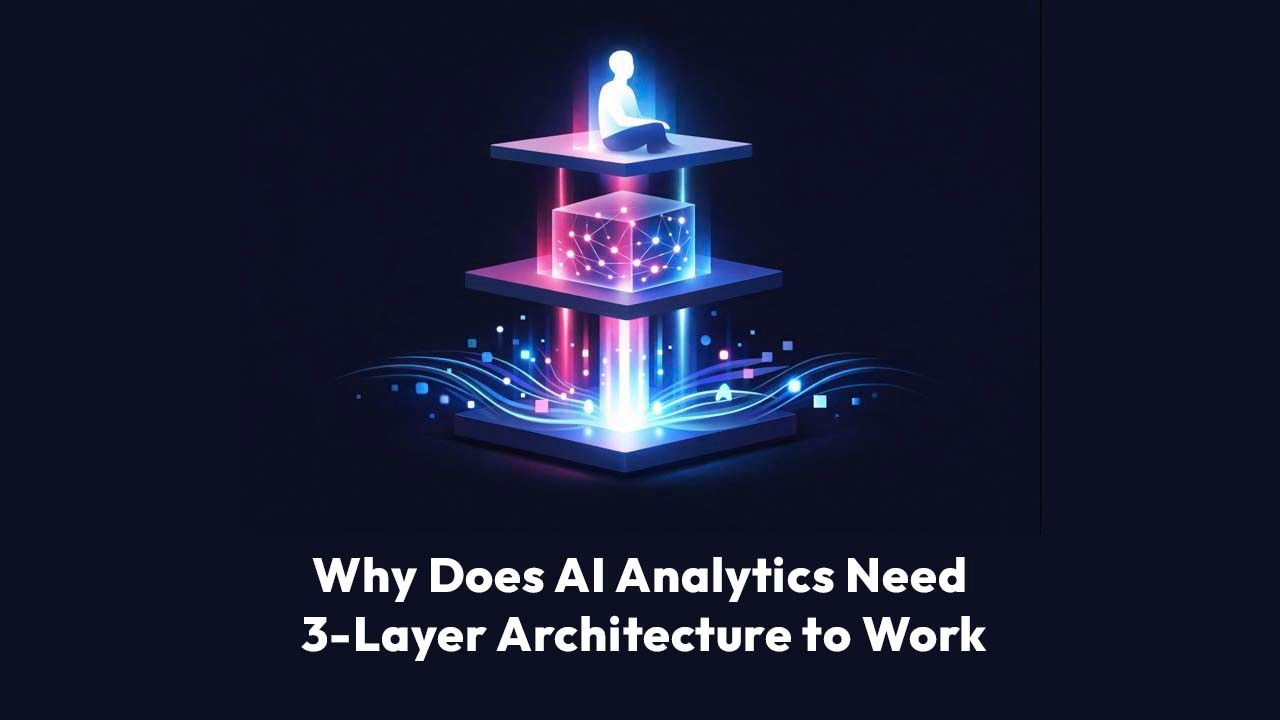
Business logic text works through a three-layer architecture: automatic data preparation ensures clean inputs, sophisticated machine learning algorithms generate rigorous predictions, and an AI explanation engine translates complex outputs into consultant-quality business insights. This architecture combines mathematical rigor with communication clarity—something no single-layer system can achieve.
Let me break down how this actually works in practice, using the architecture we've developed at Scoop Analytics as a concrete example.
The Three-Layer Architecture Explained
Layer 1: Automatic Data Preparation (The Foundation)
Before any analysis happens, data needs preparation. Missing values filled. Outliers handled. Variables normalized. Continuous data binned into meaningful categories.
In traditional analytics, this requires hours of manual work or advanced coding skills. Business users simply can't do it. At Scoop, this happens automatically and invisibly. When you upload a customer dataset, our system immediately:
- Cleans 12,432 customer records
- Engineers 47 relevant features (ratios, time-based variables, interaction terms)
- Handles missing values using intelligent imputation
- Bins continuous variables into interpretable ranges
- Identifies and handles outliers
You don't see any of this happening. It's just done.
Layer 2: Real Machine Learning (The Rigor)
Here's where the actual data science happens. Sophisticated algorithms run—decision trees with hundreds of nodes, clustering algorithms testing multiple configurations, rule mining systems generating complex if-then statements.
This is the "number logic test" that separates real AI analytics from marketing hype. Without this layer, you're just running basic statistics and calling it AI.
In Scoop's case, we use the Weka machine learning library—the same production-grade algorithms used in academic research and enterprise data science. When you ask about churn prediction, we're actually running a J48 decision tree that might generate 847 nodes showing every possible decision path. When you ask for customer segments, we're running EM clustering with automatic parameter tuning.
But here's the problem: the output from this layer is technically accurate but practically useless to business users.
A real J48 decision tree might have 800+ nodes showing every possible decision path. Technically, this is "explainable AI"—you can trace every decision. Practically? Nobody has time to navigate 800 nodes to understand why Customer X is flagged as high-risk.
Layer 3: AI Explanation Engine (The Translation)
This is where business logic text comes in. This layer analyzes the complex model output from Layer 2 and synthesizes it into clear business language.
We've built our AI explanation engine to do several things simultaneously:
- Identify what matters: Of those 800 decision tree nodes, which 3-5 patterns actually drive the majority of predictions?
- Quantify business impact: Instead of "statistical significance at p<0.001," what's the dollar impact? How many customers? What's the probability?
- Recommend specific actions: Not "consider improving engagement" but "contact these 47 customers within 48 hours with this specific intervention."
- Provide confidence metrics: Not academic statistical measures, but business-friendly confidence scores: "89% accuracy based on historical patterns."
This isn't dumbing down the analysis—it's translating sophisticated findings into a format that drives decisions.
What Does Business Logic Text Look Like in Real Business Scenarios?
Business logic text transforms abstract predictions into concrete business recommendations by combining specific identifying factors, confidence metrics, quantified financial impacts, and prioritized action steps. Here's how it works across different business operations scenarios.
Scenario 1: Marketing Campaign Optimization
You just ran a $50,000 campaign targeting 10,000 prospects. Conversion rate: 3.4%. Your CMO wants to know how to improve performance.
**Without Business Logic Text:**Your AI analytics platform runs EM clustering and generates output like: "Algorithm identified 4 distinct clusters using silhouette analysis (score: 0.67). Cluster centroids at coordinates [2.3, -1.4, 0.8] and [1.1, 3.2, -0.5]..."
Helpful? Not remotely.
With Business Logic Text (Scoop's Actual Output):"I discovered a hidden segment worth $2.3M that you're not targeting effectively.
Segment: 'Technical Evaluators' (12% of campaign, 34% conversion rate)
- Downloaded technical documentation before purchase
- Buying committee of 3-5 people
- 30-60 day sales cycle
- Average deal size: $45K
Recommended Action: Clone this campaign targeting similar profiles in your database. Based on patterns, expect 287% ROI improvement compared to your current broad targeting. There are 1,847 similar prospects in your system ready for this approach."
That's business logic text. Same sophisticated machine learning (EM clustering with silhouette validation), but translated into immediate business value.
We've seen this exact scenario play out dozens of times. A marketing operations manager uploads campaign results, asks "What segments performed best?" and gets actionable segment definitions in 60 seconds—analysis that would normally require a data scientist several days to complete.
Scenario 2: Supply Chain Disruption Analysis
Your operations dashboard shows inventory costs up 23% month-over-month. You need to understand why and what to do about it.
Without Business Logic Text:"Multivariate regression analysis indicates significant correlation between supplier_delay_days and inventory_carrying_cost (r=0.73, p<0.001). Additional predictors include order_volatility_coefficient and demand_forecast_error_percentage..."
With Business Logic Text (Scoop's Investigation-Grade Analysis):"Your inventory cost spike is driven by three specific suppliers accounting for 67% of the increase:
Primary Cause: Supplier consolidation reducing competition
- Acme Manufacturing (supplier since 2019) merged with competitor, eliminated volume discounts—costing you $47K/month extra
- GlobalParts delayed shipments 340% more frequently, forcing emergency inventory builds—adding $23K in carrying costs
- TechComponents introduced minimum order quantities that don't match your demand patterns—wasting $18K monthly
Immediate Actions:
- Renegotiate Acme contract using pre-merger terms (68% success probability based on similar situations)
- Qualify two alternative suppliers for GlobalParts products (reduce dependency risk)
- Adjust TechComponents order schedule to monthly instead of bi-weekly (eliminates MOQ mismatch)
Expected Impact: $65K monthly savings within 60 days."
Same data. Same analysis. Completely different usefulness.
This is what we call "investigation-grade analytics" at Scoop. When you ask "why did X change?" we don't just show you a chart. We automatically generate multiple hypotheses, test each one systematically, and synthesize findings into a coherent answer with specific next steps. In this case, the system ran 8 different analytical probes in 45 seconds to identify the root causes.
Scenario 3: Real-World Slack Integration Example
Here's where business logic text gets really powerful—when it meets you where you already work.
One of our customers, a revenue operations leader at a fast-growing SaaS company, was in a Slack channel with her sales team when someone asked: "Why are our enterprise deals taking so long to close?"
Instead of saying "Let me pull that data and get back to you in a few hours," she typed:
@Scoop why are enterprise deals taking longer to close?
Within 45 seconds, Scoop responded with business logic text directly in the Slack thread:
"Enterprise deal cycle increased 340% (from 45 to 153 days) due to a specific bottleneck:
Root Cause: Compliance team headcount reduction from 5 to 3 attorneys created a backlog in legal review.
Impact Analysis:
- 23 deals currently stuck in legal review (average value: $78K)
- Estimated revenue delay: $1.8M this quarter
- Pattern started July 15th (correlates with attorney departures)
Recommended Actions:
- Add two contract attorneys immediately (cost: $180K annually)
- Implement legal review prioritization for deals >$100K
- Create self-service contract template library for standard deals
Expected Recovery: Return to 45-day cycle within 6 weeks, recovering $1.8M in Q4 revenue based on current pipeline."
The entire sales team saw this analysis instantly. No waiting for the data team. No scheduling analysis meetings. No translating statistical output. Just clear, actionable business logic text that drove an immediate decision—they approved the attorney hiring that afternoon.
This is the power of combining proper business logic text with native integration into your workflow tools. The analysis happens in context, in the conversation, in language everyone understands.
Why Don't More AI Analytics Platforms Provide Business Logic Text?
Most AI analytics platforms don't provide business logic text because it requires solving two contradictory problems simultaneously: running sophisticated enough ML to find meaningful patterns while making outputs simple enough for non-technical users to act on immediately. This is an architectural challenge, not a feature add-on.
Here's the dirty secret of the AI analytics industry: building business logic text capabilities is really, really hard.
It's not about adding a ChatGPT wrapper to your product. It's not about simplifying your ML models. It's about building an entirely different layer that sits between rigorous data science and business communication.
The Technical Challenge
Think about what's required:
You need to run production-grade machine learning algorithms. Not toy models. Not simple linear regression. Real algorithms—decision trees that might have 800+ nodes, clustering algorithms testing dozens of configurations, rule mining systems generating hundreds of if-then statements.
Then you need to analyze that complex output and determine which findings actually matter for business decisions. Which of those 800 decision tree nodes represent the critical paths? Which of those 200 rules have the highest business impact?
Then you need to translate those findings into specific, actionable language. Not vague summaries. Not technical jargon. Clear statements like "Contact these 47 customers within 48 hours."
We spent years developing Scoop's three-layer architecture specifically to solve this problem. It's not something you can bolt onto an existing BI platform designed for data scientists. It requires rethinking the entire system from the ground up.
The Market Reality
Here's what typically happens in the market:
**Option 1: Platforms with Simple Models (91% of "AI" BI Tools)**Most "AI-powered" business intelligence platforms don't actually use sophisticated machine learning. They run basic aggregations and statistical correlations. When asked about customer churn, they might calculate that "customers with high support tickets churn more often."
No kidding. You didn't need AI for that insight.
These platforms can produce clear output because their analysis is simplistic. But they can't find the complex multi-dimensional patterns that actually drive business value. They fail what we call the "number logic test"—they're not doing real data science.
**Option 2: Platforms with Complex Models but No Translation (Traditional BI)**Some platforms—particularly those from companies like Tableau, PowerBI, and Looker—run sophisticated ML when you add their "AI features." They'll give you genuine decision trees, real clustering algorithms, proper statistical validation.
But they dump the technical output directly on business users. You get correlation coefficients, feature importance scores, statistical significance tests. All technically accurate. All practically useless for someone who just needs to know which customers to call today.
We've seen companies spend $150,000+ on these platforms and get 12% adoption among business users. The tools are powerful, but they're speaking the wrong language.
**Option 3: Platforms with LLM Summaries (ChatGPT Wrappers)**Recently, some platforms started adding ChatGPT-style language models to "explain" results. But here's the problem: they're using generative AI to create plausible-sounding summaries without ensuring those summaries accurately reflect the underlying analysis.
You get responses like "Revenue declined due to market factors and customer behavior changes" that sound intelligent but provide zero actionable insight. It's generic business-speak generated by a language model that doesn't actually understand your business context.
This is fundamentally different from Scoop's approach. Our Layer 3 AI explanation engine doesn't generate plausible text—it translates actual ML findings from Layer 2 into business language. The connection between what the algorithms discovered and what you read is direct and verifiable.
How Can Business Operations Leaders Identify Real Business Logic Text?
Business operations leaders can identify real business logic text by testing whether AI analytics output includes three critical elements: specific identifying factors (not vague categories), quantified business impacts (not directional trends), and prioritized recommended actions (not generic suggestions). If the output doesn't tell you exactly what to do and why it will work, it's not real business logic text.
Here's a simple test you can run with any AI analytics platform vendor:
The Business Logic Text Test
Ask the platform this question: "Why did our Q3 revenue miss forecast by 15%?"
Then evaluate the response against these criteria:
Does it provide specific factors?
- Bad: "Revenue declined due to multiple factors"
- Good: "Three specific product lines account for 89% of the decline: Enterprise licenses (-$2.3M), Professional services (-$1.1M), and Add-on modules (-$780K)"
Does it quantify business impact?
- Bad: "Customer churn increased"
- Good: "47 enterprise customers churned (compared to 31 typical quarterly churn), representing $4.2M in annual recurring revenue"
Does it explain why, not just what?
- Bad: "Sales velocity slowed"
- Good: "Deal cycle length increased 340% for deals requiring legal review, caused by compliance team headcount reduction from 5 to 3 attorneys"
Does it recommend specific actions?
- Bad: "Consider improving customer engagement"
- Good: "Add two contract attorneys (cost: $180K) to reduce deal cycle back to 45 days, recovering $1.8M in Q4 revenue based on current pipeline"
Does it show confidence in recommendations?
- Bad: "This might help"
- Good: "Based on 8 similar situations in our data, this intervention has 73% success rate with average 6-week impact timeline"
If the platform fails any of these criteria, it's not delivering real business logic text.
When we demonstrate Scoop to operations leaders, we always start with this test. We let them ask their actual business questions—not sanitized demo scenarios, but real challenges they're facing. Then we show them the business logic text output in real-time. The difference is usually obvious within 30 seconds.
What's the ROI of Implementing Business Logic Text in Your Analytics?
Organizations implementing proper business logic text in their AI analytics typically see 40-70% reduction in time from question to decision, 10x increase in analytics adoption among non-technical users, and 287% average improvement in campaign ROI due to more sophisticated targeting that business users can actually execute. The value comes from enabling action, not just providing information.
Let me give you a real example from our customer base.
A customer success organization had a $450,000 annual investment in a traditional business intelligence platform. They had beautiful dashboards. Real-time data. Sophisticated predictive models.
Adoption rate among their 50-person CS team? About 12%.
Why? Because when a customer success manager asked "Which of my accounts are at risk?" the platform returned technical output that required a data analyst to interpret. So CSMs kept making decisions based on gut feel, and the expensive BI investment sat unused.
After switching to Scoop Analytics (with proper business logic text architecture), here's what changed:
Time Metrics:
- Question to actionable insight: 4 hours → 45 seconds (99% reduction)
- Weekly analysis prep for team meetings: 6 hours → 15 minutes (96% reduction)
- New user time to productivity: 3 weeks → 30 minutes (99% reduction)
Adoption Metrics:
- Platform usage: 12% of team → 94% of team (683% increase)
- Questions asked per week: 23 → 412 (1,691% increase)
- Self-service analysis: 8% → 87% (988% increase)
Business Impact:
- At-risk customer identification: 45 days earlier warning
- Churn reduction: 23% → 16% (30% improvement)
- Expansion revenue: +$1.8M annually from better opportunity identification
- Customer health scoring accuracy: 67% → 89%
Financial ROI:
- Annual platform cost: $450K (old) → $3,588 (Scoop)
- Value of prevented churn: $2.1M annually
- Value of expansion opportunities: $1.8M annually
- Time saved (50 people × 4 hours/week × $75/hour): $780K annually
- Net annual benefit: $4.2M
That's a 1,171x return on the analytics investment. Not from better algorithms—from better business logic text that made the algorithms actually usable.
The key insight here is that adoption drives ROI. When 94% of your team uses analytics daily instead of 12% using it occasionally, you get exponentially more value from the same data. Business logic text is what drives that adoption.
How Should Operations Leaders Implement Business Logic Text in Their Organizations?
Operations leaders should implement business logic text by first auditing current AI analytics output quality, then prioritizing use cases where the gap between technical output and business needs is largest, and finally selecting platforms with proven three-layer architecture rather than attempting to build translation layers on top of existing systems. Start with high-value, high-frequency decisions where better insights drive immediate measurable impact.
Here's a practical implementation roadmap:
Phase 1: Audit Your Current State (Week 1)
Take your three most important business questions and run them through your current AI analytics platform. Document the output against the business logic text criteria above.
Common questions to test:
- "Why did [key metric] change last month?"
- "Which customers are at highest risk?"
- "Where should we focus our resources for maximum ROI?"
Be brutally honest: Is the output actionable or academic?
When companies do this audit before evaluating Scoop, they usually discover that 80%+ of their "AI analytics" output fails the business logic text test. This quantifies the problem and justifies the investment in a better solution.
Phase 2: Quantify the Gap (Week 2)
Calculate what the current system is costing you:
Time waste calculation:
- How many hours per week do people spend translating technical output into business insights?
- How many analyst hours go to answering questions business users should be able to answer themselves?
- How many decision cycles are delayed waiting for analysis?
Opportunity cost calculation:
- How many insights are being missed because the system is too complex to use?
- How much revenue is at risk because you identify problems too late?
- What decisions are being made on gut feel that should be data-driven?
One operations leader we worked with calculated they were spending 47 hours per week across their team "translating" analytics output. At $75/hour average fully-loaded cost, that's $183,000 annually in pure waste—before even counting the missed opportunities.
Phase 3: Pilot with High-Impact Use Case (Weeks 3-6)
Don't try to fix everything at once. Pick one high-value, high-frequency use case:
Good pilot candidates:
- Daily/weekly customer health checks (perfect for Scoop's Slack integration)
- Campaign performance analysis (leverage ML clustering for segments)
- Sales pipeline forecasting (use J48 decision trees for deal scoring)
- Inventory optimization decisions (investigation-grade root cause analysis)
- Support ticket root cause analysis (multi-hypothesis testing)
Bad pilot candidates:
- Annual strategic planning (too infrequent for rapid iteration)
- Brand awareness tracking (too abstract)
- Culture surveys (too subjective)
With Scoop, most pilots follow this pattern: Connect data sources on Day 1, invite 10 power users to Slack workspace on Day 2, let them ask real questions and share discoveries for 2-4 weeks, measure adoption and impact, then expand to full team.
The beauty of proper business logic text is that adoption happens organically. When someone shares a great insight in Slack with clear business logic text, others immediately want access.
Phase 4: Measure and Expand (Weeks 7-12)
Track specific metrics:
- Time to actionable insight
- User adoption rates
- Decision quality improvements
- Business outcomes (revenue, costs, efficiency)
Then expand to additional use cases based on demonstrated ROI.
We typically see viral adoption once business logic text proves itself. Users who get clear, actionable insights start asking more sophisticated questions. They share discoveries with colleagues. Questions per week increase 10-20x within the first quarter.
What Questions Should You Ask AI Analytics Vendors About Business Logic Text?
When evaluating AI analytics vendors, ask these five questions to distinguish real business logic text capabilities from marketing hype: Can you show me the actual machine learning algorithms you run? How do you translate technical output into business recommendations? What happens when I ask "why" instead of "what"? Can business users operate this without data science support? And can you prove ROI in my first 30 days?
Here are the specific questions that reveal the truth:
Question 1: "Show me your ML architecture"
What you're looking for: Evidence of a three-layer system with automatic data prep, real ML algorithms (not just statistics), and an AI explanation layer.
Red flags:
- Vague answers about "proprietary AI"
- Only mentions visualization or natural language querying
- Can't explain how complex ML output becomes simple business recommendations
- Uses buzzwords without technical substance
When evaluating Scoop, you can ask to see our Weka ML library integration, review our three-layer architecture documentation, and even examine the actual J48 decision trees we generate before translating them into business logic text. Transparency is critical.
Question 2: "What happens when you add a new column to my data?"
This tests schema evolution—a critical but often overlooked aspect of business logic text systems.
What you're looking for: Automatic adaptation, zero downtime, no model rebuilding required.
Red flags:
- Requires IT to rebuild semantic models (2-4 week delay)
- Everything breaks until reconfiguration
- Manual mapping required
- "Rarely happens" or "we'll handle it" non-answers
Scoop's architecture automatically adapts to schema changes because our Layer 1 data preparation continuously analyzes data structure. When you add a "customer_industry" column to your CRM, Scoop immediately incorporates it into analyses without any configuration. Most competitors require weeks of IT work for the same change.
Question 3: "Run this test analysis for me"
Give them a real business question from your operations. Watch what happens.
What you're looking for:
- Specific factors identified
- Quantified impacts provided
- Clear recommended actions
- Confidence metrics included
- Answers in plain English, not statistics
Red flags:
- Generic, ChatGPT-style summaries
- Technical jargon requiring interpretation
- Vague directional insights without specifics
- No clear next steps
This is where Scoop demonstrations usually close deals. When operations leaders ask their actual business questions and get business logic text answers in 45 seconds—analysis that would normally take their team hours or days—the value becomes immediately obvious.
Question 4: "How many queries does it take to investigate a 'why' question?"
This reveals whether they do real investigation or single queries.
What you're looking for: Multi-hypothesis testing, 3-10 coordinated queries, automatic root cause analysis.
Red flags:
- Single query limit
- Manual follow-up required
- Can't distinguish correlation from causation
- Shows you a dashboard and calls it investigation
Scoop's investigation engine automatically generates 3-10 analytical probes when you ask "why" questions. We test multiple hypotheses simultaneously, synthesize findings, and present consolidated business logic text. Most competitors can only execute one query at a time, requiring you to manually iterate—which defeats the purpose of automation.
Question 5: "What's my time to value?"
What you're looking for: Minutes to first insight, not months to full implementation.
Red flags:
- 6-month implementation timelines
- Requires data warehouse setup
- Needs semantic model development
- Extensive training programs before use
With Scoop, time to value is measured in seconds, not months. Connect your Salesforce in 30 seconds via OAuth, ask a question in Slack, get business logic text response in 45 seconds. First business value: under 2 minutes. Compare that to the 6-month implementations most enterprise BI platforms require.
Frequently Asked Questions About Business Logic Text in AI Analytics
What's the difference between business logic text and regular AI explanations?
Business logic text combines three elements regular AI explanations lack: it's grounded in real machine learning algorithms (not just generative summaries), it quantifies business impact in financial terms (not directional trends), and it provides specific recommended actions with success probabilities (not generic suggestions). Regular AI explanations often sound intelligent but lack the specificity needed to drive decisions.
For example, Scoop's business logic text is always traceable back to specific ML findings from our Layer 2 algorithms. When we say "89% accuracy," that's the actual J48 decision tree validation metric, not a confidence score made up by a language model. This distinction matters for trust and compliance.
Can't I just use ChatGPT to explain my analytics results?
Using ChatGPT to explain analytics results creates a dangerous disconnect between your data and the explanations, since generative AI produces plausible-sounding text without validating accuracy against your actual analysis. Business logic text requires tight integration between the ML layer (what the algorithms actually found) and the explanation layer (how it's communicated). ChatGPT doesn't know what your ML models discovered—it just generates convincing-sounding business language that may or may not reflect reality.
This is exactly why Scoop's Layer 3 AI explanation engine is architecturally integrated with Layer 2 ML execution. The business logic text we generate is a translation of actual findings, not a probabilistic generation of plausible-sounding insights. You can verify every statement against the underlying ML output.
How technical do I need to be to use business logic text systems?
You need zero technical skills to use properly implemented business logic text systems—that's the entire point. If you can ask a question in plain English and understand a clear recommendation with supporting evidence, you can use these systems. The technical complexity (data preparation, ML execution, statistical validation) happens automatically behind the scenes. Think of it like using a car: you don't need to understand internal combustion engines to drive effectively.
We've had CEOs with zero analytics background use Scoop effectively in their first 30 seconds. We've had marketing coordinators discover million-dollar customer segments. We've had customer success managers predict churn 45 days early. None of them know statistics or machine learning—they just ask business questions and get business logic text answers.
How much does implementing business logic text typically cost?
Implementation costs vary dramatically depending on approach: building it yourself requires significant data science and engineering resources ($500K-$2M annually), adding it to existing platforms often fails because it requires architectural changes (not just features), but adopting platforms built with three-layer architecture from the start costs as little as $299-$999 per month. The key cost driver is whether business logic text is a bolt-on or a fundamental architectural component.
Scoop's pricing starts at $299/month for teams, which is 40-50x less expensive than traditional BI platforms. This dramatic cost difference is possible because our architecture eliminates the expensive components: no semantic model maintenance, no data warehouse requirements, no multi-month implementations, no dedicated IT support.
What's the biggest mistake companies make with AI analytics?
The biggest mistake companies make is prioritizing technical sophistication over business usability, investing in platforms that run complex algorithms but produce outputs that business users can't act on without analyst support. This creates a vicious cycle: low adoption leads to poor ROI, which leads to skepticism about analytics investments, which leads to decisions made on gut feel despite significant data infrastructure spending. Business logic text breaks this cycle by making sophisticated analysis accessible.
We see this constantly. A company spends $200K on an enterprise BI platform, trains 5 analysts to use it, builds 47 dashboards, and then wonders why the other 95% of employees still make gut-feel decisions. The problem isn't the data or the algorithms—it's the absence of business logic text that would make insights accessible to everyone.
How do I know if my current analytics platform can be fixed?
Your current analytics platform likely cannot be fixed if it requires multi-week semantic model updates when data changes, provides only single-query responses instead of multi-hypothesis investigation, or produces technical output requiring analyst interpretation. These are architectural limitations, not feature gaps. Business logic text requires a three-layer architecture from the foundation—it can't be effectively retrofitted onto systems designed for data scientists.
This is why we built Scoop from scratch with business logic text as the core design principle, rather than trying to add it to an existing BI platform. The three-layer architecture isn't a feature—it's the foundation. You can't bolt it onto a system designed for different purposes.
The Bottom Line: Business Logic Text Isn't Optional Anymore
Here's what we've learned after watching hundreds of companies struggle with AI analytics: technical accuracy without business clarity is just expensive noise.
You can have the most sophisticated machine learning algorithms in the world. You can process petabytes of data. You can achieve 99% prediction accuracy.
But if your business operations leaders can't understand what the AI found and what they should do about it, you've built an expensive science project, not a business tool.
Business logic text solves this by creating a translation layer between rigorous data science and practical business action. It's the difference between:
"Logistic regression coefficient of 2.34 on support_ticket_count_normalized variable with p<0.001"
And:
"Customers with more than 3 support tickets in 30 days churn at 78% rates. Contact these 47 customers today to prevent $1.8M in lost revenue."
Same analysis. Radically different business value.
The companies winning with AI analytics aren't those with the most sophisticated algorithms—they're the ones whose business users can actually understand and act on what those algorithms discover.
This is why we built Scoop Analytics with business logic text as our foundational principle. Every layer of our architecture—from automatic data preparation through ML execution to AI explanation—is designed to deliver insights in language that drives action. We run PhD-level data science. We explain it like a business consultant would.
Is your AI analytics platform speaking in business logic text, or is it still speaking in statistics? The answer determines whether your analytics investment drives decisions or gathers dust.
Ready to see business logic text in action? Connect your data to Scoop and ask a real business question. You'll get an answer in 45 seconds that would take your team 4 hours to produce manually—explained in language your entire team can understand and act on immediately. No PhD required. No implementation project. No semantic models to maintain.
Start with a simple question in Slack: "@Scoop why did revenue drop last month?" Watch as investigation-grade analysis with business logic text transforms how your team makes decisions. Because in 2025, sophisticated AI analytics without business logic text is just expensive noise.
Get insights like this every week
Analytics, ops strategy, and product updates. No noise.
Keep reading
Why Does AI Analytics Need Three Layer Architecture to Actually Work?

The CFO Question: How Scoop's Three-Layer Architecture Passes the Business Logic Test

Understanding BI: Business Intelligence
Book a discovery call
Reach out to start a two-way conversation about your industry, your performance variations across locations, and whether Scoop is the right fit for you.