
How To Integrate Margin Calculation Features Into Custom Business Software?
Integrating margin calculation into custom business software means building real-time cost and revenue logic directly into the tools your team already uses — so margin visibility becomes automatic, not a manual exercise. Done right, it eliminates the lag between a pricing decision and its financial impact, and gives operations leaders a live view of profitability at every level of the business.
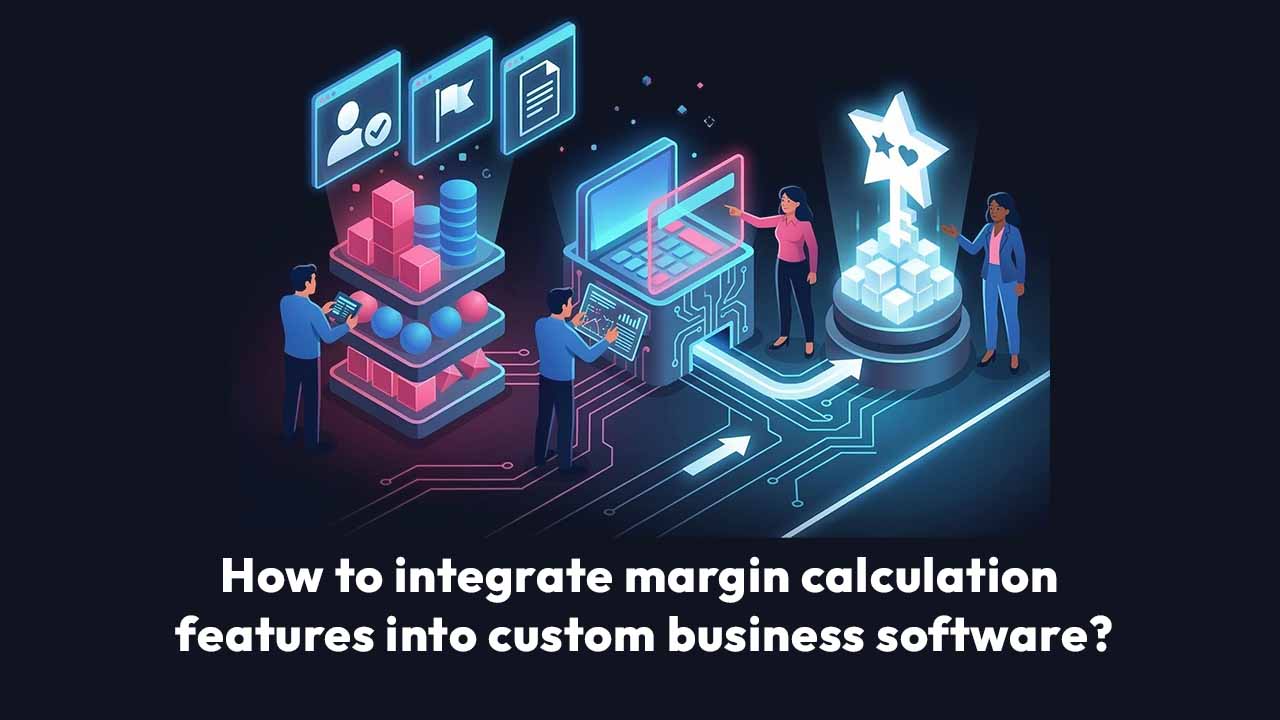
That is the short answer. But if you have spent any time trying to actually do this, you know the distance between "integrate margin calculation" and "make it work reliably across your entire operation" is substantial. Let us close that gap.
What Is Margin Calculation in the Context of Custom Business Software?
Margin calculation in custom business software is the automated process of computing profit margins — gross, net, or contribution — using live operational data rather than periodic manual exports. Instead of an analyst downloading a report and running formulas in a spreadsheet, the margin is calculated continuously inside the software itself, updated every time a relevant variable changes.
A definition worth anchoring to: gross margin is revenue minus cost of goods sold (COGS), expressed as a percentage of revenue. Net margin subtracts all operating costs from that. Contribution margin isolates variable costs only, making it especially useful for decisions about pricing, product mix, or channel strategy.
The reason this distinction matters when building custom software is that each margin type requires different inputs. Gross margin needs clean COGS data. Net margin needs overhead allocation. Contribution margin needs your variable cost logic. Getting the formula right in a spreadsheet is one thing. Building that logic reliably into a software system is another entirely.
The data is there. The why isn't.
Scoop connects to your CRM, marketing tools, and spreadsheets and investigates like a senior analyst — testing hypotheses, finding patterns, and surfacing what's actually driving your numbers.
✨ No credit card required • 🔗 150+ data source connections • 👤 No data team needed
Why Do Most Businesses Get This Wrong?
Here is the uncomfortable truth: most operations teams think they have margin visibility. They do not.
They have margin snapshots — usually from last month's close — stitched together from exports, cleaned up in Excel, and distributed in a report that is already stale before it lands in anyone's inbox. Meanwhile, the actual business kept moving. Costs shifted. A supplier raised prices. A new channel brought in volume at lower margins. None of that is visible until the next reporting cycle.
We have seen this pattern repeatedly across DTC brands, SaaS companies, and professional services firms alike. A business generating $8 million in revenue discovers, after finally building real-time margin tracking into their custom business software, that one of their three product lines has been operating below break-even for six months. The sales team was celebrating revenue growth. The margin data was hiding a slow bleed.
Surprising fact: Research across thousands of e-commerce businesses suggests median net margins hover around 3%. Not 30%. Three. That razor-thin number should make every operations leader think carefully about how often they actually see their real margin — not the estimated one.
The problem is almost never the formula. The problem is data latency, missing cost variables, and tools that were not designed to make margin a first-class metric.
What Are the Core Components of a Margin Calculation System in Custom Software?
How Do You Structure the Input Layer?
Every margin calculation depends on the quality of its inputs. Before writing a single line of integration logic, you need to know exactly what cost components will feed the system. For most businesses, the minimum viable input set looks like this:
- Revenue per transaction — unit price, quantity, and any discounts applied
- Direct costs — COGS, raw materials, or cost of service delivery
- Variable costs — shipping, payment processing fees, marketplace commissions
- Overhead allocations — if calculating net margin, a method for allocating fixed costs to products, channels, or customers
- Returns and adjustments — often the most underestimated variable
That last one deserves more attention. Returns are frequently excluded from margin calculations because they are handled in a separate system — a returns management platform, a customer service tool, or a manual process. When custom business software does not account for return rates, it systematically overstates margin. For categories with high return rates, that overstatement can be significant.
How Does the Calculation Engine Work?
The calculation engine is where the margin logic lives. In custom software, this typically takes one of three forms:
Formula-based engines are the most straightforward. You define the margin formula as a function, pass in the relevant data fields, and get a result. This works well for simple gross margin calculations but breaks down quickly when cost structures become complex — variable overhead, tiered pricing, multi-currency transactions.
Rule-based engines add conditional logic. A product sold through a direct channel has a different cost structure than the same product sold through a distributor. A customer on an enterprise contract has different unit economics than one on a self-serve plan. Rule-based engines let you encode that complexity, applying the right cost logic based on transaction attributes.
Streaming calculation engines are the most powerful — and the most relevant for operations leaders dealing with large data volumes and continuous change. Instead of calculating margin on demand or in batch, the engine processes every transaction through margin logic as it arrives. The result is always current. This is the architecture behind platforms like Scoop Analytics, which uses an in-memory spreadsheet calculation engine with over 150 Excel-compatible functions to stream data through transformation logic at scale — turning what would otherwise require a data engineering team into something any operations analyst can configure and maintain.
How Do You Actually Integrate Margin Calculation Into Existing Custom Business Software?
This is the question most articles skip past. Let us not do that.
Step 1: Map Your Cost Data to Its Sources
Before any integration, document where each cost component currently lives. COGS might be in your ERP. Shipping costs in your logistics platform. Marketplace fees in a settlement report. Payment processing fees in Stripe. Returns in your CRM.
Every source needs an integration path — either a native connector, an API connection, or a scheduled data pull. The completeness of this map directly determines the accuracy of your margin calculations. Missing one source means every margin figure the software produces is wrong by a predictable amount.
Step 2: Define the Margin Logic for Your Business
Do not assume there is a universal formula. Your margin logic is a business decision, not a technical one. Questions you need to answer before writing a single function:
- Do we allocate overhead to product-level margins, or only calculate contribution margin at that level?
- How do we handle bundled products with mixed margins?
- Are returns deducted from revenue or added to cost?
- How do multi-currency transactions get normalized?
Getting this wrong in the design phase creates a calculation engine that produces numbers nobody trusts. And a margin figure nobody trusts is worse than no margin figure at all, because it creates false confidence.
Step 3: Build in a Testing Layer
This is the step most custom software projects skip, and it is the one that causes the most problems downstream. Before deploying margin calculation logic into production, you need a test suite that validates the output against known-good historical data.
Take three months of closed transactions where you already know the correct margin — verified manually or through your accounting system. Run them through your new calculation engine. If the output does not match, the difference tells you where your logic is broken.
Bold question: How many decisions has your team made this year based on a margin figure that no one actually verified?
Step 4: Design for Real-Time Visibility
The point of integrating margin calculation into custom business software is not to produce a better report. It is to make margin a live operational metric — something every relevant team can see, in context, at the moment they are making decisions.
That means building a presentation layer that surfaces margin data where it is actually used. For a sales team, that might mean margin visibility on a deal record in the CRM before they finalize pricing. For an operations team, it might mean margin by channel on the same dashboard they use to monitor order volume. For an executive team, it might mean margin trending over time, by product line, with anomaly detection that flags when something material has changed.
Step 5: Connect the Margin Layer to Your Analytics Stack
Here is where the investment compounds. A margin calculation engine built in isolation produces numbers. Connected to a broader analytics platform, it produces intelligence.
When margin data flows into a platform like Scoop Analytics, it becomes queryable. An operations leader can ask, without writing SQL or waiting for a data analyst: "Which product categories are showing margin compression this quarter?" or "How does margin on our enterprise segment compare to last year, by channel?" The calculation engine handles the math. The analytics layer handles the investigation.
This is the difference between knowing your margin and understanding it.
What Are the Most Common Integration Challenges — and How Do You Solve Them?
Challenge: Inconsistent Cost Data Across Systems
The most frequent failure mode. COGS in the ERP does not match the landed cost in the procurement system because one includes freight and the other does not. When both flow into the margin calculation, the output is unpredictable.
Solution: Establish a single authoritative source for each cost component before integration begins. If that means a data cleaning project upstream, do it. There is no technical workaround for bad source data.
Challenge: Margin Logic That Does Not Reflect How the Business Actually Works
Finance builds the margin formula based on accounting rules. Operations uses it to make pricing decisions. The two frameworks do not always align. The result is a calculation that is technically correct but operationally useless.
Solution: Design margin logic collaboratively with both finance and operations stakeholders before building anything. A shared definition — even an imperfect one — is better than two competing definitions that produce different numbers from the same data.
Challenge: Performance Degradation on Large Datasets
Margin calculations that work fine on a thousand transactions start to slow down on a million. If the calculation engine runs in-memory against a full transaction history every time a user loads a dashboard, response times become unusable.
Solution: Use incremental calculation strategies. Calculate margin on new transactions as they arrive, store the result, and aggregate stored results rather than recalculating from scratch on every query. This is exactly how streaming architectures handle the problem — and why platforms built on in-memory calculation engines with streaming architectures consistently outperform batch-calculation approaches on large datasets.
Challenge: Margin Visibility Without Governance
Giving every user access to full margin data sounds like the right move. It can also create problems — competitive information exposed to the wrong people, margin targets visible to sales reps who use them as negotiating leverage in the wrong direction, or cost data accessible to partners who should not see it.
Solution: Build role-based margin visibility into the integration from the start. Not every user needs to see full contribution margin with overhead allocation. Some need gross margin by product. Some need net margin by channel. Scoping what each user or role sees keeps the data accessible and protected simultaneously.
How Does AI Change the Margin Calculation Picture?
Integrating AI into a margin calculation system does not change the math. The formula for gross margin is the same whether a human calculates it or an algorithm does. What AI changes is what you can do with the result.
A traditional margin calculation tells you the current state. An AI-augmented system — like what Scoop Analytics provides — tests hypotheses about why the margin is what it is. It does not just surface that margin on a product line dropped 4 points last quarter. It investigates whether that drop correlates with a change in channel mix, a cost increase from a specific supplier, a shift in customer segment, or a pricing change that did not have the intended effect.
That shift — from calculation to investigation — is significant. We have reached a point where the technical challenge of calculating margin accurately is largely solved. The harder problem, and the more valuable one, is turning that margin data into a continuous source of operational insight. That is where the investment in connecting your custom business software to a true analytics layer pays off.
Frequently Asked Questions
What is the best approach to integrate margin calculation into legacy custom business software?
Start with a data mapping exercise before touching any code. Identify every cost variable that feeds your margin calculation and document which system is the authoritative source. Then build an integration layer — API connections or scheduled data pulls — that brings those variables into a central calculation engine. For legacy systems that cannot support real-time data feeds, batch processing with frequent refresh cycles (hourly or sub-hourly) is a practical middle ground. The key is that the calculation logic lives in one place, not scattered across spreadsheets maintained by different teams.
How do you handle multi-currency margin calculations in custom business software?
Define a base currency for internal reporting and apply consistent exchange rate logic — either real-time rates from a currency API or periodic fixed rates aligned with your accounting conventions. The critical mistake to avoid is applying exchange rates at the wrong point in the calculation. Convert all cost components to the base currency before computing margin, not after. Inconsistent currency normalization is one of the most common sources of unexplained margin variance in multi-market businesses.
Can small businesses benefit from integrating margin calculation into custom software?
Absolutely — and often more so than large enterprises, because small businesses have fewer resources to absorb margin errors before they become existential. The complexity of the integration scales with the complexity of the business. A small DTC brand with a single channel and a simple product catalog can build functional real-time margin tracking with a lightweight data integration and a BI platform like Scoop Analytics, without a dedicated engineering team. The ROI on getting margin visibility right early is consistently higher than retrofitting it later when the business has grown and the data landscape has become more complex.
How does margin calculation in custom business software differ from what ERP systems provide out of the box?
ERP systems typically calculate margin at the accounting level — accurate, compliant, and retrospective. Custom business software integrating margin calculation can go further: real-time calculation as transactions occur, granular visibility at the product, channel, or customer level, and the ability to incorporate non-ERP cost variables like marketplace fees or dynamic shipping costs. The two are complementary, not competing. Use your ERP for financial reporting. Use custom software with an analytics layer for operational decision-making.
Conclusion
Integrating margin calculation into custom business software is not primarily a technical problem. The formulas are straightforward. The real challenge is data completeness, logic consistency, and making the result visible where decisions actually happen.
Get the input layer right. Define your margin logic collaboratively. Build for real-time visibility. And connect the output to an analytics platform that lets your team do more than read a number — one that helps them understand what is driving it and what to do about it.
Margins do not compress in single dramatic events. They erode one untracked cost at a time, one stale report at a time, one decision made without full context at a time. The teams that get ahead of that are the ones who made margin a live operational metric — not a monthly artifact.
That is the integration worth building.
Ready to turn your margin data into real-time business intelligence? Explore how Scoop Analytics connects to your existing data stack and makes margin visibility part of how your team works every day — not a report they wait for.
Read More
- How to Calculate Margins: A Simple Guide with a Margin Calculator
- How do I calculate profit margin for my small business?
- Step-by-step guide to calculating contribution margin for a service business.
- Explanation of the difference between gross margin and operating margin.
- What software tools can help with margin calculation for online retailers?
Get insights like this every week
Analytics, ops strategy, and product updates. No noise.
Keep reading

What Software Tools Can Help With Margin Calculation For Online Retailers?

Top Spreadsheet Software With Cloud Collaboration Features

What is a good net profit margin for a service business?
Book a discovery call
Reach out to start a two-way conversation about your industry, your performance variations across locations, and whether Scoop is the right fit for you.