The AI trust problem nobody is talking about
The flood of AI-generated content has created a paradox. There is more information available than ever, and less of it is trustworthy.
For businesses making decisions based on AI outputs, that gap is not an inconvenience. It is an operational risk.
The winners in this environment will not be the ones with the most AI. They will be the ones whose AI is trusted.
I made a version of that argument on a recent REALM Leading Minds session, talking to a room of luxury real estate advisors about a buyer they no longer recognize.
The conversation was about wealth. It ended up being about trust. Here is the longer version of what I was getting at.

When the old signals stop working
The signals that used to tell you what was real now apply equally to AI-generated noise. Polish, specificity, and the authority of a source used to mean something. Today they mean almost nothing, because a machine produces all three on demand.
At REALM, I described the newly minted wealthy buyer to make the point concrete. Two 27-year-olds bought the $80 million property down the street from me. As I put it in that session:
They woke up one morning and were instant billionaires.
Those buyers do not dress, talk, or behave like old money.
The heuristics advisors spent careers building, how someone looks and how someone speaks, stopped being reliable indicators of who was actually qualified.
Private-market liquidity changed the rules faster than the pattern-matching could keep up.
AI outputs fail the same test. Fluent, confident, and sometimes wrong. The failure hides inside the polish. The old tells break down the same three ways:
- Fluency is no longer proof. A well-written answer and a hallucinated one read identically.
- Specificity is no longer proof. A model invents a precise number as readily as it reports a real one.
- Source authority is no longer proof. AI-generated content borrows the tone of expertise without the accountability behind it.
That is the black-box AI problem stated plainly.
When you cannot see how an answer was produced, you cannot tell a good one from a plausible one.

The cost of an AI that is wrong
In consumer contexts, a wrong AI output is an inconvenience.
In the businesses I spend my time in, it is a different problem entirely. A wrong answer in front of 60 district managers on a Monday morning does not just produce a bad report. It produces bad decisions, eroded trust, and months of rebuilding credibility.
The damage compounds because the error does not stay contained:
- Managers act on the recommendation before anyone catches it.
- The action ripples across locations, each one following the same flawed read.
- Confidence in the system drops, so the next correct answer gets ignored too.
That is the accountability gap most AI implementations ignore. A tool that tells you what happened but not why leaves the hardest, riskiest step, deciding what it means, to whoever reads it last and fastest.
That was the real subtext of the REALM conversation. The advisors were not short on data.
They were short on a way to trust what the data was telling them about a buyer who no longer fit the mold.

What trusted AI actually looks like
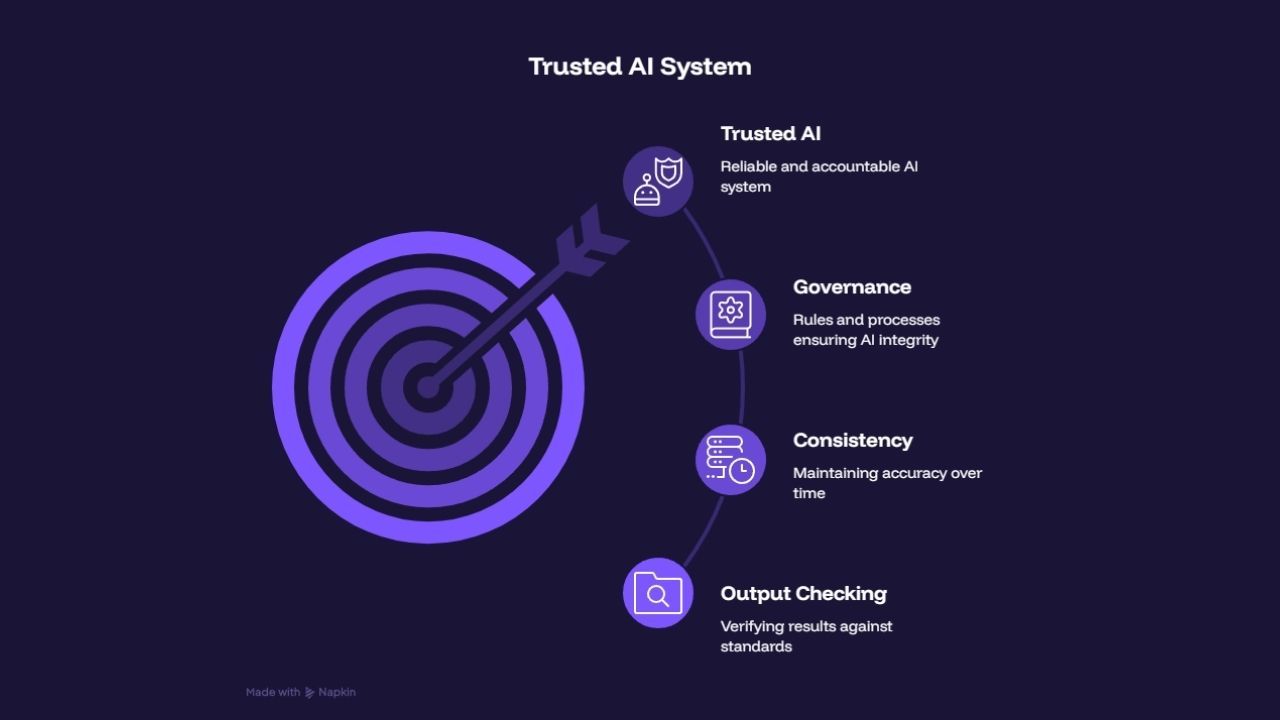
Trusted AI is not a more sophisticated model. It is a governed system. The difference is not intelligence. It is discipline.
A governed system has three properties a raw model does not:
- It checks its own outputs against a known standard before any human reads them.
- It maintains consistency across cycles, so week six is accountable to what it said in week one.
- It is governed by explicit rules about what it can and cannot produce.
That governance is what separates agentic analytics from a chatbot bolted onto a dashboard. One produces an answer when prompted. The other produces an answer it can stand behind.
I do not think of data governance as a compliance checkbox. It is the mechanism that makes the output worth acting on.
It is not the chart. It is not the click. It is whether the interpretation holds up when someone acts on it.
Why this is the right moment to solve it
The noise has made trust more valuable, not less. That was the line I kept coming back to at REALM. As I told the room:
The value of signaling to people that something is trusted actually went up.
I have watched enough of these cycles to know when a shift is structural rather than seasonal. I said as much on the call, and I meant it as more than a throwaway:
It's an interesting time. I was there for the dot-com boom. I was there for the 2008 thing. I was there for the boom in 2016, 2017. And now this is unlike anything I've ever seen.
The businesses that build governed, accountable AI systems now will hold a structural advantage that compounds as the noise grows.
Everyone is being asked to do more from less. Data exists. BI exists.
The layer that interprets it the way your best operator would, and stands behind that interpretation, is the part that does not scale on its own.
The move is not to add more AI. It is to make the AI you rely on defensible:
- Define the standard the system is accountable to before you deploy it.
- Build verification into the workflow, not as an after-the-fact audit.
- Treat consistency across cycles as a feature, not a nice-to-have.
That is the design principle behind Scoop, and it is why the system sits on top of your existing BI stack rather than replacing it.
The REALM advisors and the multi-location operators I work with are chasing the same thing from different directions. The data was never the scarce asset. Trust is.
Built for the businesses that run everywhere at once.
Scoop exists to bring best-in-class operational diagnostics to every distributed business, not just the ones big enough to staff a team for it. Meet the people building it.
- Operator-first by design
- Built for distributed teams
- Diagnostics, not dashboards
Frequently asked questions
Why is AI trust becoming a bigger problem in 2026?
The volume of AI-generated content has grown faster than the systems designed to verify it. Buyers, managers, and decision-makers are increasingly unable to distinguish trusted AI outputs from plausible-sounding noise. The premium on systems that can demonstrate verified, governed, consistent outputs has increased sharply. Trust has become a competitive differentiator, not just a feature.
- Content volume outpaced verification.
- Plausible and accurate now read the same.
What makes an AI output trustworthy?
Trustworthy AI outputs share three properties. They are verified against a known standard before delivery. They are consistent across cycles, so week six is accountable to week one. And they are governed by explicit rules about what the system can and cannot produce.
- Verified before delivery, not audited after.
- Consistent across cycles, not one-off.
- Governed by explicit rules, not open-ended.
How does ungoverned AI create operational risk?
When AI outputs reach decision-makers without verification, errors read as confidently as accurate information. In low-stakes contexts, that is an inconvenience. In operational contexts, where managers act on recommendations across hundreds of locations, a single ungoverned wrong output can produce cascading bad decisions. This is the hidden cost of black-box AI.
- Errors inherit the confidence of correct answers.
- One wrong read multiplies across every location acting on it.
What is the difference between AI as a tool and AI as a trusted system?
AI as a tool produces outputs when prompted. AI as a trusted system produces outputs that have been verified, are consistent with prior outputs, and are accountable to a defined standard. A tool is only as good as the person using it. A trusted agentic analytics system delivers value consistently, at scale, without expert oversight of every output.
- A tool waits for a prompt. A system runs on a standard.
- A tool depends on the operator. A system holds up without one watching.