Why “value add” in private equity is mostly theater (and what would actually fix it)
Why “Value Add” in Private Equity Is Mostly Theater
“Value add” in private equity is mostly theater because the people claiming it have no reliable way to move the numbers.
Operating partners hold the insight. Frontline general managers hold the levers. Nothing dependable connects the two, and that is exactly where margin disappears: location by location, cycle after cycle, below the line of sight of any quarterly deck.
An operating partner at a roll-up fund said it to us more bluntly than I could:
*“They love to say they’re being a value add, but they have no way to influence the numbers, right? That’s the real problem.”*Private equity roll-up fund operating partner
I have spent my career building analytics companies, from Birst to Scoop. I have watched the same pattern repeat for decades. Half of all BI projects fail, and it is not because of the technology. It is because the people implementing them do not understand the business problem.
Private equity has a version of that problem. It is not a strategy problem. It is not a data problem. It is an execution problem, and almost nobody is building for it.
Why does “value add” sound better at the fund than it works at the store?
Because value add in private equity is a credibility story built for limited partners, not an operating system built for general managers.
The fundraising deck shows a bench of operating partners, a 100-day plan, and a playbook. None of it describes how a best practice reaches the person running location 31 on a Tuesday.
That gap used to be survivable. It is not anymore.
Bain’s latest global report puts the math plainly. A typical deal now needs 10% to 12% annual EBITDA growth to return 2.5x over five years, roughly double what the 2010s required. Buyout holds now run close to seven years. Multiple expansion is not coming to rescue the model.
And the execution is slipping. In Alvarez & Marsal’s 2026 North America survey of investors, operating partners, and portfolio executives, 41% realized below 75% of their planned value creation over the prior 12 months.
So the claim is getting louder at the exact moment it is getting harder to deliver.
Picture the portfolio review. Forty locations on the screen.
The board reports show which locations are underwater on labor and which are leaking margin on discounting. The operating partner can see the spread between the top quartile and the bottom quartile.
What the deck cannot show is why location 17 is bleeding, or what its GM should do differently next week.
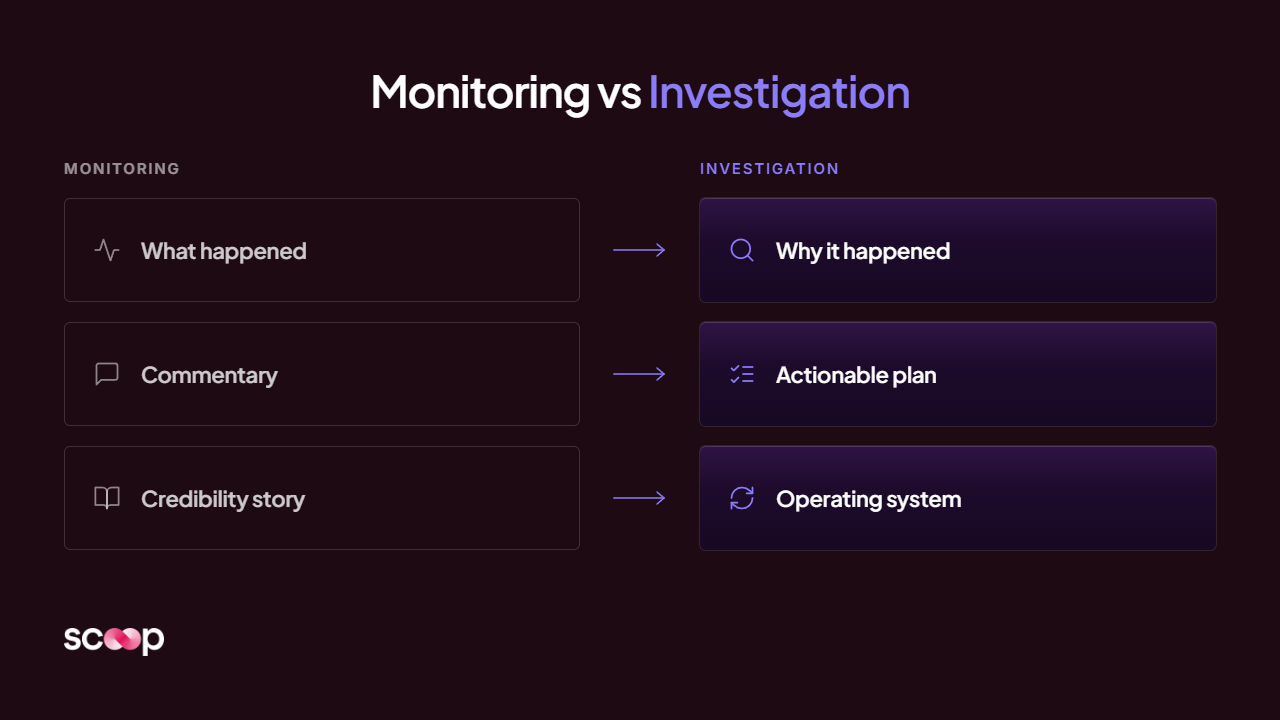
That is the difference between monitoring analytics and investigation. One tells you what. The other tells you why.
Most funds have built an expensive machine for the first and have nothing for the second, which is why the review ends with a list of locations to “follow up on” rather than a plan anyone can use to measure business performance location by location.
That is not value add. That is commentary.
Why can’t operating partners move the numbers themselves?
Because authority in a portfolio company is federated, and the operating partner sits at the far end of it.
“The CEOs own quite a lot of the judgment calls, not so much the operating partners.”
Follow the chain.
The fund talks to the portfolio CEO. The CEO talks to the COO. The COO talks to regional directors. Regional directors talk to GMs. The GM runs the shift.
Every handoff is a translation, and every translation loses fidelity.
The operating partner can recommend. The CEO decides. The GM executes, or does not.
By the time a pricing guardrail or a labor standard reaches the floor, it has been paraphrased four times by people with different priorities. That is the real gap between data and decision, and no dashboard closes it.
Roll-ups make it worse.
According to Preqin, add-ons accounted for more than half of global PE deal count in the first half of 2026. Every acquired platform brings its own systems, its own habits, and its own definitions of what “good” looks like.
Even inside a single, mature company, those definitions drift.
The CEO of the largest pawn chain in the United States, roughly 1,200 stores, told us that if you asked three different people what their “death spiral” was, you would get three different answers. That is one culture, one system, one leadership team. Now imagine six acquired brands stitched together in 24 months.
This is why better decision intelligence at the fund level does not fix anything on its own. The insight is not the bottleneck. The distance is.
Authority is federated. Judgment is concentrated. That mismatch is the whole problem.
Where does the margin actually disappear?
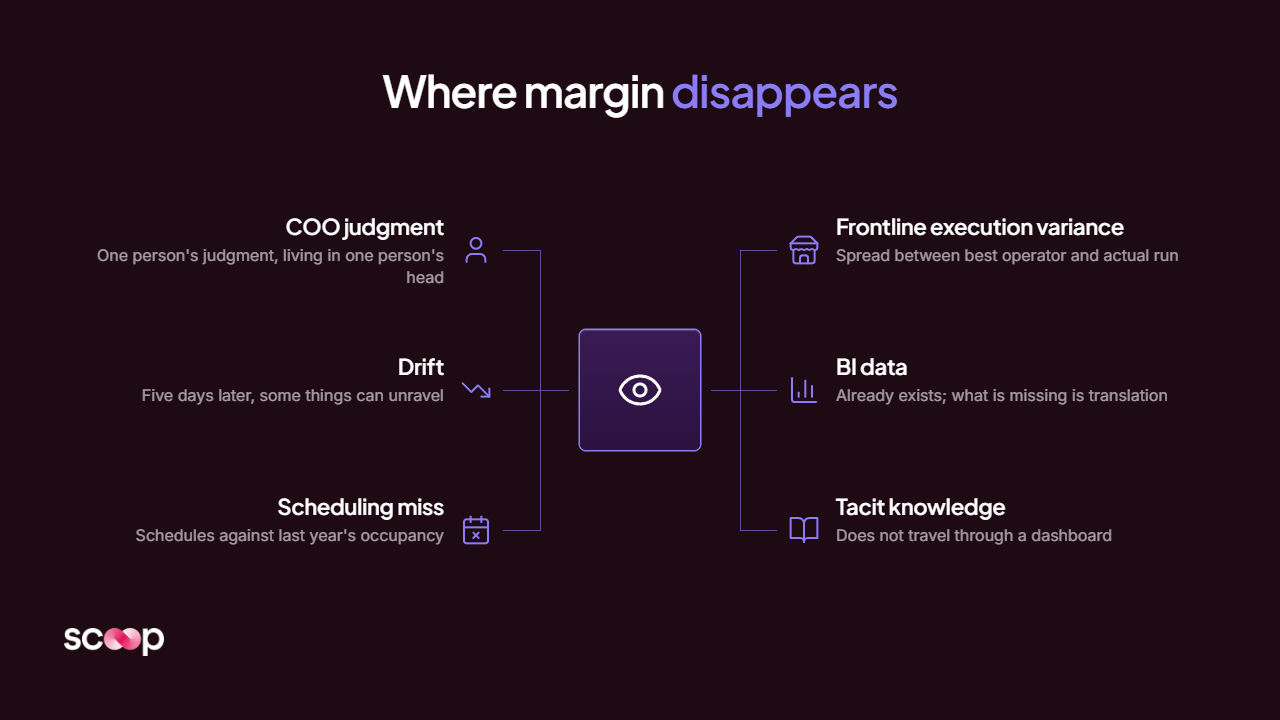
It disappears in frontline execution variance: the spread between how your best operator would run a location and how it actually gets run by the person on site.
The BI data already exists. What is missing is translation.
My co-founder Neil Shepherd put it better than any slide I have seen:
*“The COO would do this. Here’s what the COO found. Here’s what you need to do to correct this adverse trend. A lot of frontline operators are not very skilled, they’re new, or just busy. You end up with big variation in performance, and they hate that.”*Neil Shepherd, Co-founder, Scoop Analytics
Here is what that looks like in practice. At the pawn chain, the COO has spent 27 years learning one pattern cold. A store gets aggressive on lending. Inventory builds. The store starts discounting to move it. Margins fall.
The manager overcorrects by pulling back on lending, and revenue craters four to six months later. The COO sees the first signal in a single line of the Power BI report. A store manager in year two sees a number that went up.
Same report. Same data. Completely different read.
That knowledge is tacit, and tacit knowledge does not travel through a dashboard. It is why the limits of KPI dashboards show up first at the frontline.
Hospitality has its own version. In a midscale, limited-service hotel, an eight-hour housekeeping shift cleans roughly 12.5 rooms.
A GM who schedules against last year’s occupancy instead of this week’s leaks labor every single day. Operators in hotels and hospitality tell us the squeeze is real, with RevPAR still below 2019 levels and costs well above them.
A seasoned COO catches the scheduling miss on a walk-through. A new GM does not know to look.
Then there is drift.
A hotel management founder told us the part every operating partner already knows: you push a best practice, and “five days later, some things can unravel.” The 100-day plan holds for a week. Then the floor goes back to habit.
The only person who reliably catches all of this is the COO, physically walking the floor. That does not scale past a handful of locations, and it carries a risk most funds underwrite without naming. The pawn chain’s CEO told us his single biggest business risk was losing his COO. Not a market shift. Not a competitor. One person’s judgment, living in one person’s head.
This is the true last mile of business operations. The variance is not a data problem. It is a translation problem.
What would actually fix value creation in a roll-up?
Fix the execution layer, not the strategy layer. Real private equity value creation happens when the COO’s judgment reaches every GM, every cycle, in plain English, without the COO in the room.
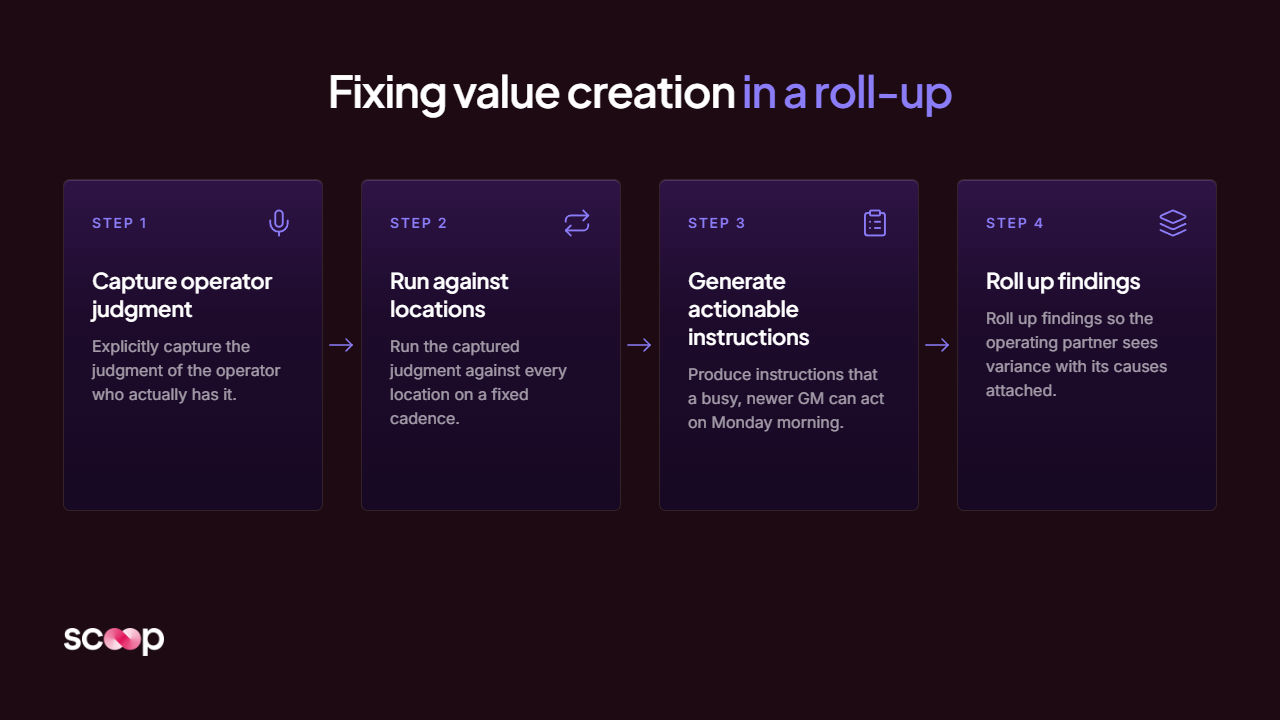
That requires four things working together.
First, the judgment has to be captured explicitly, from the operator who actually has it. Second, it has to run against every location on a fixed cadence, not when someone remembers to check. Third, the output has to be an instruction a busy, newer GM can act on Monday morning. Fourth, it has to roll up, so the operating partner sees variance with its causes attached instead of a heat map.
This is what we built at Scoop, and the capture step is less mysterious than it sounds. Here is how I put it to a quality leader at a large retailer:
“If I took a tape recorder and recorded everything you thought as you looked at your BI reports, we stick that into the system so it could do that on your behalf.”
At the pawn chain, that meant a week in Houston with district managers, regional managers, and the COO, walking through Power BI in 11 stores.
Seven hours of recordings became the logic. Our team did the capture. Nobody at the customer configured anything.
From there, how Scoop works is mechanical. Every store gets screened on a regular cycle against the COO’s own criteria. When a screen trips, the system spawns an investigation into that store: 15 to 30 probes, including a machine-learning decision tree that tests 10 to 20 variables at once against a healthier prior period. The findings get synthesized in that company’s own language, then rolled up from store to district to region to division.
A report arrives. The GM does not log in.
The district manager walks into the store visit already knowing which two things matter. The operating partner sees why the bottom quartile is the bottom quartile. And it all sits on the existing BI stack. Nothing gets ripped out.
It is also not AI let loose. It has the guardrails of how that particular business evaluates its own data, and people review what it produces.
Here is why this matters to the multiple. At a 10% to 12% annual EBITDA growth bar, narrowing the gap between your worst locations and your best is the cheapest growth available.
You already own the stores. You already own the data. You already employ the person who knows how to run them. What you lack is a way to put that person in every location at once.
We call this AI performance management: codify your best operator’s judgment once, then run it everywhere, every cycle.
Value add stops being theater the day the frontline knows what the COO knows, on Monday morning, in plain English.
Frequently asked questions
What does a private equity operating partner actually control?
Usually less than the title implies. Operating partners advise portfolio CEOs, shape the value creation plan, and bring playbooks, but day-to-day judgment calls sit with the portfolio company’s leadership. Their leverage depends on how well recommendations survive the trip to the frontline, which is why prescriptive analytics only matters if it reaches the person who can act.
Why do roll-ups show more performance variance across locations?
Each acquisition brings its own systems, staff habits, and definitions of good performance. Without a shared standard applied to every unit every cycle, variance compounds. Multi-unit models like franchise operations face the same adherence problem: the standard gets set, then it drifts.
Can AI replace the COO or the operating partner?
No, and it should not try. The goal is to scale people, not replace them. AI investigation built on a COO’s captured judgment does the legwork across every location so the COO and operating partner spend their time on decisions only they can make.
Does fixing frontline execution require replacing our BI tools?
No. The data and the BI layer are rarely the problem, even where users struggle with Power BI. The missing piece is interpretation and action on top of what already exists: the layer that tells each GM what the numbers mean and what to do next.