Decision automation vs. decision augmentation: why the distinction matters
Automate the legwork, not the judgment
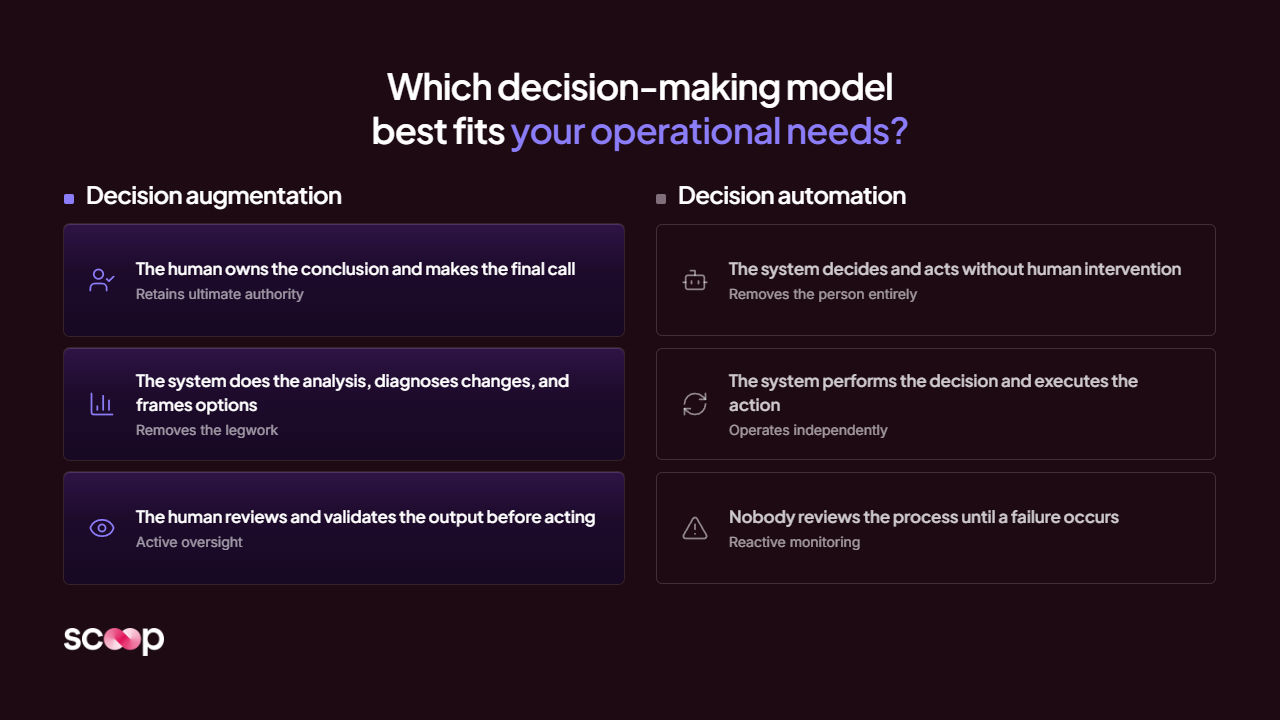
Decision automation means a system makes and executes a decision without a person. Decision augmentation means the system does the analysis and a person makes the call, faster and better informed.
For multi-location operators the distinction matters because it decides who stays accountable for the P&L: your managers, or a model nobody can question.
My co-founder Neil Shepherd put our position in one sentence on a call in:
“We're going after the augmentation part of AI, not the, shall I say, the workflow automation side where we're taking workers.”Neil Shepherd, co-founder, Scoop Analytics
That was not a hedge. It was a choice, and the market is now proving it right.
What is the difference between decision automation and decision augmentation?
Automation removes the person from the decision. Augmentation removes the legwork from the person.
Most frameworks describe three levels of decision intelligence:
- Decision support. The system shows you data. You do the analysis and make the call.
- Decision augmentation. The system does the analysis, diagnoses what changed and frames the options. You make the call.
- Decision automation. The system decides and acts. Nobody reviews it until something breaks.
Augmentation is the same principle behind augmented analytics: the machine does the work, the human owns the conclusion. It is not a weaker form of automation. It is a different job.
Even the bullish forecasts keep most decisions human. Gartner predicts at least 15% of day-to-day work decisions will be made autonomously by agentic AI by 2028, up from 0% in 2024. That leaves 85% with a person.
Why is the market pulling back from decision automation?
Because the ROI never showed up.
Gartner predicts over 40% of agentic AI projects will be canceled by the end of 2027, citing escalating costs, unclear business value and inadequate risk controls.
It also estimates only about 130 of the thousands of vendors selling agentic AI are the real thing.
We hear the same thing in the field.
A PE operating partner with a multi-unit restaurant and hospitality portfolio told us the enterprise CIOs he works with are pulling back on workflow automation because "the ROI was never really well established."
What they are chasing instead is decision velocity. He described it as their primary AI objective for the next 12 to 18 months.
Automation disappointed for three predictable reasons:
- The demo is not the operation. A narrow, clean pilot rarely survives dozens of locations with different managers, vendors and labor markets.
- The cost comes first and the value never arrives. Integration, exception handling and risk controls eat the projected savings.
- Nobody owns the bad call. When the system makes a decision your GM wouldn't have made, there is no one to ask why. That is the real cost of black-box AI.
The market has rendered its verdict. Automation for its own sake is being cut.
Why does the distinction matter for multi-location businesses?
Because the same decision gets made hundreds of times a week, by people with very different experience.
Automation tries to remove those people. Augmentation tries to make the least experienced of them decide like your best.
The evidence favors augmentation. In an NBER study of 5,179 support agents, an AI assistant raised productivity 14% on average and 34% for novice and low-skilled workers, with minimal impact on the most experienced.
The researchers found it spread the best practices of top performers to newer workers.
That is the multi-location problem exactly. At the largest pawn chain in the United States, the COO had 27 years of pattern recognition, and many store managers had a year or two.
Augmentation gives the newer manager three things:
- The read your best operator would give, every cycle.
- The why behind the number, not just the number. That is what AI investigation adds on top of a dashboard.
- The decision, still in their hands.
It is why we think AI decision management lifts the floor of your organization before it lifts the ceiling.
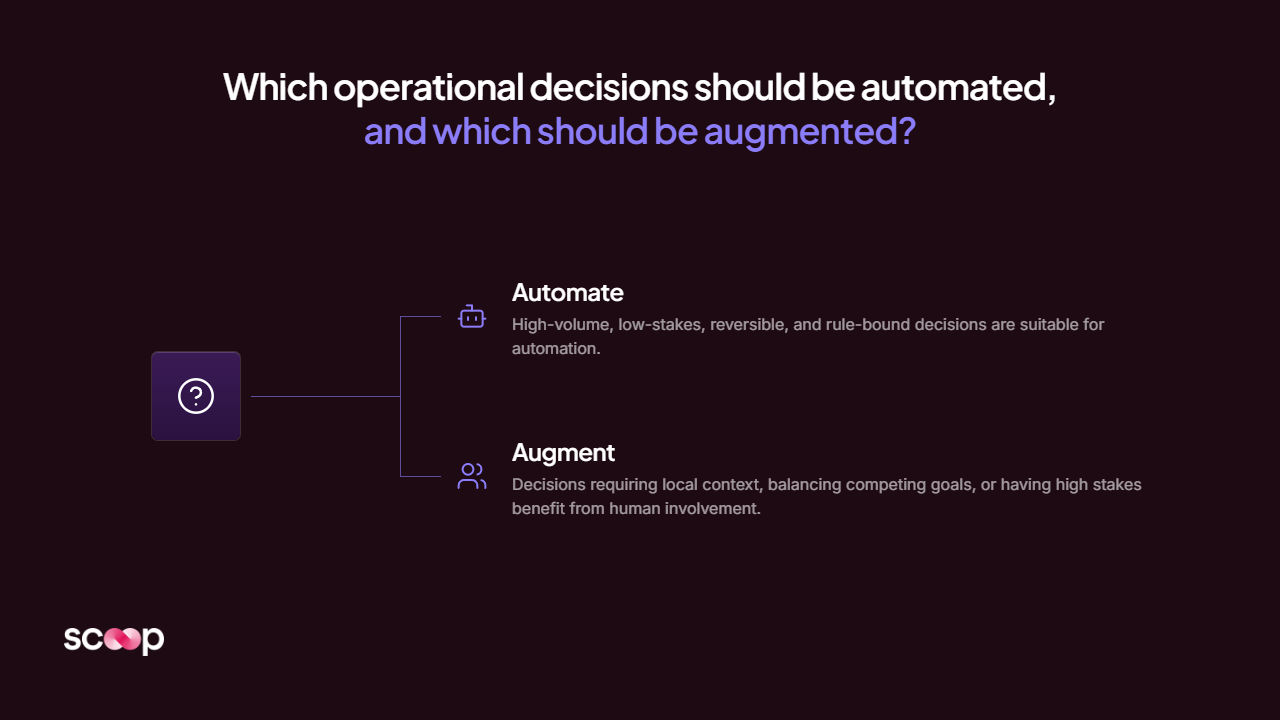
Which operational decisions should be automated, and which should be augmented?
Automate what is high-volume, low-stakes, reversible and rule-bound. Augment anything that needs local context, trades off competing goals, or is expensive to get wrong.
The hotel group we work with shows the line clearly.
It already automates pricing with an AI revenue management system, and it works because demand pricing is narrow and measurable.
Operations are a different story.
In a midscale limited-service hotel, an eight-hour housekeeping shift cleans about 12.5 rooms. A system can flag the property running well below that, but only the GM knows whether it is staffing, training or a week of heavy checkouts.
The pawn chain's "death spiral" shows the cost of automating the wrong call.
- Aggressive lending builds inventory
- Discounting erodes margin
- Lending gets pulled back too hard
- Revenue craters four to six months later
A rule that auto-tightened lending on a margin dip would speed the spiral up.
Four questions draw the practical line between a human in the loop and AI autonomy:
- Can the decision be reversed within a week?
- Does it follow a rule you could write in one sentence?
- Is the cost of a wrong call small and contained?
- Would two of your best GMs make the same call?
Four yeses: automate it.
Any no: augment it.
How does Scoop apply decision augmentation?
We automate the legwork and leave the judgment where it belongs. Scoop doesn't automate judgment. It automates the legwork that prevents judgment from happening.
- Screening every location, every cycle, against your best operator's criteria. Think of it as anomaly detection tuned to thresholds your operators set.
- Investigating whatever trips a screen, with 15 to 30 probes per store per period.
- Rolling up findings from store to district to region.
- Delivering a report with what changed, why, and options for what to do next.
The decision stays with the manager. Nobody logs in, and nothing acts on its own. It all sits on top of your existing BI stack.
The logic comes from recording your best operators as they read their own reports.
At the pawn chain that meant a week in 11 stores and seven hours of recordings, now screening a chain of roughly 1,200 stores.
People review what it produces, and their corrections feed back in. That is human-in-the-loop AI as a design choice, not a compliance checkbox.
Built for the businesses that run everywhere at once.
Scoop exists to bring best-in-class operational diagnostics to every distributed business, not just the ones big enough to staff a team for it. Meet the people building it.
- Operator-first by design
- Built for distributed teams
- Diagnostics, not dashboards
What should you tell your CFO or board about AI ROI?
Tell them you bought faster, better decisions, not fewer people. Then measure it that way.
You would not be alone in reassessing. In a January 2025 Gartner poll of 3,412 webinar attendees, only 19% said their organization had made significant agentic AI investments.
Four measures a PE sponsor will actually accept:
- Time to diagnosis. Days between a location going off plan and someone knowing why.
- Coverage. Share of locations reviewed through your best operator's lens each cycle, versus the ones a regional leader can visit.
- Spread. The gap between your best and worst locations on the metrics that matter. Augmentation should narrow it, the way the NBER study saw the biggest gains among novices.
- Consistency. Whether three managers reading the same numbers reach the same conclusion.
That is decision velocity, measured. It is a better answer to a board than a headcount reduction that never materializes.
Automation asks you to trust a system with your business. Augmentation asks the system to earn your managers' trust. Only one of those survives a bad quarter.
Codify what your best operators already know.
Scoop captures your operators' tribal knowledge, screens every location automatically, and delivers role-specific action plans. Nobody writes a prompt. The plan just arrives.
- Codified tribal knowledge
- Automatic screening
- Action plans, not dashboards
Frequently asked questions about decision automation vs decision augmentation
What is decision augmentation?
Decision augmentation is AI that does the analysis behind a decision, diagnosing what changed and framing the options, while a person makes the final call. It makes human decisions faster and better informed instead of replacing them.
What is decision automation?
Decision automation is AI that makes and executes a decision without human review. It works best for high-volume, low-stakes, reversible decisions that follow a clear rule, such as reordering stock to a fixed par level.
Is decision augmentation just another word for dashboards?
No. Dashboards are decision support: they show data and leave the analysis to you. Decision augmentation does the analysis, explains why a number moved and frames the options before a person decides.
Which decisions should a multi-location business automate?
Automate a decision only when all four of these are true:
- It can be reversed quickly.
- It follows a rule you could write in one sentence.
- A wrong call is cheap and contained.
- Your best managers would all make the same call.
Does decision augmentation reduce headcount?
That is not the goal. Augmentation takes the volume work off your managers and analysts so they spend their time on judgment. The aim is to scale your people, not replace them.