Build vs Buy Analytics: Who Actually Uses It
Demos are quick. Production is not. The six things that break when you build this yourself.
Building an AI analytics system for multi-location operations is something BI teams can maybe prototype in a few weeks. A working demo that proves the concept.
Taking it to production is a different project. Fiscal calendar edge cases, 3am pipeline failures, inference costs at 400 locations, output accuracy gates: none of it shows up in the prototype.
This is what the build actually costs.
What does a build-it-yourself AI analytics project actually look like?
Build the demo first. Honestly, build it. Three weeks with Claude Code, some SQL against the warehouse you already have, and a working proof that reads your data and writes a plausible location summary.
It will demo well.
Then the real scope shows up.
The demo runs one location, on clean data, on a good day, with someone technical watching it. Production runs every location, on messy data, unattended, while people who are not technical make decisions off the output.
Those are not the same system. The gap between them is the whole project, and none of it is visible in the version that demoed well.
- The prototype answers "can we make the model write a summary." Production answers "can we trust the summary at 400 locations without a human checking each one."
- The prototype runs when you run it. Production runs on a schedule, resumes when it breaks, and stays inside a cost ceiling.
- The prototype uses whichever agentic AI analytics pattern you wired up on day one. Production has to keep working when a provider changes behavior underneath you.
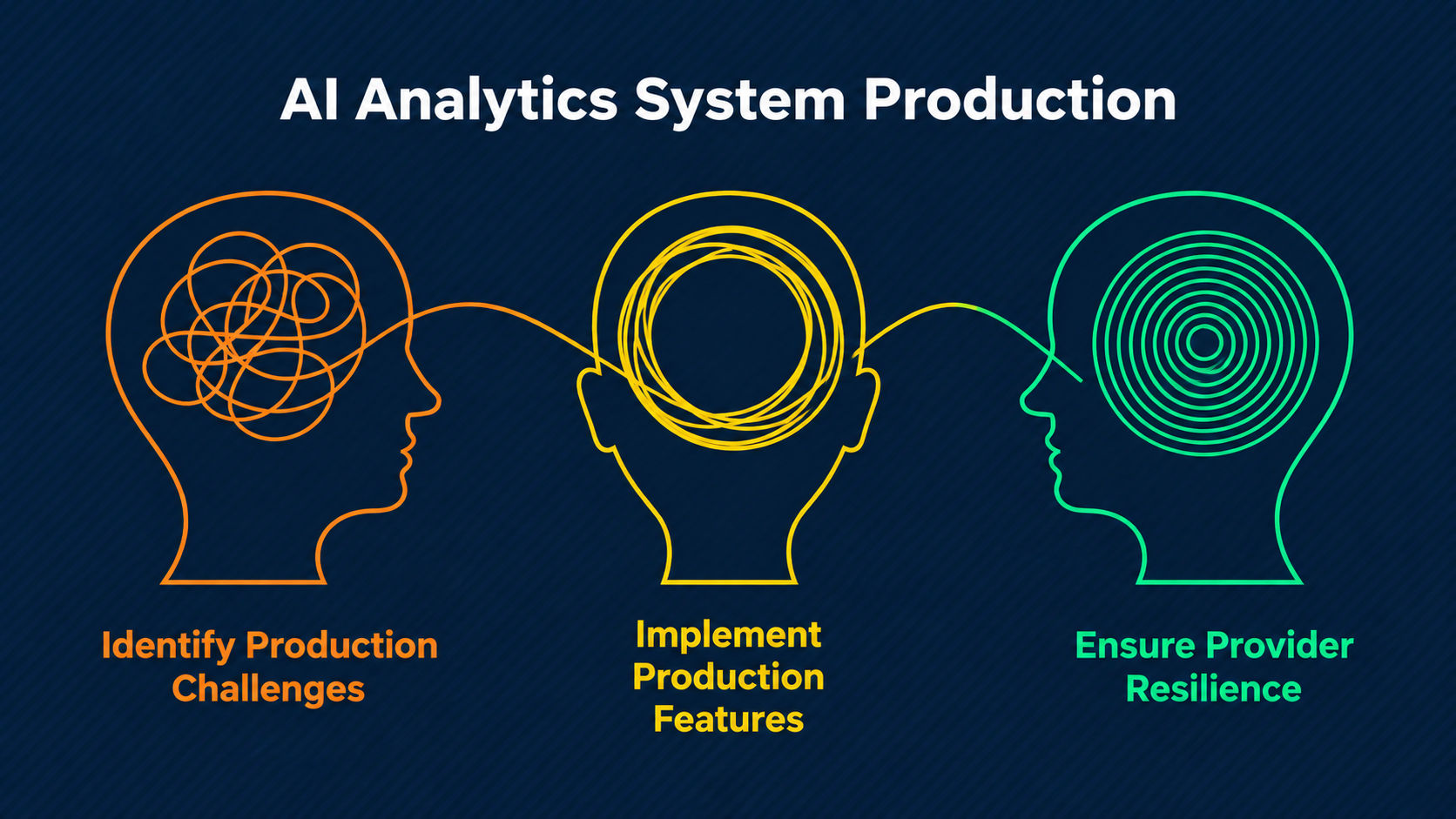
What breaks when you take it to production?
Six components break, and each one is a real failure mode, not a hypothetical. These are the parts a prototype skips and production cannot.
The query engine has to handle fiscal calendar edge cases, stock versus flow semantics, and peer math. One public holiday corrupts every location's comp that week in the same direction, and it reads as a real trend. Your model reports a pattern. There is no pattern. There was a holiday.
The production harness needs checkpointed resume, per-task model routing, and hard cost caps. One provider rate-limits at 3am. Does the pipeline resume from where it stopped, or restart from zero and bill you for the whole run twice? You find out the first time it happens, in production.
The knowledge layer has to be versioned and auditable. An 18% revenue drop: tax season, or a real crisis? The model writes "crisis." The person who knew the difference just left the company, and the config that encoded their judgment was never written down because the prototype did not need it.
The output gates enforce banned vocabulary rules and degenerate-stat checks. "You match your peers exactly." Grammatical. Plausible. False. One sentence like that, in front of the wrong executive, ends the programme. A demo has no gate. Production lives or dies on it.
Cross-cycle memory carries action identity across cycles. "Is this new advice, or am I retreading week two?" If the report cannot answer that, the operator stops reading by week four. The prototype has no memory of last cycle because there was no last cycle.
Inference economics decide whether this is affordable at scale. Pilot cost times 100 is not a surprise you want to discover after launch. You architect for scale on day one, or you rebuild for it later, under load, with a bill attached.
Six components. Each one is a thing someone owns.
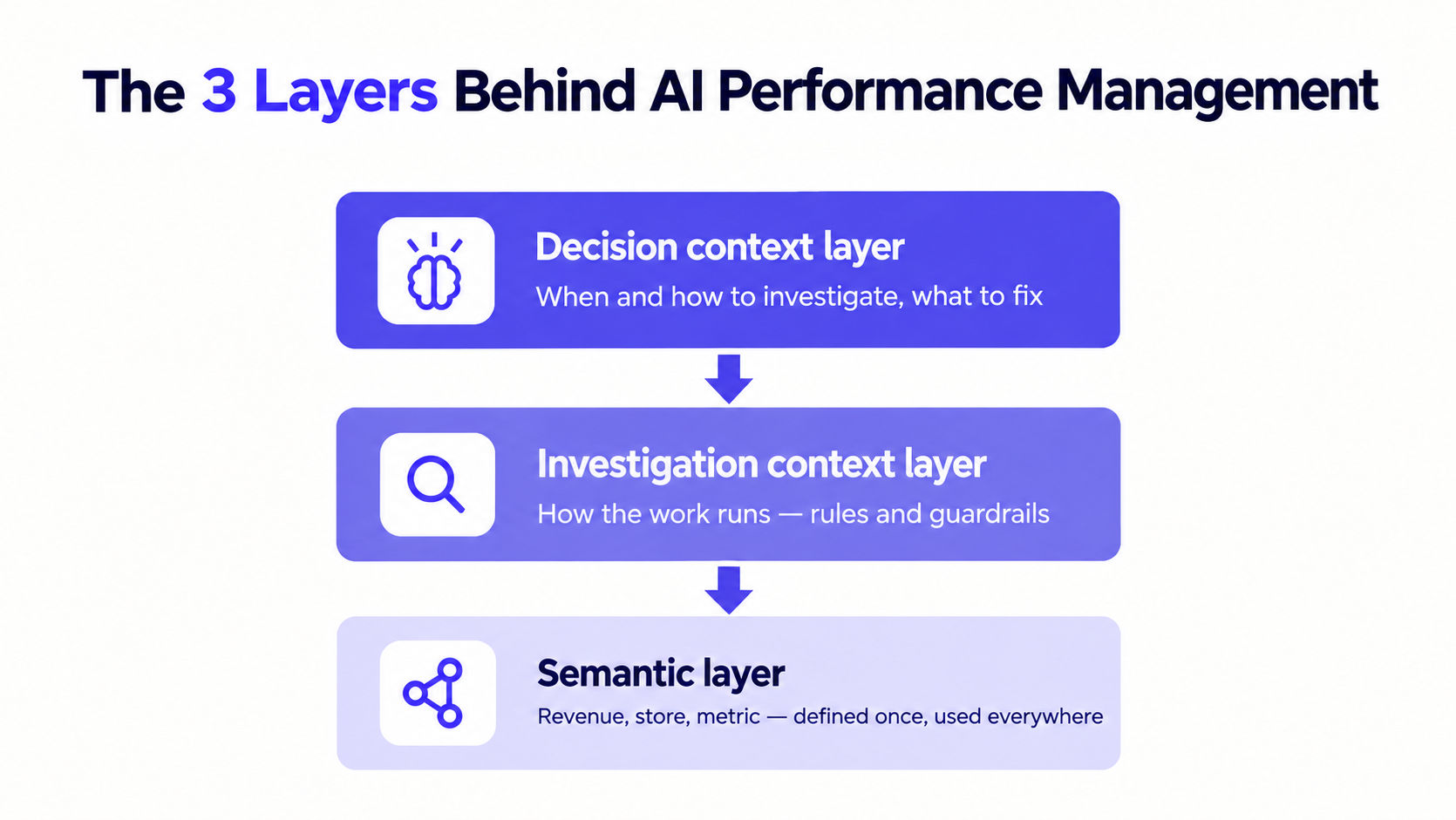
What is the true cost of building vs. buying?
The true cost is the maintenance commitment, not the engineering hours. Building it yourself runs 12 to 24 months to production. Scoop is 4 weeks to live. But the timeline is the smaller number.
Each of those six components is something a person on your team owns every week, forever. The query engine's calendar logic. The harness that resumes at 3am. The config that encodes who-knew-what.
The gate that catches the false sentence. That is not a project with an end date. That is a product with an on-call rotation.
The industry numbers are not kind to the build path.
- More than 40% of agentic AI projects will be canceled by the end of 2027, per Gartner (June 2025).
- Three in four firms building aspirational agentic architectures on their own will fail, per Forrester (Predictions 2025).
- 88% of proof-of-concepts never reach production, per IDC (CIO Playbook 2025).
You are not being asked to write a query. You are being asked to become a software company, staffed and funded to maintain a production AI system, on top of the BI work you already own.
That is the real line item.
Built for the businesses that run everywhere at once.
Scoop exists to bring best-in-class operational diagnostics to every distributed business, not just the ones big enough to staff a team for it. Meet the people building it.
- Operator-first by design
- Built for distributed teams
- Diagnostics, not dashboards
When does building make sense?
Building makes sense in four specific cases. This is not a trick question, and the honest answer is sometimes "build":
- Analytics is your core product. If what you sell is the analytics itself, own every layer.
- You have a BI engineering team with real capacity, not a team you will borrow from and hope.
- You run fewer than 15 locations. The scale problems that break the six components mostly do not bite yet.
- You want to own every layer and you have the timeline to do it. Twelve to 24 months is fine because the control is worth it to you.
If all four fit, build. You will might build something good.
If none of them fit, the math changes. You are a BI team being asked to run a software product for a business whose core product is not software.

What does buying actually get you?
Buying gets you the production system without the four-year detour to build it. Four weeks to pilot. No forward-deployed engineers parked in your environment. Published pricing, so the number is the number.
Your BI team gets the better trade. Instead of rebuilding infrastructure Scoop spent 4 years and 1,539 commits on, they work on what only they can do: the questions specific to your business, the models nobody else can build because nobody else has your data or your context.
- You keep your warehouse. You keep Power BI or Tableau. The bought layer sits on top, not instead of.
- The six components are already built, tested against real failures, and maintained by the vendor whose only job is maintaining them.
- Your team stops owning an on-call rotation for a system that is not your product, the shift covered in how AI is changing business intelligence.
The build is not impossible. It is just a software company's job. If you are not a software company, buying is not the cheaper option. It is the one that lets your BI team do BI. The full agentic analytics production surface is what you are buying out of, not into.
Your dashboards show what happened. Scoop says what to do.
Scoop adds the diagnostic and action layer your BI tools cannot: finding what needs attention across every location, and what to do about it. Your stack stays exactly where it is.
- Sits on top of your BI
- Diagnostic and action layer
- No migration required
Frequently asked questions
Can't our BI team just use Claude Code to build this?
They can build the demo, and it will demo well. Three weeks, Claude Code, SQL against your warehouse, a working summary on the happy path. The gap is production: the six components (query engine, harness, knowledge layer, output gates, cross-cycle memory, inference economics) that the prototype skips and a live system at 400 locations cannot. Building the demo is not the hard part. Owning what it hides is.
How long does it actually take to build production-grade AI analytics?
Twelve to 24 months to production if you build it yourself, versus 4 weeks to a live pilot with a bought solution. The build timeline is dominated by the parts that never appear in the prototype: resumable pipelines, auditable config, output accuracy gates, and cost control at scale. And unlike a normal project, it does not end at launch. Each component is maintained every week after.
What is the total cost of ownership for building in-house?
The engineering hours are the smaller cost. The real total cost of ownership is the permanent maintenance commitment: six production components, each owned by someone on your team every week, indefinitely. Add the failure risk. Gartner expects more than 40% of agentic AI projects to be canceled by the end of 2027, and IDC reports 88% of proof-of-concepts never reach production. The cheap-looking build is often the expensive one.
Do we have to replace our existing BI tools?
No. A bought solution sits on top of the existing BI stack, not instead of it. Your data warehouse stays. Power BI or Tableau stays. The layer you are buying adds the production AI system on top of what you already run, so there is no migration and no rip-and-replace.
What happens to our data if we buy from Scoop?
Scoop is built on your data, not a copy of it, and pairs with the stack you already have rather than migrating it out. The bought layer reads from your existing warehouse and BI tools and adds interpretation on top. For the specifics of the deployment and data handling, the how Scoop works page is the reference, and anything data-residency-specific should be confirmed with the team.